
How to build a 15-minute morning news routine
Use a small, repeatable first pass to find out what changed, check one important claim, and save deeper reading for later.
You do not need to read everything that happened overnight. You need a small, repeatable way to find out what changed, check one important claim, and decide what deserves more time later.
Treat fifteen minutes as a first pass. Set a timer, use a short list of sources, and save deeper reporting for a separate reading block. The stop matters as much as the reading: without it, a quick check can become an open-ended scroll.
Change the topics, sources, and format to fit your work, location, and tolerance for breaking news. Keep the clock. For a broader framework, see how to keep up with the news without living in a feed.
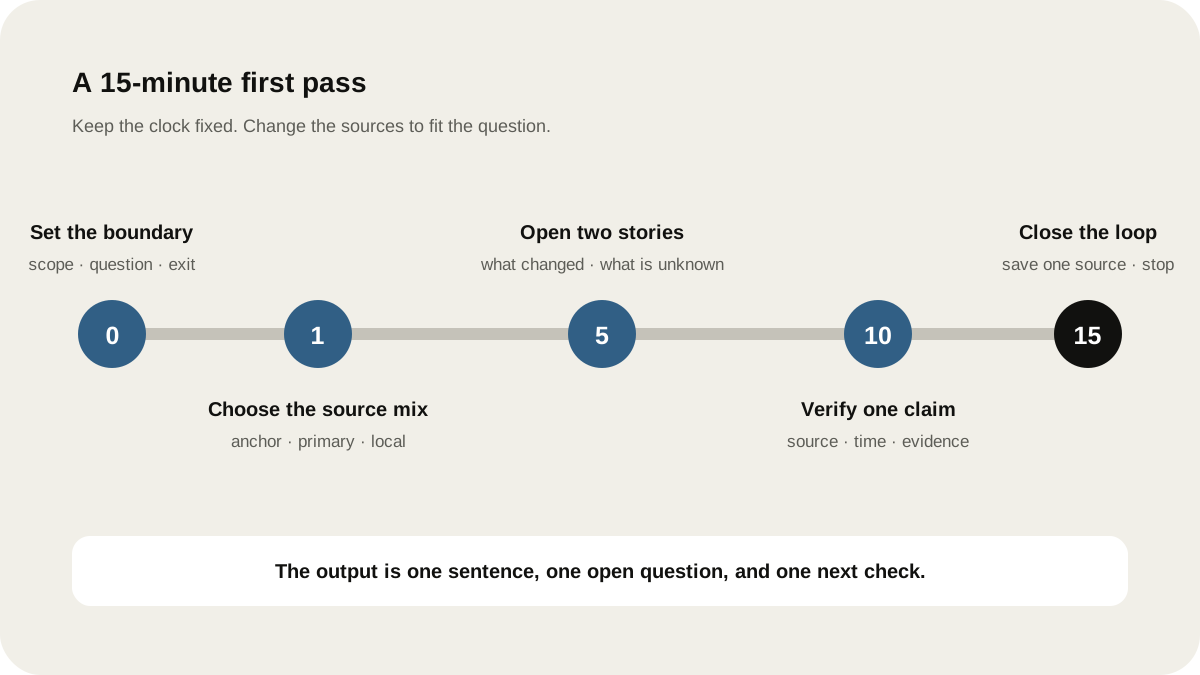
Original routine and illustration: Lissin Editorial. Verification steps are informed by AP’s verification guidance and Reuters’ journalistic standards.
Before the first morning: save your sources
Choose and bookmark your source list once, outside the 15-minute block. You need a general newsroom, a local or specialist source, and a place to check original documents for the subjects you follow. The source roles below explain what to look for. On later mornings, use those bookmarks instead of searching for a new reading list.
Keep this card beside them:
| Time | Action | Leave with |
|---|---|---|
| 0–1 minute | Choose today's question | One reason to check |
| 1–5 minutes | Scan your saved sources | Two stories worth opening |
| 5–10 minutes | Read those stories | What changed and what is unknown |
| 10–13 minutes | Check one consequential claim | A source or an explicit uncertainty |
| 13–15 minutes | Save the next action and stop | One follow-up, if needed |
Minute 0 to 1: Set the boundary before you open a feed
Choose three things before you read:
- Your scope: for example, world news, your country, your city, and one work-related beat.
- Your question: what could affect my decisions, colleagues, customers, community, or plans today?
- Your exit: after 15 minutes, you will save anything that needs a deeper read instead of opening another tab.
Leave one slot for a story outside your usual list. A routine that only confirms what you already expect is too narrow. Give an unexpected headline a quick look without giving every headline equal weight.
Keep notifications out of this first minute. Alerts are useful for genuine emergencies, but they are a poor substitute for a source list. Start from the publications and official pages you chose, not from whichever headline a platform puts in front of you. If your problem is an endless scroll, how to stay informed without doomscrolling goes deeper on setting that boundary.
Minute 1 to 5: Use a small source mix
Choose sources with different jobs; five versions of the same homepage add little.
1. An anchor source for the broad picture. Pick one wire service or general newsroom with a wide reporting network. Reuters and The Associated Press both publish standards that emphasize accuracy, attribution, and independence. Those standards make them useful starting points; keep checking as reports develop. A reputable outlet can still publish an early report that changes as more facts arrive.
2. A primary source for the subject that matters most. This might be a government agency release, court filing, company filing, central-bank statement, public meeting agenda, research paper, or transcript. Primary documents often tell you what an institution actually said or filed. Context and independent reporting still matter when you decide what the event means, whether the claim is complete, or whether the document is being interpreted fairly.
3. A local or specialist source. Add a newsroom or reporter who covers your city, industry, beat, or community. Local reporting can supply details a global outlet may miss. A specialist can explain the history and terminology behind a technical story. Choose a source for its reporting record and expertise; matching your views is not the test.
4. Optional context, clearly labeled. A newsletter, podcast, or analyst can help you spot themes and questions. Treat it as a guide to what to investigate. Separate its analysis from the underlying report, data, or document.
A morning pass needs no more than this. Extra sources often add repetition rather than evidence. When two outlets publish the same wire copy, count it as one report in two places.
Minute 5 to 10: Scan headlines, then open two stories
Read the anchor source's top headlines and choose two items: one that appears broadly consequential and one that is relevant to your work or place. Add a local or specialist item if it is genuinely new. Do not open every headline that sounds urgent.
For each story, write three short lines:
- What happened: only the reported event or decision.
- What is still unknown: missing data, disputed details, timing, or a claim that has not been confirmed.
- Why it belongs on my list: the decision, meeting, deadline, or question it may affect.
This note keeps a headline from becoming a conclusion. “Company announces a new plan” is different from “the plan will work.” “Officials say an investigation found…” is different from “the investigation proves…” Keep the wording close to what the source can support.
If a story is about a developing event, record the publication time and read the update label. A morning routine has a built-in limit: the article may be accurate when you read it and incomplete an hour later. Mark it for a later check instead of refreshing it all morning.
Minute 10 to 13: Run one verification check
Pick the claim that would matter most if it were wrong. It may be a number, a quote, a proposed rule, a market-moving announcement, or a dramatic image. Run this quick check:
Source: Who is making the claim? Is the page reporting what happened, quoting someone else, or repeating another outlet? Follow the link to the original document or statement when one is available.
Time: When was the information published, and what period does it describe? Old footage and old statistics can look new when they are detached from their date.
Evidence: What supports the claim? Look for the filing, dataset, court order, transcript, research paper, or named on-the-record source. For a statistic, check the denominator, geography, comparison period, and whether the number describes a count, estimate, forecast, or percentage change.
Independence: Is the second source adding reporting, or copying the first source's wording? A second article is useful when it brings separate reporting, a primary document, or a different person with direct knowledge.
Label: Is this a fact, a source's claim, an analysis, or an opinion? Keep those categories separate in your note. If you cannot confirm a consequential claim in three minutes, write “unverified” and defer it. Do not pass it along as established fact just because it fits the headline.
The Associated Press describes a similar newsroom discipline in its verification guidance: corroborate facts with documents and on-the-record sources, check timing and location for visual material, and use several independent, reliable sources when appropriate. Reuters' journalistic standards likewise put accuracy ahead of speed, prefer named sources, and call for transparent corrections. You can borrow the discipline without pretending that a 15-minute routine turns you into a professional fact-checker.
Minute 13 to 15: Close the loop
Write a one-sentence morning brief for yourself. Name the main development, the detail you still need, and the source or time you will check next.
Schedule a follow-up only when the story could change a real decision or deadline. Save the article, primary document, or official update page. Do not leave six tabs open as a reminder; choose one next action.
Then close the feed. If an item deserves a longer read, give it a separate calendar block or reading queue entry. The morning routine has done its job when it tells you what to investigate next and lets you leave the rest for later. If repeated coverage is making the routine feel longer without adding much, see news fatigue: how to stay current with less repetition.
When audio helps
Audio is a good format for the first pass when your hands or eyes are occupied: during a walk, while making breakfast, or on a commute. A short audio briefing can give you the day's main subjects without asking you to stare at a screen.
Use audio for orientation and text for the verification layer. Listening is sequential, so it is harder to jump between two versions of a number, inspect a chart, open a source link, or compare the exact wording of a quote. When a story matters, pause the audio and open the transcript, article, filing, or official page. If a briefing does not provide source names or show notes, treat its claims as leads to check rather than conclusions.
If you are driving, follow local hands-free rules and do not read or tap through stories. Set up the briefing before you move, or wait until you can safely look at the source. A routine that cannot be completed safely can wait.
Three ways to adapt the routine
Seven-minute version: Read the anchor source's top headlines, open one story, and verify one consequential claim against a primary source. Write the one-sentence brief and stop.
Twenty-minute version: Keep the same first 15 minutes, then spend five minutes with one local or specialist report. Add context only when it answers the open question in your note.
High-volatility version: Use the anchor source and the relevant official channel first. Mark the publication time, check for updates, and avoid treating social posts or screenshots as evidence until their origin and date are confirmed.
You can also swap the source mix by day. A finance-heavy morning may require a filing or regulator. A city-focused morning may require a local newsroom and public meeting page. A technology morning may need a company release plus a specialist reporter. The clock stays fixed; the sources change with the question.
At minute 15, stop. Keep the one question that needs more work, save its best source, and leave the rest for later.
Try a listening-first version
If you prefer audio, use a prepared episode for the first ten minutes and keep five minutes for one source check and your closing note. This replaces the reading stages above; adding a full episode to them would run past the timer.
Choose the topics, sources, length, and recurring schedule in Lissin. Try a request for the first pass:
Make a ten-minute morning briefing about my city and the technology topics I follow. Use the sources I provide. Lead with dated developments, distinguish reporting from opinion, and name any important uncertainty. Keep background brief.
Listen to the first episode, then change what does not fit your morning. Keep your saved sources for the claim you want to check.
See how to create a personal show on iPhone, or explore existing audio on Lissin before deciding whether listening fits your morning.
Sources
- Reuters Journalistic Standards and Values: accuracy, sourcing, corrections, and the preference for named sources.
- Verification at AP: corroborating facts with documents and on-the-record sources, and checking visual material.
- Pew Research Center (2022), "Americans' News Habits and Digital Platform Reliance": national survey data on scheduled news routines versus continuous algorithmic exposure.
- Reuters Institute for the Study of Journalism (2023), "Digital News Report: News Fatigue and Information Overload": empirical findings on daily news boundaries and reader disengagement from repetitive headlines.