
News fatigue: how to stay current with less repetition
A lot of contact with the news can still leave you with very little that is new. Learn to separate updates from repackaging.
Staying current does not require reading every update
News fatigue often arrives disguised as diligence. You open one app for a quick check, see the same headline in four versions, watch a clip repeating yesterday's facts, and keep scrolling in case something important has changed. The result is a lot of contact with the news and little sense of what is new.
Original illustration: Lissin Editorial.
Start by checking what each item adds. In this hypothetical set, four headlines produce only two pieces of reporting:
| Item | What it adds | Keep it for |
|---|---|---|
| A local reporter's account of a council vote | The decision and interviews from the meeting | Original reporting |
| Another outlet's rewrite of that account | A different headline, with the same quoted sources | Usually no additional evidence |
| A reporter checking the published vote record | Independent confirmation or a correction | Verification |
| A commentator reacting to the vote | An interpretation of the decision | Analysis, if that is what you need |
Repeated coverage can confirm a fact or expose an error. Keep those additions. Cut the extra alerts that merely send you back to the same account.
If you need help with the act of stopping, use the doomscrolling guide. For choosing check times, start with the daily news routine.
Research links perceived news overload with avoidance, but does not establish that repetition causes every reader to disengage. These studies cover different settings:
| Evidence | Scale and method | Useful finding | Limit |
|---|---|---|---|
| Digital News Report 2026 | Cross-national survey across 48 markets | 42 percent said they sometimes or often avoid news | Self-report; not a clinical measure and not proof that repetition caused avoidance |
| News overload meta-analysis | 17 papers; 13,143 participants | Perceived overload was positively associated with news avoidance | Association across studies, not a causal estimate for one reader |
| Gurr and Metag | Longitudinal diaries and interviews | Participants described prolonged repeated coverage as redundant or annoying; some avoided the issue | Qualitative accounts do not define a universal response |
| Liang and Fu | Nearly 7,500 Twitter ego networks | Overload and redundancy were associated with unfollowing sources | One platform; does not identify an ideal source count |
Find the repetition before you cut your sources
Repetition is not always useless. During a fast-moving emergency, several updates from different reporters may add confirmation, local detail, or a correction. A developing story can change between two checks. The problem is the feeling that you are consuming a great deal while receiving almost no additional information.
For a week, look at the first few items you read about a major story and label each one:
- New: a verified fact, decision, development, or firsthand report.
- Context: background that helps explain what the new fact means.
- Reaction: a quote, opinion, prediction, or argument about the event.
- Packaging: a new headline, clip, post, or thumbnail built from the same material.
Then ask three quick questions: What changed since my last check? Who did the reporting? What perspective or evidence is still missing? If the answer to the first question is “nothing,” you have reached a natural stopping point. Return when the story has a new phase instead of refreshing the same feed.
Labeling repetition protects time for stories that deserve a second read. An original investigation and a second outlet's copy of its central paragraph may use the same topic, but they do different jobs. One adds reporting; the other may add only another notification.
A qualitative, longitudinal study by Gwendolin Gurr and Julia Metag followed people's experiences with prolonged coverage of ongoing political issues. Participants described repeated exposure in terms such as redundancy and annoyance, and some reported avoiding the issue. The study helps explain how repetition can feel different from useful follow-up. It used diaries and interviews, so it does not establish a universal response for every reader or topic. (Study details)
Build a small source set with different jobs
More sources do not automatically create better coverage. A useful source set has different roles, so each new item has a chance of adding something distinct.
Try four roles:
- A general briefing source for the major developments.
- A local or regional source for decisions and effects closer to you.
- A specialist source for one area you follow, such as technology, climate, markets, health policy, or sport.
- A primary source when it matters, such as a government data release, court order, company filing, research paper, or transcript of a public statement.
The fourth role needs care. A primary document is close to the event or decision; it is not automatically neutral or complete. An official announcement can tell you what an institution claims and when it claims it. You may still need independent reporting to test the claim, add context, or identify what the document leaves out.
Source variety means variety of function and reporting, not a collection of links that all repeat the same wire copy. In a study of nearly 7,500 Twitter ego networks, Hai Liang and King-wa Fu found that information overload and redundant material were associated with people unfollowing sources. The study observed one platform and cannot tell us the ideal number of sources for a person. It supports a narrower design principle: keep sources that cover different topics or add distinct reporting, and review sources that create a high volume of duplicates. (Journal of Computer-Mediated Communication study)
You can apply that principle without building a perfect media diet. Mute duplicate alerts. Unfollow accounts that post a burst of near-identical updates. Keep one place for breaking news and use a slower source for explanation. Revisit the list every few weeks, especially after an election, crisis, or major product launch changes the mix of accounts in your feed.
Keep a source-audit card
After a few checks, record what each source uniquely supplied:
Source:
Original reporting or documents it added:
Useful corrections or context:
Duplicate alerts I can turn off:
Keep, mute alerts, or remove:
Mute notifications before removing a source whose reporting you still value. Revisit the card after the story enters a new phase: a source that only repeated the announcement may later publish the investigation you need.
Use a catch-up rhythm when you have been away
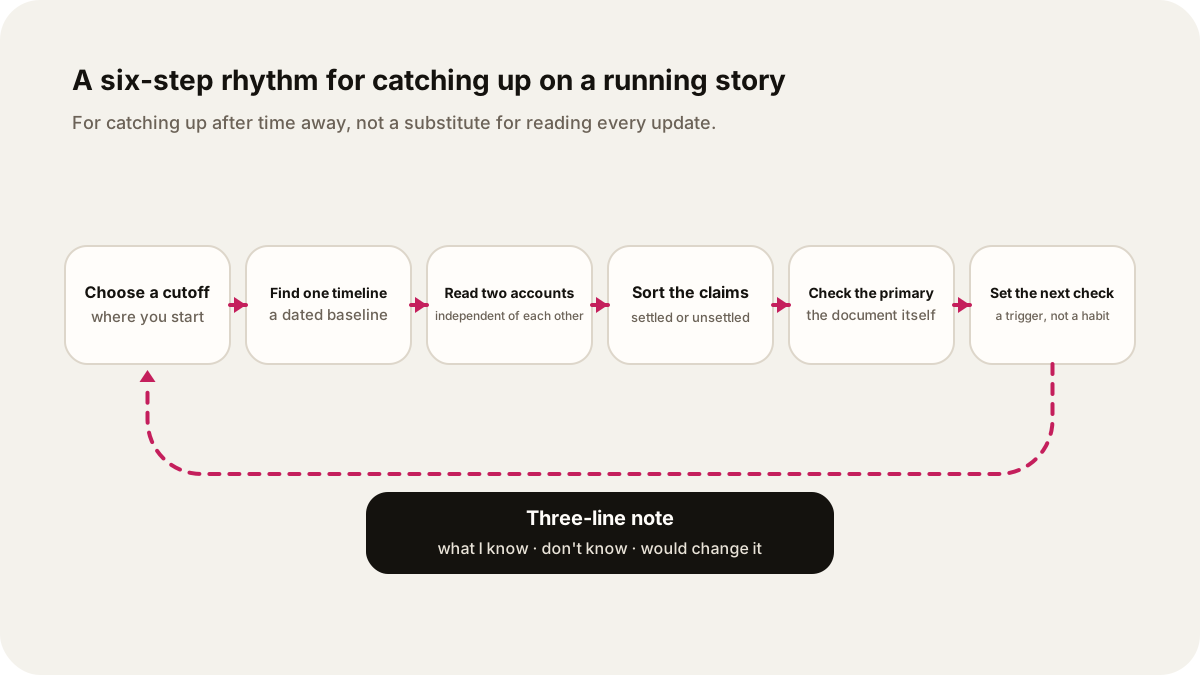
Taking a day or a week away from the news can create a second problem: the return feels like a backlog. Use a bounded catch-up instead of trying to read everything in chronological order.
Use this sequence:
- Choose a cutoff. Write down the date and time of your last check.
- Find one timeline or briefing. Use it to identify the main developments, not to settle every question.
- Read two independent accounts. Look for reporting that adds different evidence, geography, or expertise.
- Separate settled from unsettled. Note what has been confirmed, what remains disputed, and what is still being investigated.
- Check a primary document when it is relevant. Read the release, filing, ruling, dataset, or transcript behind the claim.
- Set the next check. If there is no clear reason to return sooner, leave the story until that time.
For an ongoing story, a three-line note can be enough: “What I know,” “What I do not know,” and “What would change the picture.” This keeps uncertainty visible and gives your next check a purpose. It also makes it easier to notice when a new article has not changed the picture at all.
For a more detailed version, read How to follow a fast-moving story without rereading the background. Write the baseline once, then track the changes.
When using a summary, search result, newsletter, or chatbot to orient yourself, treat it as an index. Open the original reporting or document for claims that matter. Check publication dates, corrections, and whether a headline is describing a new event or a reaction to an old one. A fast summary can save time; it should not be the only source for a consequential claim.
Protect your attention without making promises about how you will feel
A repetition-management routine can reduce unwanted duplication and make your choices more visible. It cannot guarantee calm, prevent upsetting stories, or make uncertainty disappear. Some news is difficult because the underlying event is difficult, regardless of the app or schedule you choose.
Pay attention to what happens after a check. Do you have a clear next question, or are you clicking because the feed offers another item? Are notifications interrupting sleep or work? Are you avoiding a topic because you have enough information for now, or because you have no bounded way to enter it? These observations can guide a small change: fewer alerts, a different source, a shorter session, or a scheduled catch-up with a trusted person.
A reading plan is an information habit, not a diagnosis or treatment. It cannot change the underlying event or remove uncertainty. It can give the next check a purpose and make repeated coverage easier to recognize.
Start with three decisions today: keep one source for timely updates, add one source that supplies context or local reporting, and choose the next time you will check. Mute the first source that repeats both without adding anything.
Ask an audio show to focus on changes
Give a recurring Lissin show a specific job: “Follow this beat using the sources I provide. Focus on new reporting and corrections. Keep familiar background short, and separate new facts from reactions.”
Compare the first episodes with the source-audit card. If the show repeats old material or misses an important correction, adjust the brief and keep checking the reporting. Episode length alone does not tell you whether the information is new.
Review Lissin's personal-show options, or explore existing audio to decide whether this format fits your next check.
Sources
- Reuters Institute, Digital News Report 2026 executive summary. Cross-national survey reporting 42 percent sometimes-or-often news avoidance in 2026; survey measure, not a clinical assessment.
- Xu, He, Guo, and Ding, “Relationship between news overload and news avoidance: A meta-analysis,” Journalism (published online 2024; print issue 2026). Meta-analysis of 17 papers and 13,143 participants; reports association, not causation.
- Gurr and Metag, “Fatigued by Ongoing News Issues? How Repeated Exposure to the Same News Issue Affects the Audience,” Mass Communication and Society, 2021. Qualitative longitudinal study using diaries and interviews.
- Liang and Fu, “Information Overload, Similarity, and Redundancy: Unsubscribing Information Sources on Twitter,” Journal of Computer-Mediated Communication, 2017. Observational analysis of nearly 7,500 Twitter ego networks; platform-specific findings.