
How to spot hallucinations in AI-generated spoken summaries
A polished synthetic voice speaks fabricated claims with complete confidence. Spotting errors requires auditing named entities, dates, and numbers.
When reading generated text on a screen, visual formatting often reveals AI hallucinations. A reader notices strange formatting inconsistencies, missing hyperlink previews, or awkward sentence structures that prompt skepticism.
In synthesized audio, however, spotting errors is dramatically more difficult. Modern text-to-speech models render fabricated claims with rich vocal timbre, natural prosodic cadence, and complete conversational confidence. A generated voice can state an entirely fictitious judicial ruling or an invented economic statistic with the exact same authoritative tone it uses for verified historical facts.
Auditing spoken audio requires specific listening discipline: identifying high-risk claim categories, checking underlying source cards, and refusing to let vocal fluency substitute for empirical evidence.
The vocal fluency trap: why natural intonation mimics authority
In human social interaction, listeners use vocal prosody as a heuristic for competence. When a human speaker hesitates, uses verbal fillers ("um," "ah"), or stumbles over words, listeners instinctively perceive uncertainty. Conversely, a speaker who delivers statements with smooth cadence, steady pitch, and unhesitating rhythm is perceived as knowledgeable and trustworthy.
A comprehensive survey on hallucination in natural language generation by Ji and colleagues in ACM Computing Surveys warns that generative models decouple fluency from factuality:
- Epitome of the "Stochastic Parrot": As noted by Bender, Gebru, and colleagues, large language models predict statistically probable linguistic sequences, not verified real-world facts.
- Acoustic smoothing: When text generation is paired with a neural speech synthesizer, the acoustic model applies realistic human intonation curves across fabricated sentences.
- The confidence illusion: The synthetic voice does not hesitate when delivering an error; it pronounces a hallucinated statistic with identical clarity to a verified truth.
High-risk categories for AI hallucinations
Hallucinations in spoken news and technical summaries are not random gibberish. They follow predictable structural patterns where the model attempts to bridge knowledge gaps with plausible-sounding fabrications:
- Specific numbers and percentages: "Consumer spending fell by 2.4 percent last month." Generative models frequently invent decimal statistics that sound plausible in context but contradict primary releases.
- Proper nouns and institutional attribution: Fabricating journal titles, combining names of two different researchers, or attributing a policy white paper to the wrong think tank.
- Legal rulings and statutory deadlines: Generating convincing descriptions of court decisions that were never issued or misstating the exact dates of regulatory deadlines.
- Causal certainty: Describing an unproven correlation as a confirmed causal mechanism (e.g., stating a pharmaceutical trial proved disease prevention when the paper reported only an exploratory biomarker).
The spot-check routine: pausing on numbers and opening source cards
You do not need to manually verify every sentence in a twenty-minute audio episode. To maintain a trustworthy audio habit, apply a targeted spot-check discipline:
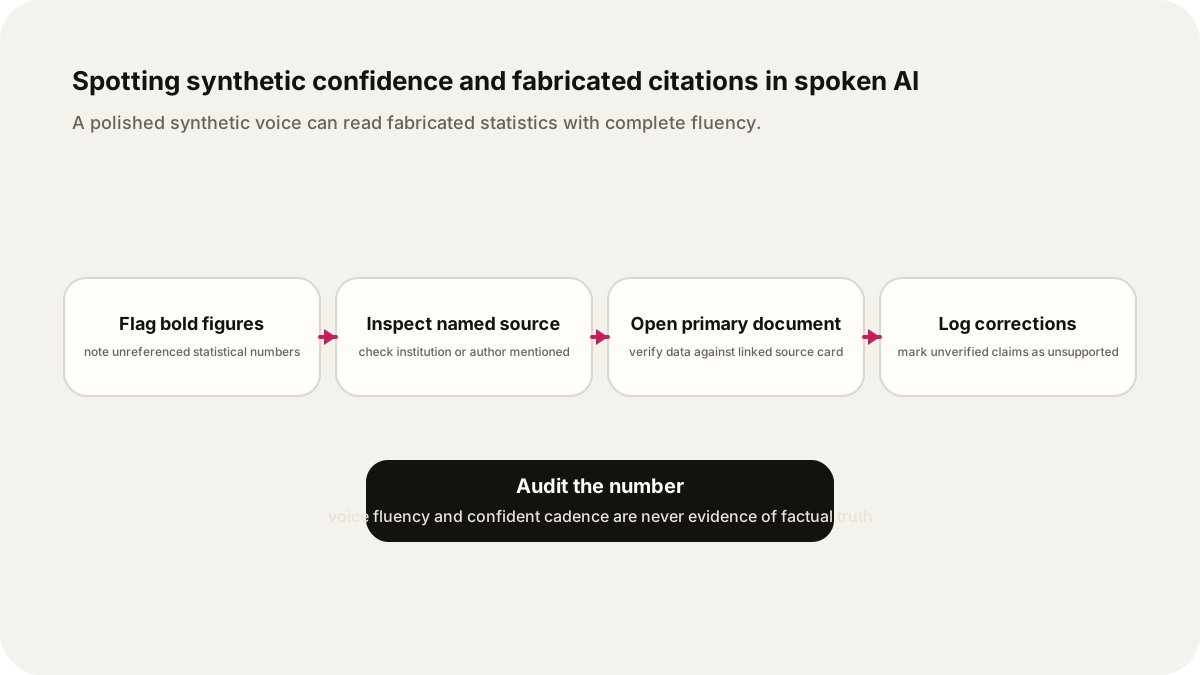
- The "Number Rule": Whenever an audio briefing states a specific numerical metric (inflation rate, trial sample size, revenue figure), pause playback and open the accompanying episode source card. Verify that the primary source document is linked and that the reported number matches the source text exactly.
- The "Study Check": If a spoken summary claims "a 2024 Harvard study proved X," verify the actual lead author, journal name, and publication date in the metadata. If the show cannot provide a direct link to the study, treat the claim as unverified.
- Check the delta log: For developing news stories, review the episode's revision history to see what claims were updated or corrected since the initial generation.
Recommended verification standards for spoken audio
When publishing or evaluating spoken summaries, editorial workflows should prioritize transparency and claim-level verification over black-box generation. As outlined in our guide to source links and corrections in AI audio, a trustworthy audio workflow benefits from clear verification standards:
- Claim-linked sources: Spoken assertions should link directly to primary URLs, official documents, or academic publications so listeners can inspect the evidence.
- Verifiable transcripts: Interactive transcripts allow listeners to locate specific sentences and cross-reference them with primary sources.
- Transparent corrections: When source facts change or initial reports are retracted, published records should include dated editorial notes explaining what was revised.
In Lissin, choose the topic or sources, the direction, the sound, and the length. If a factual claim matters, open its source and check it. Generated narration can still be wrong.
Try a request that keeps the claims checkable:
"Create a 12-minute technical briefing on recent solid-state battery manufacturing announcements. Strictly enforce claim verification: cite only primary statements from the engineering firms named. If a firm's energy density claims have not been verified by an independent third-party testing laboratory, explicitly state that the figure is unverified company marketing. Include direct links to all cited white papers in the episode show notes."
By demanding source transparency and practicing targeted spot-checking, listeners can enjoy the speed of personalized audio without falling victim to synthetic overconfidence.
Sources
- Ji, Z., et al. (2023), "Survey of Hallucination in Natural Language Generation": comprehensive ACM survey analyzing hallucination taxonomy and mitigation methods.
- Bender, E. M., Gebru, T., et al. (2021), "On the Dangers of Stochastic Parrots: Can Language Models Be Too Big?": foundational paper on linguistic plausibility versus real-world factual grounding.
- Huang, L., et al. (2023), "A Survey on Hallucination in Large Language Models: Principles, Taxonomy, Challenges, and Open Questions": technical analysis of hallucination detection and verification architectures.
- Lissin for iPhone.