
Audio explanations or flashcards? When each helps you learn
An audio explanation helps you understand a topic, self-testing shows what you can recall, and a week that alternates them with gaps between sessions uses both for what each does well.
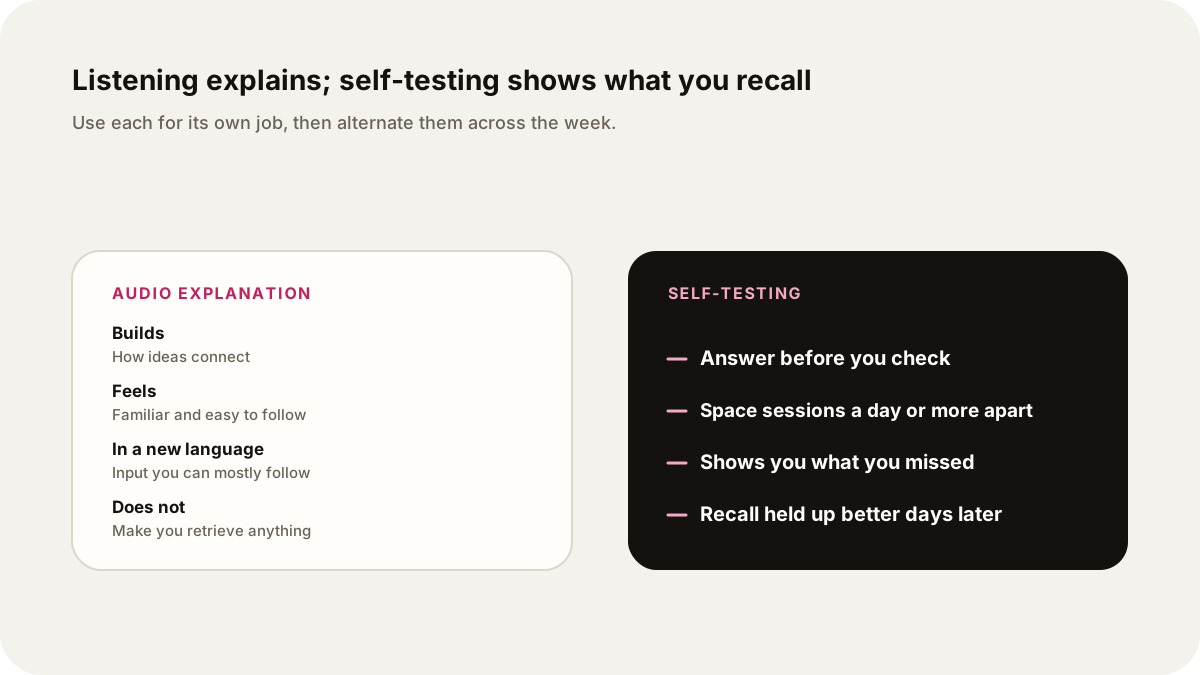
Use an audio explanation when you need to understand how ideas connect, and use flashcards or other self-testing when you need to find out what you can actually recall. They do different jobs. Listening puts the material in front of you again; it does not make you pull anything out of memory, and that retrieval step is what the strongest learning research supports.
The useful pattern is to alternate them. Hear an explanation, then close it and test yourself. Spend the next session on the questions you missed, and leave a day or two between sessions. The same split applies to a language you are learning: listening gives you input you can follow. It also applies to your own notes, which work better as material for questions than as something to replay.
What an audio explanation does well
A good explanation gives you the shape of a topic: why a process happens, how two ideas differ, and what an example looks like in practice. That is hard to get from a stack of cards, which break a subject into separate facts. Audio also fits moments when you cannot read, such as a walk or a commute.
The limit is that following an explanation feels like learning whether or not you could reproduce it. In a well-known experiment by Roediger and Karpicke (2006), students who restudied prose passages did better on a test five minutes later than students who had practised recalling them. On tests two days and one week later, the students who had practised recall remembered substantially more. Restudying also made students more confident about how much they would remember. Replaying an episode is a form of restudying, so expect it to feel more effective than it is.
Why self-testing earns its place
Retrieval practice means producing an answer from memory before you look: a flashcard, a practice question, or writing down everything you remember about a topic. A review of ten common study techniques by Dunlosky and colleagues (2013) gave practice testing and distributed practice its highest utility rating. The benefits held for learners of different ages and abilities, across many kinds of test, and in real classrooms. Rereading and summarisation were rated low utility, and the authors suggest practice testing in place of rereading.
Self-testing is not limited to memorising definitions. Karpicke and Blunt (2011) found that practising retrieval of science texts produced more learning than building concept maps while studying them, including on questions that required inferences. So when a card feels too narrow, use a harder prompt: "Explain why this happens, without notes."
Flashcards have a weakness of their own. A card can only test what someone thought to put on it, and a set made of isolated facts can leave you unable to explain how they fit together. An explanation fills that gap, which is why the two work better as a pair than as rivals.
Space the sessions
Spacing is the second half of the evidence. In a study of more than 1,350 people, Cepeda and colleagues (2008) taught a set of facts, gave a review after a gap, and tested at delays of up to a year. The best gap grew as the test delay grew. When the test was a week away, the best gap was about 20 to 40 percent of that week, roughly one and a half to three days. When it was a year away, the best gap was a much smaller share of the delay.
Those were facts learned in a research setting, not a whole course, so treat the numbers as a guide. The practical reading is simple: do not hold all your practice the night before. Return to the topic after a day or two, and test yourself when you return.
A worked example: one topic over one week
Suppose you have a biology test next Monday on mitosis and meiosis. One way to plan the week:
| Day | Audio | Self-testing |
|---|---|---|
| Monday | A ten-minute explanation comparing the two | Five minutes writing what you remember, then about ten cards made from the textbook so exact terms come from your course |
| Tuesday | None | Answer every card before turning it over; mark the misses |
| Wednesday | None | None. The gap is part of the plan |
| Thursday | A short episode on only what you missed, such as why meiosis halves the chromosome number | The cards again |
| Saturday | None | A closed-book test from a blank page, then the cards |
| Sunday | None | A short review of anything still missed |
The audio appears in two sessions; self-testing appears in every session except Wednesday's break. That balance is deliberate: the explanation helps you build the picture, and the testing tells you whether you can use it.
Listening in a language you are learning
Listening gives you input in the new language, but it helps most when it is input you can mostly follow. In his account of the input hypothesis, Stephen Krashen (1982) argues that people acquire a language by understanding messages that contain structure a little beyond their current level. Context and knowledge of the world fill the gaps. He calls understanding necessary but not sufficient. In practice, choose a subject you already know something about, so the content carries you when a word is new.
How much do you need to know? Van Zeeland and Schmitt (2013) varied the share of known words in four spoken stories and tested 40 non-native and 36 native listeners on what they understood. Most non-native listeners understood adequately when 90 percent of the words were known, and comprehension was more consistent at 95 percent. If you are missing more than about one word in twenty, ask for simpler language or a slower pace instead of replaying the same episode.
Be clear about what listening alone does not do. In Brown, Waring and Donkaewbua (2008), 35 Japanese university learners of English met 28 target words in stories. Those who only listened could translate about 2 percent of the words immediately afterwards. On unprompted recall, on average none of the words met only by listening were expected to be retained after three months. The authors suggest listening at an easier level than you read, or at a slower narration speed, and reading a text before listening to it.
So write down the new words you want to keep and turn them into cards. That is retrieval practice again, not more listening. Listening also gives you no feedback on your own speaking.
In Lissin you choose the language, accent, and pacing, so you can ask for an explanation at your level and change it after the first episode.
Turning your own notes or voice memos into a review
Your notes already contain what your course or project treats as important. The risk is turning them into something you only replay, which is rereading by ear. Ask instead for the notes to be organised around a question: how the main ideas connect, what is still unclear, and a few questions you can answer from memory.
For a voice memo, transcribe it first, read the transcript, and correct names, dates, and numbers before you use it as a source. Lissin can work from text you paste or a document or PDF you add. Keep the original for anything you need to quote exactly, and do not let a tentative idea in your notes become a firm claim in the episode.
One more use of a voice memo: record yourself explaining the topic from memory before you open your notes, then compare. That is free recall, the same kind of retrieval used in the studies above, and it shows you what to ask the next explanation to cover. For a longer source, the same habit applies; see listening versus reading a long article and planning a short series around one public lecture.
Make a show around it
Here is an example request you could give Lissin for the Monday session:
Using the notes I have pasted, explain the difference between mitosis and meiosis for a first-year biology student. Compare their purpose, number of divisions, and the cells they produce, and give one everyday analogy. End with five questions, and save the answers for a short recap at the very end.
Stop the episode when the questions start and answer them before you hear the recap. If an example does not make sense, ask for a different one instead of replaying the same passage.
Sources
- Roediger, H. L., & Karpicke, J. D. (2006), "Test-enhanced learning: Taking memory tests improves long-term retention," Psychological Science: restudying beat recall practice at five minutes; recall practice produced substantially greater retention at two days and one week, while restudying raised confidence.
- Dunlosky, J., et al. (2013), "Improving Students' Learning With Effective Learning Techniques," Psychological Science in the Public Interest: practice testing and distributed practice rated high utility; rereading, highlighting, and summarisation rated low.
- Karpicke, J. D., & Blunt, J. R. (2011), "Retrieval practice produces more learning than elaborative studying with concept mapping," Science: retrieval practice outperformed concept mapping, including on inference questions.
- Cepeda, N. J., et al. (2008), "Spacing effects in learning: A temporal ridgeline of optimal retention," Psychological Science: the best review gap grows with the test delay; about 20 to 40 percent of a one-week delay.
- Krashen, S. D. (1982), Principles and Practice in Second Language Acquisition: the input hypothesis, with understanding described as necessary but not sufficient.
- van Zeeland, H., & Schmitt, N. (2013), "Lexical coverage in L1 and L2 listening comprehension," Applied Linguistics: adequate listening comprehension at 90 percent known words, more consistent at 95 percent.
- Brown, R., Waring, R., & Donkaewbua, S. (2008), "Incidental vocabulary acquisition from reading, reading-while-listening, and listening to stories," Reading in a Foreign Language: very few new words learned or retained from listening only, with suggestions to listen at an easier level or read first.