
Story routines for young children: bedtime, car trips, play
Keep the story short, put it in the same place each day, and leave time to talk about it afterwards.
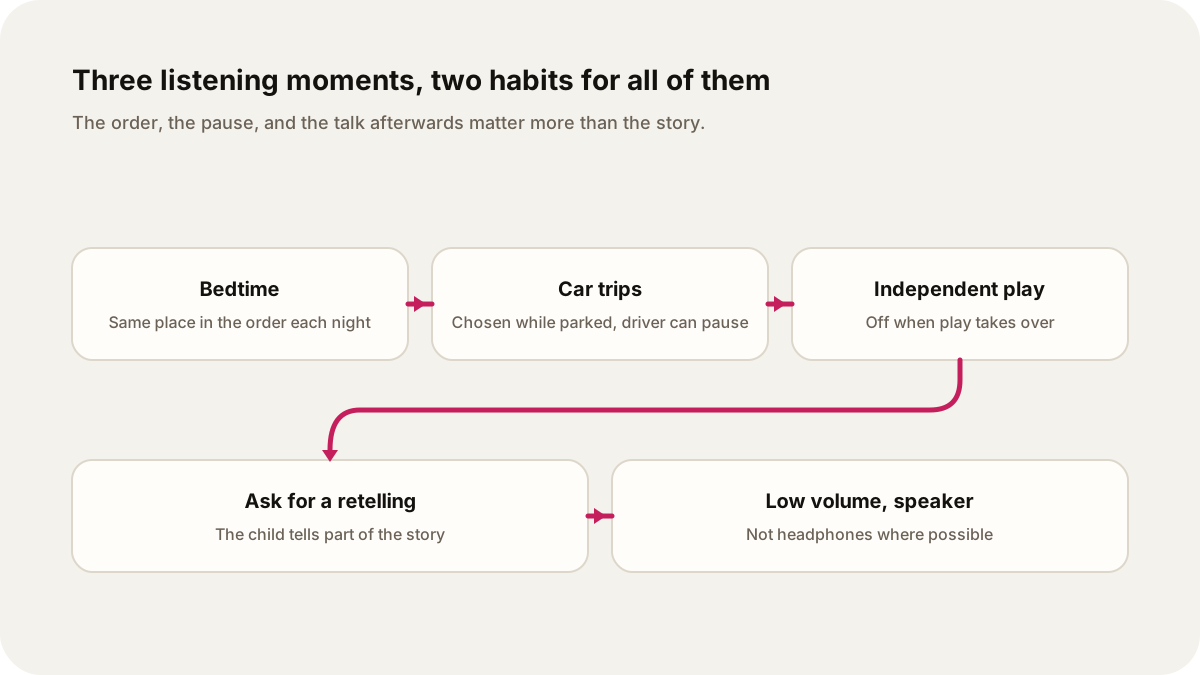
A listening routine for a young child works best when it is short, happens at the same point in the day, and leaves time to talk. At bedtime, that means one story in the same place in the evening order. In the car, it means a story chosen before you set off that the driver can pause at any moment. During independent play, it means a story the child can ignore without losing anything.
What listening does for language and imagination is more modest than many claims about it. Stories carry words children rarely hear in everyday talk, and talking about a story has better evidence behind it than hearing one. An audio story is not a shortcut to a bigger vocabulary or better sleep, and it does not replace reading together, conversation, or an adult looking after the child.
What does listening do for language and imagination?
Books carry words that daily talk does not. Jessica Montag, Michael Jones and Linda Smith compared 100 children's picture books with matched samples of speech addressed to children. The books contained more unique word types than the conversation (Psychological Science, 2015). That study counted the words in the text. A story read or played aloud carries the same kind of language, but the study did not measure what children learned from listening to it.
Talking about the story matters more than hearing it. In dialogic reading, the child becomes the storyteller while the adult listens and asks questions. The US What Works Clearinghouse reviewed five studies covering more than 300 preschool children, most from economically disadvantaged families, and rated the effect on oral language as positive (What Works Clearinghouse, 2007). The active ingredient is the exchange between adult and child, which a recording cannot supply on its own.
Audio alone is not the same as a picture book. Hutton and colleagues scanned 27 children with an average age just under five. Each heard similar five-minute stories as audio only, as recorded narration over still illustrations on a screen, and as an animation (Brain Connectivity, 2019). Comprehension was the same for audio and illustrated stories, and lower for animation. Compared with audio, the illustrated version was linked to less strain on the language network, and the authors suggested illustrated stories may suit that age best. The study did not test an adult reading a book aloud with a child, and a small lab study does not settle what works at home, but it is a reason to keep picture books alongside audio rather than swap one for the other.
For school-age readers, a National Literacy Trust review found audiobooks can support reading skills such as comprehension, along with reading enjoyment. It also noted that most studies look at listening alongside reading, and that listening for enjoyment needs more research.
Imagination is harder to measure. A story without pictures leaves the child to supply the faces and places, and you can find out what they pictured by asking. That is a good reason to enjoy audio stories. It is not evidence that they build imagination faster than books or play.
Build the bedtime routine first, then add a story
The order of the evening matters more than which story you choose. In a survey of 10,085 mothers in 14 countries, children up to age six who had a consistent bedtime routine went to bed earlier, fell asleep faster, woke less often in the night, and slept longer. More frequent routines went with better outcomes (American Academy of Sleep Medicine, 2015). Mothers reported these results themselves, so the study shows an association, not proof that a routine causes better sleep. The examples the AASM gives are a bath, brushing teeth, and a bedtime story.
An audio story can take the story slot, or sit after a book. A few choices help it fit:
- Same place, every night. Put the story after teeth and before lights out, so it signals the end of the day rather than a new activity.
- Keep the screen out of it. The American Academy of Pediatrics suggests screen-free times, including before bed, in its family media plan guidance. A story played through a speaker avoids the screen, but the phone it comes from should stay across the room, not in the bed.
- Give it an ending. A cliffhanger invites one more episode. A story that finishes lets the routine finish too.
- Keep the volume low. The World Health Organization advises keeping personal device volume at no more than 60% of maximum, and in its advice for children suggests built-in or external speakers rather than headphones where possible (WHO, safe listening).
If you are weighing a familiar recording against a new story for wind-down, personalized story vs generic sleep story compares the two.
A worked example: one evening, start to finish
Here is a hypothetical routine for a four-year-old with a 7:30 lights-out. Adjust the times; keep the order.
| Time | What happens | Who leads |
|---|---|---|
| 6:50 | Bath | Adult |
| 7:05 | Pyjamas and teeth | Child, with help |
| 7:10 | One picture book; the child names what they see and the adult asks one question | Child and adult |
| 7:18 | An eight-minute audio story from a speaker on the shelf, chosen and previewed earlier in the day | The story |
| 7:27 | Two questions: "Where did the train go?" and "What would you plant in the moon garden?" | Child tells, adult listens |
| 7:30 | Lights out | Adult |
The adult previews the story at lunchtime, not for the first time at 7:18 with a sleepy child. On nights that run late, drop the audio and keep the order. If the child asks for a different ending, that becomes tomorrow's story.
Car trips: choose before you start the engine
A story in the car is for the passengers. The driver's attention belongs to the road. The US Centers for Disease Control and Prevention describes three types of distraction: visual, taking your eyes off the road; manual, taking your hands off the wheel; and cognitive, taking your mind off driving (CDC). Reaching for a phone to find the next episode is manual and visual. Trying to follow a gripping plot through a busy junction is cognitive.
- Set up while parked. Choose the episodes and download them before you leave, so nobody needs to search for the next one or rely on signal.
- One complete story per stretch. Short episodes with endings suit a trip broken by stops better than one long serial.
- The driver can pause, no argument. Agree this before you set off. Merges, roundabouts, and directions come first.
- Save the questions for the rest stop. Asking a child what they think happens next works better when the driver can listen too.
- Pick for the youngest listener. Preview anything new, and choose a story the youngest can follow.
Independent play: make the story easy to ignore
During quiet play, the story should be something the child can drop without missing anything. The research here is about television, not audio. Schmidt and colleagues observed 50 children aged one to three during an hour of play, with an adult quiz show on for half of it. With the TV on, children played in shorter episodes with shorter bursts of focused attention (ScienceDaily summary of the Child Development study, 2008). That study does not tell you what a children's audio story does to play. It is still a reason to turn audio off when the child stops listening, rather than leaving it on as background.
- Start it when the child asks and stop it when they drift into their own plot.
- Avoid stories that give instructions. A narrator telling the child what to build next takes over play the child was leading.
- Stay within earshot. A recording does not supervise anyone.
If you are deciding what to play it on, smart speakers vs dedicated audio players compares how each one handles content and controls.
Make a show around it
Lissin makes a story from what you describe. You choose the subject, the length, the voice, and the pacing. You can make one episode, or schedule a show to return daily or weekly that remembers what it has already covered, so the train in tonight's story can pick up where it left off yesterday. If an episode does not fit, remix it: ask for simpler words, a shorter version, or a calmer voice.
Example request:
Create a nightly bedtime story for a four-year-old about a small train that visits a moon garden. Keep each episode about eight minutes, use one calm narrator and simple words, and end every episode with the train safely back home.
Listen through each new episode before playing it to your child, and change what does not suit them.
Sources
- Montag, Jones and Smith (2015), "The words children hear: Picture books and the statistics for language learning," Psychological Science: picture books contain more unique word types than matched child-directed speech.
- What Works Clearinghouse (2007), Dialogic Reading intervention report: positive effects on oral language across five studies of preschool children.
- Hutton et al. (2019), "Functional connectivity of attention, visual, and language networks during audio, illustrated, and animated stories in preschool-age children," Brain Connectivity: equal comprehension for audio and illustrated stories, lower for animation.
- National Literacy Trust (2020), "Audiobooks and literacy: a rapid review of the literature": audiobooks and reading skills, with a call for more research on listening for enjoyment.
- American Academy of Sleep Medicine (2015), "Study shows that children sleep better when they have a nightly bedtime routine": survey of 10,085 mothers in 14 countries.
- HealthyChildren.org (American Academy of Pediatrics), "How to Make a Family Media Plan": screen-free times including before bed.
- World Health Organization, "Deafness and hearing loss: Safe listening": the 60% volume guide and speakers rather than headphones for children.
- Centers for Disease Control and Prevention, "About Distracted Driving": visual, manual, and cognitive distraction.
- ScienceDaily (2008), "Parents Should Limit Young Children's Exposure To Background TV": summary of Schmidt et al., Child Development, on background television and toy play.