
Micro-breaks between meetings: what the research supports
Breaks of ten minutes or less make people feel a little more energetic and less fatigued, so here is how to use one for curious listening without turning rest into more work.
Short breaks during the workday do help, but by less than the claims around them suggest. A 2022 meta-analysis of 22 study samples and 2,335 participants found that breaks of ten minutes or less left people feeling somewhat more energetic and less fatigued. Both effects were small. The same review found no reliable overall gain in performance, and no reliable gain on cognitively demanding tasks.
That is enough reason to take five to fifteen minutes between meetings. It also sets the limits for a listening break. Use the gap to look away from the screen, move, and hear something you picked out of curiosity. Do not use it to fit in more work, and do not expect it to repair a workload that is wearing you down.
What the research on micro-breaks shows
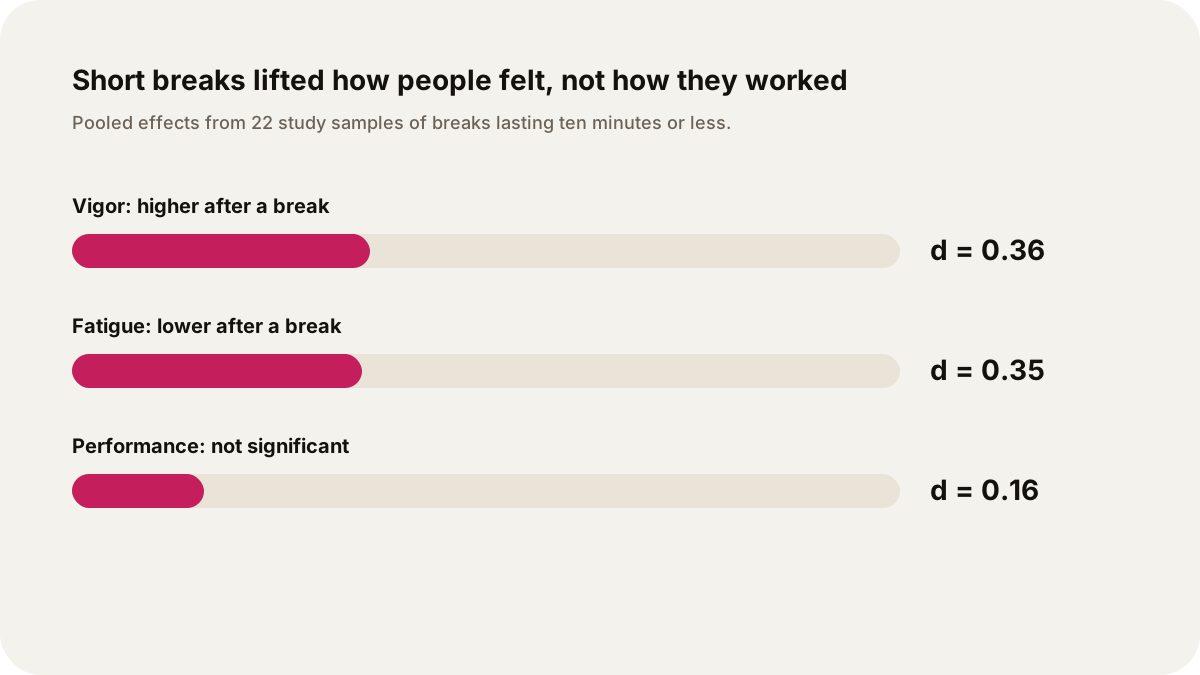
The clearest summary is a systematic review and meta-analysis by Albulescu and colleagues in PLOS ONE. The authors define micro-breaks as short pauses in a task lasting no longer than ten minutes. Across the studies they pooled, breaks raised vigor (d = 0.36) and lowered fatigue (d = 0.35). Researchers usually call effects of that size small.
Performance is where the evidence thins out. The overall effect (d = 0.16) was not statistically significant. Breaks did help on clerical tasks (d = 0.56) and creative tasks (d = 0.38). On cognitively demanding tasks the estimate was close to zero (d = -0.09). Longer breaks were linked to larger performance gains, and the authors suggest that recovering from highly depleting work may take more than ten minutes.
The review has limits worth knowing. Thirteen of the 22 samples came from laboratories rather than workplaces. The breaks themselves, such as watching clips, stretching, relaxing, or talking with others, varied too much to compare. So the research supports taking a short break. It does not tell you that listening to something beats a walk, a stretch, or a glass of water.
Why the gap between meetings matters
Back-to-back meetings leave no gap at all. A Microsoft Human Factors Lab study put EEG caps on 14 people during four half-hour video meetings, once back to back and once with ten-minute meditation breaks. The company reports less build-up of stress-related brain activity when breaks were included. Treat that as a pointer, not proof: it is a small, company-published study that does not describe itself as peer-reviewed, and the breaks were meditation, not listening.
Video calls may add their own strain. In Technology, Mind, and Behavior, Stanford researcher Jeremy Bailenson proposes four causes of video call fatigue: close-up eye gaze, cognitive load, constantly seeing your own face, and being held in place in front of the camera. He is explicit that these arguments have not yet been directly tested. His suggestions include making audio-only meetings the default where possible.
Your eyes are part of the picture too. The American Optometric Association describes digital eye strain as a group of eye and vision problems from prolonged screen use. It recommends a 20-second look at something 20 feet away every 20 minutes, and 15 minutes of rest for the eyes after two hours of continuous computer use. A listening break lets you keep your mind occupied while your eyes do something other than read.
Set up a listening break so it stays a break
The danger is that the phone you listen on is also the phone with your inbox. In a survey study reported by the Association for Psychological Science, employees who used their smartphones during lunch reported more emotional exhaustion later in the day. A survey cannot show that the phone caused it, but the practical lesson holds: decide what you will hear before the break, so the break is not spent choosing.
- Pick the episode in the morning. When the meeting ends, press play and put the phone in a pocket or face down.
- Choose a subject with no link to your job. Recovery research calls this psychological detachment. In a randomized experiment by Conlin, Hu, and Barber, even a 40-second break in a monotonous task improved performance, and the benefit ran through psychological detachment rather than mood. That was a short laboratory task, so take it as a hint rather than a rule.
- Fit the length to the gap. A five-minute episode in a ten-minute gap leaves time to stand, stretch, and refill a glass.
- Stop when the next meeting starts. An unfinished episode will still be there tomorrow.
- Leave some breaks silent. Nothing in the evidence says a break needs content.
Listening during a break is different from listening while you work. If you are wondering about the second case, see whether spoken audio helps you focus.
Keep learning by ear without turning rest into work
If you are tired of screens but still curious, listening is a fair way to meet a new idea. A meta-analysis of 46 studies and 4,687 participants by Virginia Clinton-Lisell in the Review of Educational Research found no reliable overall difference between reading and listening comprehension. Reading did better when people set their own pace and when the questions asked for inference rather than literal recall. So use audio to be introduced to a subject, and go back to text when you need the details. The guide to listening versus reading a long article covers that hand-off.
What keeps it restful is the absence of obligation. Sonnentag and Fritz's Recovery Experience Questionnaire measures four kinds of recovery experience: psychological detachment, relaxation, mastery experiences, and control. It was built for evenings, weekends, and holidays rather than ten-minute gaps. Still, learning something because you want to sits much closer to those experiences than a learning target does.
So skip the notes, the quiz, and the plan to finish a series this week. Ask one question per episode. Choose something lighter than the work you just left: for example, how birds find their way on migration rather than the policy you are drafting. If you find you cannot follow even a gentle explanation, stop. That tells you something about the day, not about your ability to learn.
What a break cannot do about burnout
Burnout is often used loosely to mean "very tired." The World Health Organization uses it more narrowly. WHO includes burn-out in ICD-11 as an occupational phenomenon and states that it is not classified as a medical condition. It describes a syndrome resulting from chronic workplace stress that has not been successfully managed, marked by exhaustion, mental distance or cynicism about the job, and reduced professional efficacy. The term applies to work, not to other areas of life.
That definition places the cause in how work is organized, so a five-minute episode does not address it. The micro-break review measured short-term vigor and fatigue, not burnout. If exhaustion or cynicism about your job lasts for weeks, raise workload with your manager or HR, and talk to a doctor or occupational health service about how you feel. An audio show is not a treatment for burnout, chronic fatigue, or any other health problem.
A worked example: three breaks in a meeting-heavy day
Here is a hypothetical Tuesday with meetings from 9:00 to 16:00. Before the first call, the person chooses two short episodes and saves them for offline listening.
| Break | What happens | What is heard |
|---|---|---|
| 10:30 to 10:40, after two video calls | Stand at a window and look at something far away | A five-minute episode on how a glacier moves |
| 12:50 to 13:05, end of lunch | Walk around the block, phone in pocket | A ten-minute episode on how the shipping container was invented |
| 15:10 to 15:15, after a hard planning session | Refill water, sit with eyes closed | Nothing |
The last break is silent on purpose. The planning session was the kind of demanding task where the meta-analysis found no performance boost from short breaks, so there is nothing to optimize. If the shipping container episode raised a question worth more time, it can become a longer request for the weekend.
Make a show around it
In Lissin you describe what you want to hear and choose the length, and Lissin researches and scripts the episode. You can download episodes in the app for offline listening, schedule a recurring show that returns daily, and remix an episode if you want it shorter or calmer. Here is an example request for a between-meetings break:
Make a five-minute episode explaining how a glacier moves. Use one real glacier as the example, skip the long introduction, keep the pace calm, and end with one question I could explore another day.
Listen to the first episode and change what does not fit the gap you have.
Sources
- Albulescu et al. (2022), "Give me a break!" A systematic review and meta-analysis on the efficacy of micro-breaks for increasing well-being and performance, PLOS ONE: effect sizes for vigor, fatigue, and performance; task-type and duration moderators; study limits.
- World Health Organization (2019), Burn-out an "occupational phenomenon": International Classification of Diseases: ICD-11 definition, three dimensions, not a medical condition.
- Microsoft WorkLab (2021), Research proves your brain needs breaks: EEG study of 14 people in back-to-back meetings with and without meditation breaks.
- Bailenson (2021), Nonverbal overload: A theoretical argument for the causes of Zoom fatigue, Technology, Mind, and Behavior: four proposed causes of video call fatigue, not yet directly tested.
- American Optometric Association, Computer vision syndrome: digital eye strain and screen rest guidance.
- Association for Psychological Science, Why you should break up with your smartphone during lunch breaks: survey findings by Rhee and Kim (2016) on smartphone lunch breaks and later exhaustion.
- Conlin, Hu, and Barber (2021), Comparing relaxation versus mastery microbreak activity, Psychological Reports: 40-second micro-break experiment and the role of psychological detachment.
- Clinton-Lisell (2022), Listening ears or reading eyes, Review of Educational Research (ERIC record): reading and listening comprehension compared across 46 studies.
- Sonnentag and Fritz, Recovery Experience Questionnaire (University of Mannheim): the four recovery experiences and the off-job context the measure was built for.