Why talk audio can work against focus — and where it actually helps
The same companies selling you focus music are quietly telling you not to use talk audio for deep work, and the reasoning holds up.
You want something in your ears while you write the report, work through the spreadsheet, or sit down to read. A podcast feels like company. An AI-narrated show feels even more relevant, because it's built around the exact thing you're thinking about. So you press play and get to work.
Then twenty minutes later you notice you've reread the same paragraph three times, or you can recount the entire story from the show but can't remember what you just typed. That's not a willpower problem. It's a channel problem, and an entire industry of focus-audio companies has been built around avoiding it.
This is worth saying plainly, because it runs against what an audio app would normally tell you: spoken-word audio, including narrated shows like the ones Lissin makes, is generally not the right tool for deep work. Here's why, and where spoken audio does earn a place in a focused day.
An industry built specifically around removing words
Look at the products designed for concentration rather than entertainment, and a pattern shows up immediately: none of them use lyrics, dialogue, or narration.
Brain.fm sells instrumental tracks engineered for focus, sleep, and relaxation. Its own site states the music has "no lyrics or intrusive sounds" and is "designed to prevent distraction," and its science page explains the broader design goal: "most music in the world is designed to grab your attention, which leads to distraction," so the composition process actively subdues or removes attention-grabbing elements so the audio can sit in the background. Brain.fm also markets a patented approach it calls neural phase locking, aimed at coordinating brainwave activity associated with focus — that's the company's own characterization of its technology, not an independently verified finding, but the underlying design choice is telling regardless of whether the mechanism holds up: the product is built to be heard without being listened to.
Endel takes a different technical approach — generative, adaptive soundscapes that shift with time of day and other inputs rather than fixed compositions — but lands on the same rule. A comparison of the two services on bestfocusmusic.com frames the shared complaint both products are answering: people find ordinary playlists disruptive because "switching songs, lyrics, or sudden changes in volume break their workflow." Endel's pitch is continuity and absence of surprise, which is a different route to the same destination as Brain.fm's silence-shaped-like-music.
Focus@Will, more recently operating as focus.music, was one of the earliest services built specifically around this idea — curated instrumental channels, tuned by genre and reported personality type, marketed explicitly as attention tools rather than music for its own sake. A roundup of Focus@Will alternatives lists Brain.fm, Endel, myNoise, Brainwaves, Noisli, and Headspace's focus tracks as the comparable field — six products, and not one of them is built around spoken language. Some of these services do make specific productivity claims in their own marketing; those numbers come from the vendors, not from independent research, so they're worth treating as claims to weigh rather than settled facts.
Why words compete with words
None of this is an accident of taste. Language runs through a narrow, shared channel in the brain. Reading a report, writing an email, and holding a chain of reasoning together all draw on the same verbal working memory that processes spoken words — the mental equivalent of a single lane. When you listen to someone talk while you're also trying to read or write, you're asking two verbal tasks to merge into that one lane at the same time, and something has to give: comprehension of what you're hearing, quality of what you're producing, or both, usually without you noticing which one lost.
Instrumental music and sound design mostly bypass this collision. A synth pad, a chord progression, and even most rhythmic textures are processed differently from language, which is why they can sit in the background of a task that itself lives entirely in language. That's the actual argument for wordless focus audio, and it's a stronger one than "words are distracting" — it's not about distraction as a vague feeling, it's about two processes competing for the same limited resource.
This is also why the popular workaround of "just play music with lyrics I already know" holds up better than brand-new lyrical content: familiar words require far less active processing than words you're hearing for the first time, so the collision is smaller. It still isn't zero, which is part of why dedicated focus-audio products avoid lyrics altogether rather than relying on familiarity as a fix. For a related version of this same trade-off in a different setting, see what the research says about music, talk, and gym performance — physical effort tolerates spoken content much better than verbal cognitive work does, because it isn't competing for the same channel.
How to tell the collision is happening
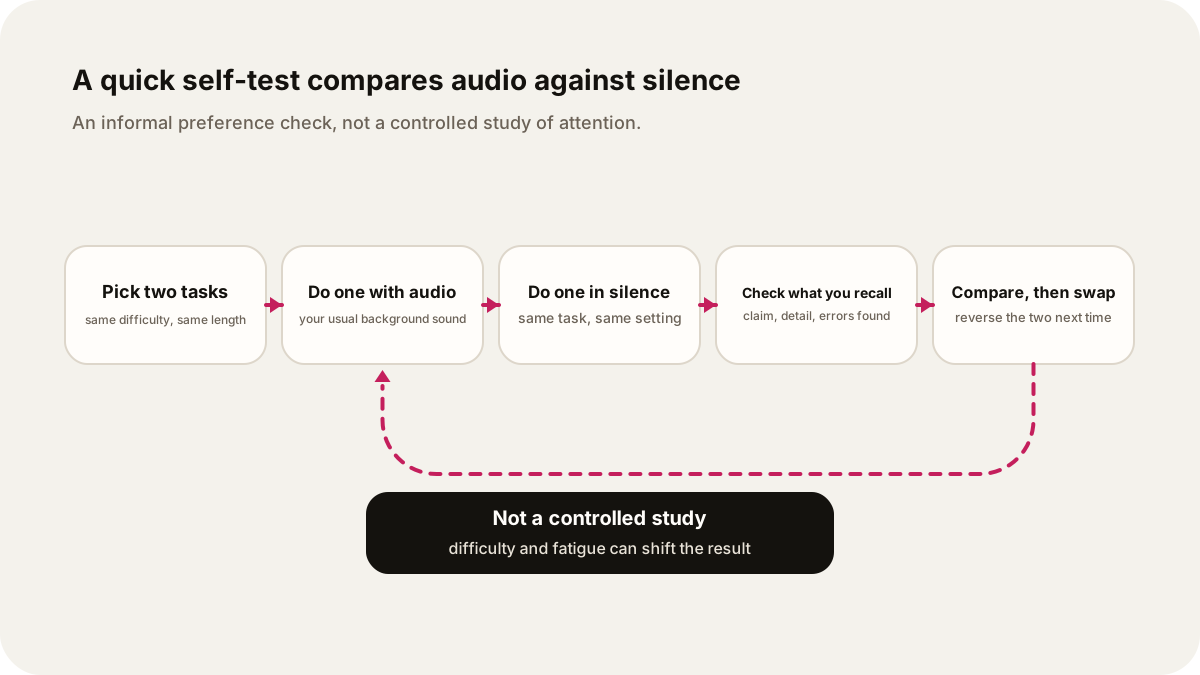
You don't need a lab to notice this. A few practical signs: rereading the same paragraph without absorbing it, writing a sentence and then forgetting the point you were building toward, realizing you tuned the audio out entirely and can't say when you stopped following it, or finishing a work block able to summarize the show in detail but not the document you were supposedly writing. Any one of those is a sign the audio and the task are drawing on the same resource rather than two separate ones.
The fix isn't willpower or better headphones. It's turning the spoken audio off, or swapping it for something wordless, for exactly as long as the task stays verbal. Once the task turns manual or repetitive again, spoken audio stops competing and starts filling capacity that was genuinely open.
What this means for a narrated show specifically
A narrated audio show is language from the first second to the last. There's no instrumental stretch to duck into when you need to concentrate — the entire product is the thing that competes with reading, writing, and thinking. That's true of Lissin's shows as much as it's true of any podcast, audiobook, or radio segment. If you're deep in a task that requires the verbal part of your mind — drafting, analyzing, coding logic that reads like a sentence, studying something you need to retain — putting a spoken show in the background works against you, not for you, regardless of how relevant or well-produced the content is.
This is worth stating without the usual hedge, because the honest answer here doesn't flatter the product: if today's block of work is real deep work, the right move is an instrumental focus track, ambient sound, or silence — not a talk show, and not an AI-narrated one either. A show built specifically around your topic doesn't change the channel problem; if anything, content you find personally engaging can pull harder at your attention than background music you tune out by design.
Some people say they can run a demanding work task and a talk show at once without any noticeable cost. Individual capacity varies, and not all deep work is equally verbal — skimming a familiar report draws on the channel less than drafting an argument from scratch does. But self-report is a weak instrument here: it's genuinely hard to notice in the moment that attention has split, which is exactly why the rereading-paragraph test above is a more useful check than how focused a task feels while you're inside it.
Where spoken audio does fit
None of this means spoken-word audio is only good for the couch. It means the job has to match the moment, and there's a real category of moments where a talk show or narrated piece is the better choice, not a compromise.
Low-cognitive-load administrative work. Sorting files, clearing a straightforward inbox, filling out a form you've filled out a dozen times, renaming a batch of photos, organizing a folder structure — tasks that use almost none of your verbal working memory leave room for spoken content without the same collision. You're not composing sentences in your head while you drag files into folders, so a show can run alongside that work without a measurable cost.
Task transitions. The few minutes between finishing one piece of deep work and starting the next aren't actually part of either task. Making coffee, refilling a water bottle, stretching, or walking to another room to switch gears is exactly the gap a short segment can fill — something to occupy the interval without asking your verbal system to do double duty, since you're not trying to hold either task's content in mind during the switch.
Commutes and chores. Walking, driving, doing dishes, folding laundry — physical, largely automatic activities that don't route through the same channel language does. This is exactly the territory where a narrated show or podcast makes sense as a default rather than an exception, and it's worth planning for deliberately rather than defaulting to whatever autoplay picks next. For a fuller breakdown of how to choose what to listen to across a mix of hands-busy activities, see how to pick audio for cooking, commuting, and folding laundry.
The pattern across all three: the less a task depends on active language processing, the safer it is to add more language on top of it. Deep focus sits at one end of that scale; chores and commutes sit at the other.
A simple way to split the day
If your day has a real deep-work block — the two hours you protect for writing, analysis, or study — treat that block as an instrumental-or-silence zone. That's the moment Brain.fm, Endel, and similar products are built for, and it's a fair use case for them even from an audio company's perspective.
Save narrated audio, whether that's a news show, a personalized deep dive, or a podcast, for the parts of the day built around lower verbal load: the commute in, the errands after lunch, the inbox cleanup before a meeting, the walk you take to reset between two demanding tasks. Matching the audio to the actual cognitive demand of the moment will do more for both your focus and your listening than switching apps or hunting for a "better" focus playlist ever will.
Why Lissin is telling you this instead of pitching you a focus mode
Lissin exists to turn a topic, question, mood, or source into a spoken show, and that only works if the format is honest about what it's for. Recommending narrated audio for a deep-work session would be good for engagement and bad advice, and the two shouldn't get confused just because one company makes the product being discussed.
So use Lissin where spoken audio genuinely helps: the commute, the chores, the low-load admin stretch, the gap between two hard tasks — the moments this piece and its two companions above are actually about. Skip it, or any other talk-based audio, for the block of your day where the work itself is made of words. Explore audio on Lissin for those in-between moments, and give your deep-work hours the instrumental silence they actually need.
Sources
- Brain.fm homepage for its "no lyrics or intrusive sounds" design claim and product positioning.
- Brain.fm's science page for its stated design philosophy on attention-grabbing elements and its neural phase locking claim.
- bestfocusmusic.com, "Brain.fm vs Endel: Which Focus Music App Is Best for Deep Work?" for the comparison of structured versus adaptive instrumental focus audio and the stated complaint about lyrics and playlist changes breaking workflow.
- earlystagemarketing.com, Focus@Will alternatives roundup for the comparable field of instrumental focus-audio products (Brain.fm, Endel, myNoise, Brainwaves, Noisli, Headspace).