Music, talk, or both? What the research says about gym audio and performance
The research doesn't crown one winner for gym audio — it splits cleanly by workout intensity and type, and the right answer to “music or talk” often changes within a single session.
A 45-minute steady-state row and a set of 400-meter sprint repeats put very different demands on your ears. One wants sound that fades into the background while you count breaths; the other wants a beat your feet can find without thinking about it. Most advice about workout audio skips that distinction and argues for a single winner — usually music — based on studies that were never testing the same kind of exercise.
The research does give music a real edge on two specific measures: how much people enjoy a session, and how much a matched beat helps a synchronized movement. Talk audio — podcasts, audiobooks, narrated shows — isn't competing on those same measures and doesn't need to. Its advantage shows up in perceived effort during lower-intensity, longer, or more repetitive work, where the job isn't matching a beat but not noticing the clock.
Neither finding cancels the other out, and neither applies to every workout. Here's what the studies actually measured, and which kind of session each result fits.
A quick comparison
| If you're doing… | Reach for… | Why |
|---|---|---|
| HIIT, sprints, tempo intervals | Tempo-matched music | Synchronizing movement to a beat has a measured work-enhancing effect; talk audio has no beat to sync to. |
| Incline walk, easy cardio, steady-state cycling | Talk audio | Perceived exertion is already low; audio that holds your attention through content, not tempo, fills the time without fighting your effort. |
| Warm-up and cool-down | Talk audio, or either | Intensity is low enough that immersion is doing the work, not beats per minute. |
| Long endurance session (run, ride, row) | Either, often talk | Once effort settles into a rhythm you're not consciously syncing to, distraction from monotony matters more than beat-matching. |
| Your hardest intervals, near max effort | Music, if anything | Past a certain intensity threshold, music's effect on perceived effort fades and the workout dominates attention regardless of audio. |
Music's measured edge is enjoyment, not just energy
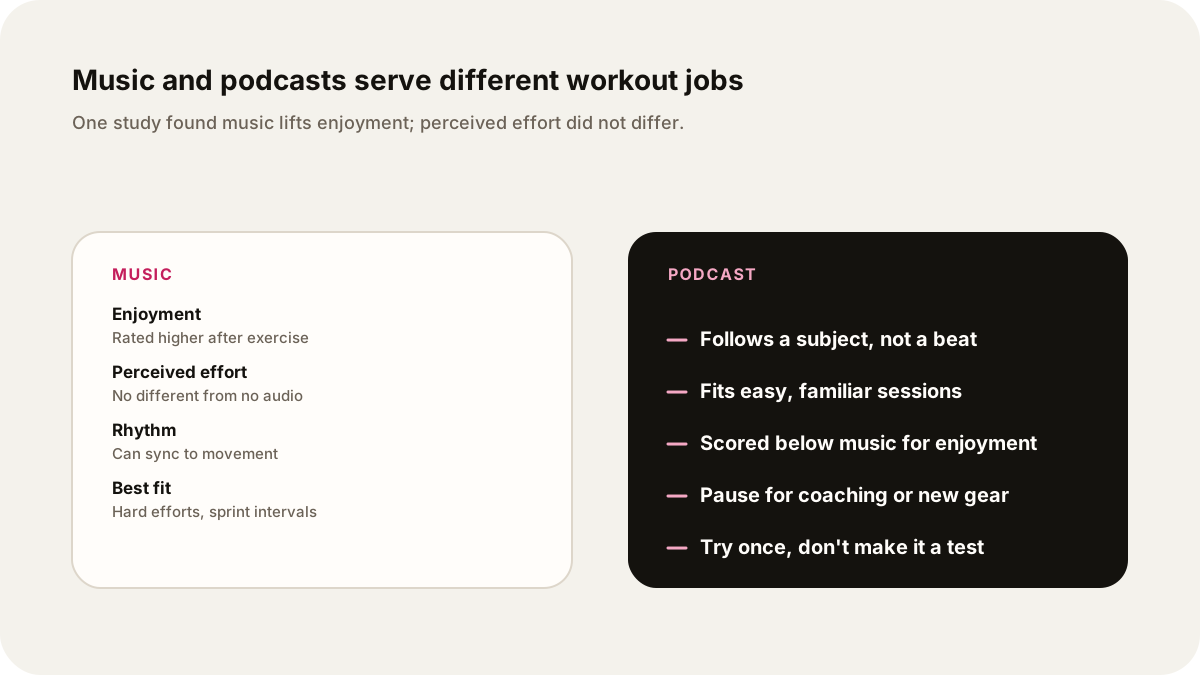
The clearest finding in favor of music concerns how much people like the workout while they're in it, separate from any performance effect. Live Science's review of the research cites work by Costas Karageorghis, a professor at Brunel University London who has studied music and exercise for two decades. One of the studies he points to, published in the journal Psychology of Sport and Exercise, found a 28 percent increase in enjoyment for people who exercised while listening to music compared with exercising in silence — and enjoyment was 13 percent higher for the music group compared with a group that listened to a podcast instead.
That 13-point gap is worth sitting with, because it's the most direct head-to-head enjoyment comparison in the research: not music versus nothing, but music versus spoken audio. Fit&Well's comparison of music and podcasts during exercise points to a similar conclusion from a different angle, citing a Memorial University of Newfoundland study finding that music can reduce rating of perceived exertion, increase exercise enjoyment, and enhance exercise performance during moderate-intensity exercise. Different research groups, similar direction: on enjoyment specifically, music has real backing.
None of that means talk audio has no enjoyment value — people choose podcasts for workouts constantly, and enjoying a workout is not the only thing that keeps someone coming back to it. It means that if enjoyment is the specific thing you're optimizing for in a given session, the evidence currently favors music over talk, not an even split between them.
The mechanism: matching a beat does something talk audio can't
Music's other advantage is closer to physiology than mood. Karageorghis, as described in the Live Science piece, distinguishes between listening to music passively and "synchronous mode," where a person consciously matches their movement pattern to the beat. That synchronized mode can produce what he calls an ergogenic, or work-enhancing, effect of 10 to 15 percent — and in his lab studies, the same synchronization has reduced oxygen intake by up to 7 percent during matched effort. He's careful to note that those numbers come from controlled lab conditions with few outside distractions, so real-world results during a busy gym session may be smaller.
Tempo matters for this effect, and the research gives rough ranges: around 120 beats per minute suits low-intensity work like a brisk walk, while up to 140 beats per minute suits high-intensity efforts like running. For pure synchronization — matching footstrike to the beat — the useful tempo is often half your actual cadence, since most people don't want a beat on every single step; 90 BPM comfortably supports 180 strides per minute.
This is also the part of the comparison where a dedicated product exists specifically to do the work for you. RockMyRun, a workout-music app, builds its pitch entirely around this mechanism: its listing describes a "Body-Driven Music" system that automatically adjusts tracks to sync with your steps or heart rate, lets you manually dial in a target BPM, and structures its stations to build in tempo as a workout progresses. That's the kind of tool the synchronization research is describing in practice — and it's a fundamentally different product category from spoken-word audio, which has no tempo to build.
Where that edge runs out
The synchronization advantage isn't unlimited. The same Live Science coverage notes that once a person crosses roughly 75 percent of their VO2 max — solidly into high-intensity territory — music becomes "relatively ineffectual" at changing how hard the effort feels. Past that point, the physical demand of the workout itself takes up enough attention that audio, of either kind, has less room to influence perception.
That's a useful ceiling to know about if you've assumed music is always doing something for you. During your hardest reps, the tempo-matching and mood benefits both start to fade, and what's left is closer to a personal preference for what's playing in your ears while you suffer through the last set.
Where talk audio actually wins: attention, not tempo
The Fit&Well piece is explicit that podcasts aren't just a fallback when you don't feel like music — they do a specific job music doesn't. It describes the core mechanism of music's enjoyment boost as distraction from exhaustion, then adds a direct line: podcasts or audiobooks "can do the same thing." The same feature also points to a secondary benefit unique to spoken content — it's often educational, and cites a sports psychologist's observation that running stimulates brain regions involved in learning, problem-solving, and creative thinking, on top of whatever distraction effect is happening.
Where the two formats genuinely diverge is tempo. Fit&Well's own framing is blunt about it: podcasts "don't have the benefit of BPM to increase your workout intensity, so they're not ideal for HIIT training, but they have their own unique benefits when doing monotonous endurance exercise like cycling or running." Its stated rule of thumb — podcasts for learning over long stretches, music for performance-based work — matches what the physiology research above would predict: talk holds attention during work that doesn't need a beat, and gets out of the way during work that does.
That's a narrower claim than "talk audio is better for exercise," and it's the more defensible one. It's also the same logic that applies outside the gym: choosing an audio format by the job it needs to do, not by which one wins on average, is the same reasoning behind how to pick audio for a hands-busy hour like cooking or folding laundry, where the task doesn't require full visual or rhythmic attention but does leave your ears free.
Match the format to the workout, not to a blanket rule
Put the two bodies of evidence side by side and a pattern falls out that has nothing to do with which format is "better." Music wins where a beat can do physical work: intervals, sprints, tempo runs, anything where synchronizing footstrike or stroke rate to a rhythm changes the effort. Talk audio holds its own where the workout is long, steady, or low-intensity enough that the limiting factor is boredom rather than beat, and where the content itself — not the tempo — is what keeps you moving through the set.
That also means the honest answer to "music or talk" changes within a single workout, not just between people. A warm-up, a steady main set, and a finishing sprint can each call for a different answer, the same way a single day's news consumption might call for a fast briefing at one moment and a longer explainer at another — a distinction covered in more detail in audio news briefing vs. news podcast. The format that fits changes with the job, not with a fixed preference you carry into every session.
Where a spoken show actually beats a playlist
None of the research above argues for spoken audio during the workouts where tempo is doing the work. It does describe, fairly specifically, where talk audio has a legitimate case: the incline walk before you lift, the easy recovery ride, the warm-up and cool-down, and the long steady session where the goal is finishing the distance, not synchronizing to a beat. Those are exactly the sessions where distraction and engagement matter more than beats per minute — and where a narrated show, not a playlist, is the more useful thing in your ears.
That's the gap Lissin is built for, and only that gap. It isn't a fitness app, doesn't track your BPM or your pace, and won't try to sync a script to your stride the way a tempo-matched playlist can. What it does is take a topic, question, mood, or source you give it and turn it into a researched, narrated show you can queue up before you start moving — useful for the incline walk, the easy spin, the cooldown, or the long steady miles where the research above says talk genuinely competes with music, not for the interval set where a beat is doing the work. Explore audio on Lissin for the next steady session on your schedule.
Sources
- Live Science, "Can music really influence your workout?" for Costas Karageorghis's research on enjoyment (28% vs. silence, 13% vs. podcasts), the synchronous-mode work-enhancing effect (10–15%), the oxygen-intake reduction (up to 7%), BPM guidance by intensity, and the roughly 75% VO2 max threshold where music's effect on perceived exertion fades.
- Fit&Well, "Should you listen to music or podcasts during your workout?" for the Memorial University of Newfoundland findings on perceived exertion and enjoyment, the distraction and educational case for podcasts, and its conclusion that podcasts suit monotonous endurance work while music suits performance-based, BPM-driven training.
- RockMyRun on the App Store as a named example of a BPM-synced workout-music product, cited for its "Body-Driven Music" tempo-matching and step/heart-rate sync features.