
Audio news briefing vs. news podcast: which fits your day?
A briefing can also be a podcast. Choose between a short overview and a deeper episode by the question you need answered.
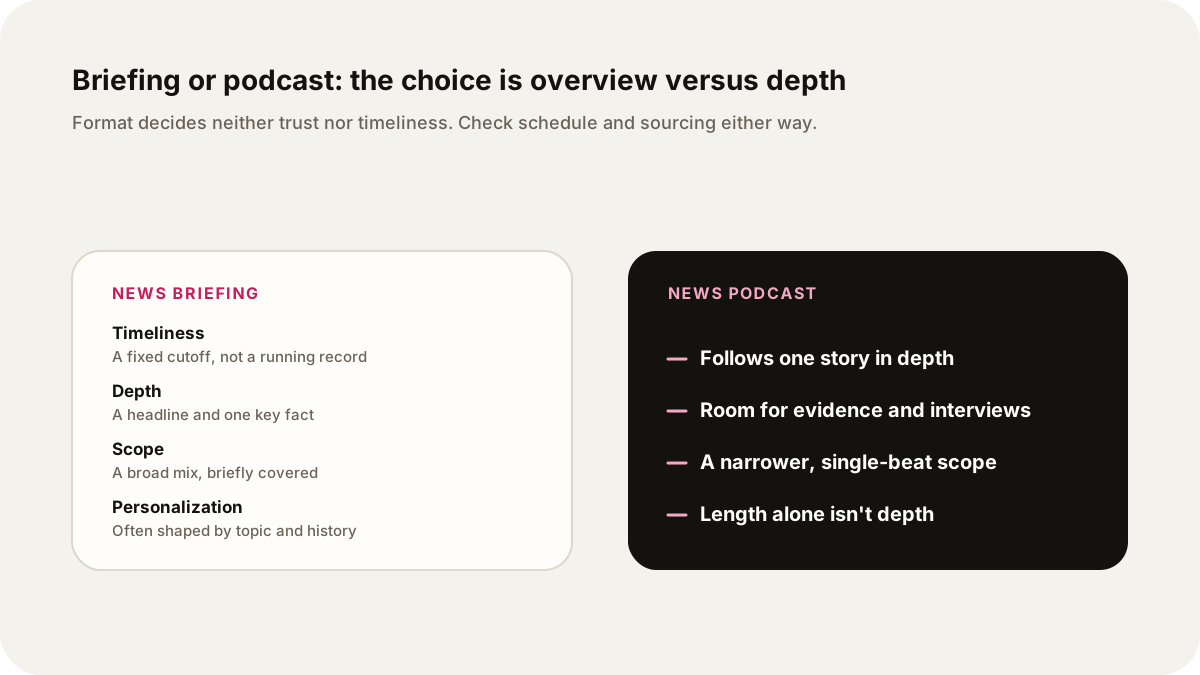
Choose a briefing-style episode when you want a short overview of several stories. Choose a reported single-story episode when you want to understand one event in more depth. Both can be podcasts: a briefing describes the editorial format, while a podcast is a way to publish and follow audio.
NPR's Up First is a podcast with a briefing job. The Daily and Vox's Today, Explained offer examples of a more focused reported or explanatory episode. Pick the question you want answered, then check the actual episode length.
Original illustration: Lissin Editorial.
A quick comparison
| If you want… | Start with… | Why |
|---|---|---|
| A dependable overview | A briefing-style show | It gives a small, edited set of headlines in a predictable window. |
| One story with context | A reported news podcast | The episode can spend time on causes, evidence, interviews, and consequences. |
| News that follows your interests | A personalized briefing or recommendation feed | Topic, language, location, and listening history can shape what appears. |
| A record you can revisit | Either format with accessible notes and an archive | Check the actual source links, transcript and correction information before choosing. |
| Breaking developments | A live news source or frequent-update feed | Neither a fixed briefing nor a scheduled episode guarantees the latest update. |
Timeliness: the schedule matters
Briefings answer, “What changed since I last checked?” A clear cutoff time and a compact selection make them useful for orientation. They are not a running record of every update.
The schedule is part of the listening contract. On its current US Apple Podcasts listing, Up First describes a weekday release at 6:30 a.m. Eastern Time, with a stated 10-minute rundown of three big stories. Check the episode itself: the listing also contains longer episodes, so that description is not an upper runtime limit. The BBC’s Global News Podcast describes twice-daily weekday editions, daily weekend editions, and extra episodes for urgent stories.
Those are useful patterns, not promises that every briefing will be current when you press play. A major event can move faster than any production cycle. Podcast schedules vary: some shows publish daily, some weekly, and some when a story warrants it. A later edition may include a development missing from a morning release; a weekly episode may have more time to examine it. Check the reporting cutoff in either case.
Check the release time, update frequency, and whether the feed labels breaking or bonus episodes. For a fast-moving event, use the audio episode as a starting point and check the publisher’s latest written or live coverage before treating it as the final word.
Depth: what does the episode explain?
A short briefing has to make hard choices. It may give you three stories, a headline, a key fact, and a little analysis. That breadth creates a mental map of the day, but each story gets less room for competing accounts, history, and uncertainty.
A reported single-story episode can stay with one question. The Daily describes a 20-minute episode format built around the biggest stories of the day, while Vox’s Today, Explained calls itself a daily news explainer. That leaves room for evidence, interviews, timelines, and stakes.
Length alone does not determine depth. A long episode can wander, and a short episode can clarify a complicated point. Listen for the work inside the runtime: named sources, a clear distinction between what is known and what is disputed, and enough context to understand why the story matters.
Editorial scope: breadth and focus are both choices
Briefings tend to cover a broad mix: politics, business, international news, technology, and a local or personal-interest item. The point is to scan the agenda without opening ten feeds.
Single-story episodes and specialist shows narrow their scope. A show might focus on one story per episode, one beat such as economics or technology, or one editorial lens such as analysis and interviews. That narrower scope can make the show more coherent, but it can also leave gaps in your day’s news.
Neither format is automatically more complete. A briefing’s editor decides which stories fit the slot; a single-story show's editor decides which questions deserve an episode. If you need broad awareness, compare the show’s stated coverage with what it repeatedly leaves out. If you need expertise, choose a show that names its beat and reporters.
Personalization: useful for attention, risky for blind spots
Some briefings are assembled for the listener rather than written as one identical episode for everyone. A service may use your chosen topics, location, language, follows, or recent listening to order what you hear. Spotify’s published explanation of recommendations says its systems can use a listener’s taste profile, searches, follows, language, location, device, and broader listening trends when recommending podcasts and other content.
Personalization can save time. A commuter in Bengaluru may need a different local mix from a listener in Toronto. It can also make the editorial package less visible: you may not know which stories were omitted, why an item appeared, or which source supplied it. That is an inference from how recommendation systems work, not a claim about every briefing.
Following a named show lets you choose a particular editorial package, whether it offers briefings or longer episodes. You choose the show, follow it, and decide whether to play an episode. Discovery systems still influence what you find next, so keep a small set of trusted shows and use recommendations to explore beyond them. For a broader look at how a listener’s intent can shape an audio episode, see how AI turns research into a personalized audio show.
Duration and discovery: inspect the episode
Check runtime before pressing play, especially if you have a fixed gap. A show's description may describe its usual editorial format while individual editions include longer reporting, special episodes or other material. A short briefing can fit breakfast; a longer episode may need a separate walk or commute.
You can follow either kind of show in a podcast app, encounter it through recommendations, or find it through a publisher's own site. The BBC describes browsing its audio through featured content and podcast categories. Spotify describes recommendation inputs that include listening and search behavior. Neither delivery path guarantees depth, independence or a useful archive.
Sample an episode with a specific question in mind. Does it give the main development and its date? Does it explain the point you wanted to understand? Can you find the underlying source? If you need to compare a chart or exact wording, reading alongside listening may be the better choice.
Trust belongs to the source and the process
An authoritative voice and a calm soundtrack are not evidence. Trust comes from reporting, attribution, corrections, independence, and a way to inspect the underlying work.
The Associated Press publishes standards that illustrate what to look for in any news audio. Its principles call for accurate and honest reporting, source identification, and independence. Its guidance for audio says actuality should not be altered in a way that changes its content, and its standards describe how disputed information should be attributed and errors corrected.
Apply those questions to both formats:
- Does the episode name who reported the information and where it came from?
- Can you find links, transcripts, background reading, or a correction note?
- Does the host separate reporting from analysis and opinion?
- Is the publisher clear about sponsorship, subscriptions, and editorial ownership?
- Does the feed update or correct an episode when a material fact changes?
Either format can meet or miss these standards. The delivery shape does not settle the trust question.
Five minutes a day or one weekly review
How often you listen is a separate choice from the format. A five-minute daily episode and a longer weekly review can both be briefings, but they answer different questions.
| Factor | Five-minute daily | Weekly review |
|---|---|---|
| The question it answers | What changed since yesterday in one story I already follow? | How did this week's developments connect? |
| What fits | One development, its date, and the minimum background | Several related developments, where sources disagree, and what is still open |
| What it gives up | Room for history, competing accounts, and context | Speed: a development can be days old by the time you hear it |
| Choose it when | The subject moves quickly and you know the background | The subject changes slowly, or a daily check mostly repeats what you heard |
Five minutes cannot hold the whole day's news. Give a short episode one question small enough to answer, and say whether you want an update on a story you know or an explanation of something new. An explanation needs time to introduce the subject, so it may not fit.
A weekly review suits listeners who want less frequent contact with the news. Avoiding the news is common: 42% of respondents across all surveyed markets said they sometimes or often avoid it, according to the Reuters Institute's Digital News Report 2026, which describes that figure as flat year on year. A weekly rhythm for slower subjects is one way to keep up without a daily check. Ask it for connections and changes rather than a replay of every headline, and keep urgent information separate: a weekly review is not where you should learn about a closure or a safety alert.
You can mix the two. Follow one fast-moving story daily and put a slower subject, such as energy policy or a long court case, on a weekly schedule. A recurring Lissin show can return daily, weekly, or every two weeks.
A practical routine for most listeners
If your day allows it, use two stages. Start with a short briefing to learn the shape of the news. Later, pick one podcast episode that answers the question you still have. A broad first pass should not be your only contact with a complicated story.
If you have only a few minutes, choose a briefing with a transparent publisher and stated schedule. With a longer commute, choose a podcast whose reporting style fits your interests. If the story is unfolding quickly, favor a source that publishes updates. A 15-minute morning news routine can help you make that first pass repeatable without turning it into an all-day feed.
On a busy morning, play the briefing. When one headline stays with you, give the longer podcast your next open stretch of time.
When you want to set the brief yourself
Sometimes the available shows do not cover your combination of topics or sources. Lissin lets you describe a personal show, choose its length and direction, and request a one-time episode or recurring series.
For a short briefing, try: “Give me a short update on the transport and technology subjects I follow, using the sources I provide.” A deeper request could be: “Explain one change in this week's transport plans, including the background and what is still undecided.” These are different editorial jobs, even if you ask for the same voice.
Check the result against the reporting. A generated explanation does not replace a reporter's firsthand work or guarantee the latest update. See how to make a show on iPhone, or explore existing Lissin audio before choosing the format.
Sources
Examples use US Apple Podcasts listings checked 7 September 2026; schedules, availability, and subscription terms can vary by country and change over time.
- NPR’s Up First listing for its stated format, release schedule and variable episode runtimes.
- BBC’s Global News Podcast listing for its stated cadence and breaking-news episodes.
- The New York Times’ The Daily listing and Vox’s Today, Explained listing for show descriptions and formats.
- Spotify’s explanation of recommendations for published recommendation inputs.
- BBC Help on accessing BBC Audio for browsing and category paths.
- Associated Press news values and audio/reporting guidance for accuracy, attribution, independence, audio editing, and corrections.
For broader audience research, see the Reuters Institute Digital News Report 2026 and Ofcom's audio-listening research. Population-level popularity does not settle which episode fits your question.