Lissin

How AI turns research into a personalized audio show

This guide explains a general research-to-audio workflow. Lissin is the product example; its private architecture is outside the scope.

Lissin Editorial10 min read

A personalized audio show begins before a model writes a sentence. The first input is intent: a question, topic, perspective, or source a listener wants to follow.

Lissin helps people choose the subject, mood, or source while the product handles research, structure, script, voice, and delivery.

Research-to-audio is a chain of editorial and technical decisions. Smooth audio cannot repair a weak source or unsupported claim. The pipeline needs a visible trail and a safe failure mode at every stage.

This article explains a general research-to-audio workflow, using Lissin as the product example. Lissin’s private models, providers, latency, source limits, and internal controls are outside its scope.

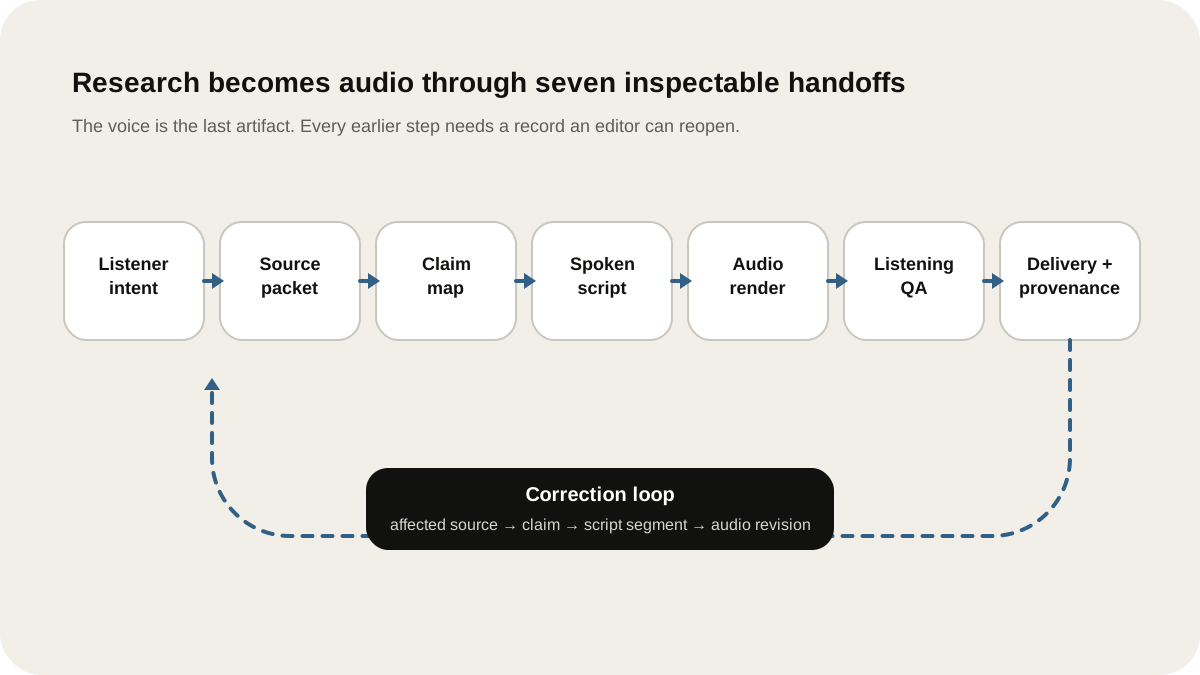
A seven-step pipeline moves from listener intent to a source packet, claim map, spoken script, audio render, listening quality assurance, and delivery with provenance. A correction loop connects delivery back to the source packet.
Seven inspectable handoffs connect a listener’s question to the released audio and its later corrections.

Editorial synthesis: Lissin, drawing on retrieval-augmented generation, the NIST AI Risk Management Framework, C2PA specifications, and Tacotron 2.

Start with intent, not a profile

Personalization works best when it begins with what the listener asked for. A useful request says what the topic is, what angle matters, how deep the answer should go, and how fresh the information needs to be. “Give me the latest on battery recycling” leaves more open than “Give me a ten-minute, beginner-friendly briefing on policy changes in the European Union, using official sources and marking anything that is still proposed.”

The second request gives the system an editorial contract. It sets a scope, an audience, a time boundary, and a preference for evidence. Those details shape the result without changing the underlying facts for one person.

A system can adapt length, vocabulary, examples, pacing, and delivery time. It should not bend the evidence toward a more pleasing conclusion. A listener who prefers a confident voice still needs to hear when sources disagree. A quick summary still needs the date and scope of a claim that could change.

Intent should carry boundaries too. A request may include a private document or a subject that needs care. Collect only what the task needs, explain how supplied material will be used, and do not treat a long-term behavioral profile as a substitute for a clear request. See personalized news without the echo chamber for the same tradeoff in news products.

Retrieve material before writing

The research stage builds a candidate source set. It may include official announcements, papers, public datasets, court decisions, company filings, interviews, or reporting. The important design choice is to retrieve evidence first and ask the language model to work from that evidence, rather than asking it to recall a topic from its parameters alone.

The 2020 paper “Retrieval-Augmented Generation for Knowledge-Intensive NLP Tasks” describes this pattern: a retriever supplies relevant passages to a generator for knowledge-heavy tasks. The broader lesson is that writing should have a bounded, inspectable research packet behind it.

Each source needs more than a title. Record its URL or identifier, publisher, date, retrieval time, and relevant passage. Keep a snapshot or hash where rights allow it. A search-result snippet is a lead, not evidence. A secondary summary can locate a document, but the final claim should point to the original when one exists.

Retrieval needs a stopping rule. Stop when the packet covers the scope, includes the strongest available primary material, and represents relevant disagreement. If a topic is moving quickly, label the result “as of” a date and time. Freshness is part of the answer, not a hidden implementation detail.

Evaluate sources as an editor would

Finding a document does not make it a good source. A source check asks who published it, what they directly know, how close they are to the event or data, when it was written, and whether it supports the exact statement under consideration.

For a product launch, start with the company’s release and check an independent record. For science, read the paper’s methods and limitations instead of repeating a press release. For policy, distinguish a current rule from a proposal or older law.

The pipeline should preserve those distinctions in its notes. “The report says X” is different from “X is true.” “The authors found an association” is different from “the intervention caused an outcome.” When two credible sources disagree, the script can describe the disagreement and its reason. It should not blend both into a tidy sentence that neither source supports.

NIST’s AI Risk Management Framework treats risk management as work spanning design, development, deployment, and use. Source quality and uncertainty cannot live in a one-time prompt; they belong in the workflow, review record, and listener experience.

Build a traceable synthesis

Before drafting the spoken script, turn the research packet into a claim map. Every important claim should have one or more supporting passages, a source date, and a status such as supported, contested, inferred, or unresolved. The map can also flag claims that need a qualification, such as “in the study sample,” “according to the company,” or “the proposal would.”

The model can arrange the material, group related facts, remove repetition, and choose a sequence for the listener’s goal. It should not fill gaps with plausible-sounding detail. If the claim map has no support, remove the detail, mark it unknown, or retrieve more evidence.

Traceability makes review practical. An editor can click from a sentence to its supporting passage, and a later correction can find every affected sentence. A listener can see which parts are reported facts and which are synthesis. Citation need not interrupt speech, but the source trail should sit beside the audio in the episode notes. See how to verify an AI-generated news summary for a source-first check.

Write for the ear

An audio script is not a web page read aloud. Listeners cannot scan back to a heading or see a chart while walking. The script needs clear signposts, short enough sentences, and enough repetition for names, dates, and numbers to land on a first listen.

Good writing for the ear introduces a technical term, says who made a claim, and gives the listener a reason to care about the next section. It turns “2026” into “twenty twenty-six” when useful, spells out acronyms, and avoids paragraphs that depend on a visual table.

Personalization can change the route. A beginner may need background first; an expert may want the new finding and a short reminder. The underlying claim map should remain stable.

The script should preserve attribution. “The regulator’s notice says…” is more honest than presenting a disputed forecast as narration’s own fact. If a point is an interpretation, name the interpreter or call it an inference. A warm voice cannot stand in for a source.

Turn the script into speech

Speech synthesis converts the approved text into audio. Research such as Tacotron 2 helped establish how neural systems can generate speech from text, but the model is only one component of an audio product. Voice quality depends on the script, pronunciation choices, segmentation, timing, and the final encode.

A recommended handoff keeps text and audio linked. Render segments with stable IDs, retain the script revision used for each, and keep a pronunciation list for names, places, units, and abbreviations. If someone finds a mistake, the team should know which text produced the sound and which file needs replacement.

Voice selection is also a rights and disclosure question. A system should use voices with permission, avoid impersonation, and tell listeners when narration is synthetic if that affects their understanding. Style can be calm, energetic, or conversational; it should not disguise missing evidence.

Make QA a listening test

Quality assurance has two sides. Automated checks can confirm source references, working links, required sections, time window, and expected audio format. An alignment or transcription pass can catch dropped words, repetitions, and numbers spoken incorrectly. Audio checks can flag clipping, silence, abrupt joins, and inconsistent loudness.

Human listening catches what a checklist misses. Does a proper name sound right? Does the caveat arrive before a wrong conclusion? Does the transition clarify the story? Is the pace comfortable for the intended setting? Does the ending stop at a useful takeaway rather than stretch for a sign-off?

High-stakes subjects need a factual spot-check after rendering. The reviewer should listen to the audio, open the cited source, and confirm that the wording matches the evidence. A script can pass text review and fail in speech if a negation disappears or a decimal is read ambiguously. This is a recommended pattern, not a claim that every Lissin show receives human review.

Deliver the show with its provenance

Delivery is part of the editorial contract. Alongside the audio, a listener should find its title, scope, “as of” date, sources, editorial summary, and revision status. That gives people a route to inspect a claim without requiring the underlying script to be public. Treat these as recommendations unless a public Lissin page confirms a particular surface.

The C2PA specifications offer a useful model for recording the source and history of digital media. A research-to-audio system may use a different implementation, but the principle is the same: retain a verifiable trail from source packet to script revision to audio asset. Provenance does not prove that a claim is true. It tells people what process and materials produced the file.

The delivery layer should respect access and rights. A supplied document may be usable privately but not for public redistribution. Source terms, retention limits, permissions, and sharing controls belong in product design, not a last-minute legal note.

Corrections are part of the show

Research changes. A source may correct a number, a court may issue a new ruling, or an editor may discover that a sentence went beyond its evidence. A responsible system treats correction as a normal release path.

Identify the affected source, claims, script segments, and audio segments. Publish a new revision with a note about what changed and why. Future listeners should receive the corrected version, while people who heard the earlier version need a way to learn about a material error. Preserve enough history to explain the change while following retention and rights requirements. Read how source links and corrections build trust in AI-generated audio for more on this principle.

Corrections should stay separate from personalization. Changing length or voice creates a new presentation of the same evidence; it should not rewrite the evidence. A listener should tell whether an update reflects a preference or a new fact.

The finished voice is the last release artifact, not the end of the editorial work. Keep the source packet, claim map, script revision, audio revision, and correction record connected so an editor can trace and fix a disputed sentence later.

Where Lissin fits

Lissin is the product example in this guide. You choose a question, topic, perspective, mood, or source, then decide how the show should sound and when it should arrive. Lissin handles the research, structure, script, voice, and delivery. The stages above describe the editorial standard we think a research-to-audio product should meet. Lissin’s private architecture remains outside the scope.

Explore audio on Lissin and hear the kinds of personal shows it can create.

Sources