
How to verify an AI-generated news summary
Choose one important claim, open its source, and record what the evidence supports before you share it.
An AI-generated news summary is a shortcut through reporting; its reliability comes from the evidence behind it. A polished paragraph can move a date, turn a proposal into a decision, or assign a real person words they never said. For a listener, the useful question is whether important claims have a trail to named, checkable sources.
You do not need to fact-check every adjective. Inspect the claims that could change what someone believes or does, whether they appear in a chatbot answer, search-page overview, email briefing, or audio digest.
For a quick first check, choose the most consequential claim, open its original source, and compare the wording and date. If the source does not support it, keep the claim marked unverified rather than asking another chatbot to agree. Expand the check to quotations, numbers, and causal claims before you repeat or act on them.
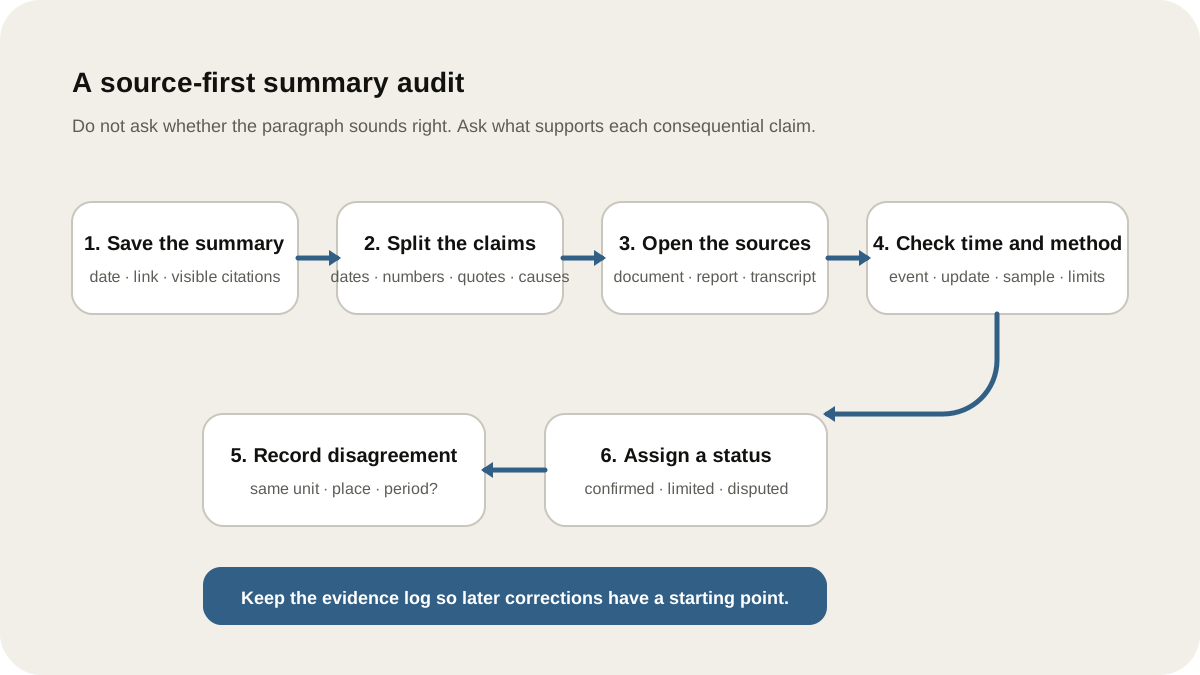
Editorial synthesis: Lissin, based on the NIST Generative AI Profile, AP reporting standards, and AP verification guidance.
Begin with one clear question
Write down what the summary is supposed to answer: What happened? Why does it matter? What should people watch next? Those questions need different evidence. Add three boundaries before searching:
- Time: Is this about the last hour, the last week, or a longer trend?
- Place: Which country, city, market, or community is affected?
- Stakes: Is the listener looking for background, a decision, or urgent safety information?
The boundaries tell you which source belongs in the audit. A local emergency office may be best for an evacuation order; a research paper may explain a mechanism while saying nothing about what changed this morning.
Build a small source set
Start with the record closest to the claim: a court order, filing, election return, official alert, research paper, transcript, meeting record, or first-hand interview. Then add independent reporting or specialist context that tests what the record means in practice.
Primary does not mean neutral. A company release is primary evidence of what the company announced, not independent proof that its plan will work. An agency statement records the agency’s position, which may leave out a disputed detail. Use primary sources to establish what was said or recorded, and independent sources to test the meaning of that evidence.
For every source, keep a short card with its URL, publisher, title, author, source type, and exact claim. Add event, publication, update, and access times; geography; method or underlying document; incentives; and correction or version notes. The card should explain why the source belongs without hiding that decision inside a model’s ranking.
Check who is close to the story. A local or affected source can reveal names, services, timelines, laws, and consequences that distant coverage misses. Each account earns a different kind of weight: a resident can describe impact without establishing the total number affected, while an official order can establish an instruction without proving that it worked. For international stories, open local reporting in the original language where possible. Machine translation can help you find material; it should not be the final check for a consequential quote.
Source count can mislead. Five outlets repeating the same wire copy are one reporting chain; trace the key claim to its first document, interview, dataset, or on-the-ground report. A source that names its author, method, and correction path is easier to audit than one that silently changes a paragraph.
Pull the summary apart
Save the summary with its date, time, link, and visible source list. Number each sentence and split it into checkable claims. Mark every person, organization, place, event, date, number, quote, prediction, and statement about cause or motive.
Do not let a paragraph count as one claim. “The agency approved the plan after protests, which will cut costs by 20 percent” contains at least three claims: approval, the reason or sequence, and the projected savings. Each may have a different source and confidence level.
Use a small evidence log:
| Summary claim | Source and date | What the source supports | Status |
|---|---|---|---|
| The agency approved the plan | Agency decision page, 14 May | Records a vote to approve; no cost estimate | Confirmed, limited |
| Protests caused the change | Local report, 15 May | Officials said protests influenced timing | Attributed, causation unclear |
| Costs will fall by 20 percent | No source found | No support yet | Unverified |
Copy the relevant sentence or paragraph with its page title and publication or update time. This shows whether the source supports the whole claim or only a nearby detail.
The agency example above is hypothetical. For your own check, copy this compact record into a note:
Claim I am checking:
Original source and date:
What it actually supports:
Status and what still needs checking:
Date I checked:
Start with one completed record. Add detail when the source, timing, or disagreement requires it rather than turning a routine check into an empty form-filling exercise.
Check the clock and the method
“Published” is only one date. Record when the event happened, when the source observed or measured it, when the page was published, when it was last updated, and whether the information is preliminary, revised, or final.
An article updated on Friday may still describe what was known on Wednesday. A live page may replace an earlier statement without preserving its wording. If a summary says “has ended,” “is now legal,” or “the latest figures show,” find the release date and the period the figures cover.
When dates conflict, write the timeline instead of averaging them: announced on 3 June, approved on 10 June, effective on 1 July. “Approved” and “in force” are different claims. For a developing story, a dated change log is often more useful than another paragraph of background. This guide to following a fast-moving story explains how to keep the baseline and the new development separate.
Test expertise by method, not title. Ask whether the author had direct access, how data was collected, which definitions and limitations are visible, and whether the item is original research, a review, a preprint, a press release, or an opinion column. A credential can help, but it does not replace a method. A local reporter with documents and named witnesses may know more about a city decision than a national commentator.
Verify every quotation
Find the transcript, video, hearing record, speech, interview, or document. Confirm the speaker, exact wording, date, setting, and whether the words came before or after the event being summarized.
Watch for a paraphrase placed in quotation marks, a shortened quote that loses a qualification, or a sentence from a written report presented as something a person said aloud. The Associated Press’s standards call for reports, emails, and news releases to be identified when they are the source of a quote. If you cannot locate the words in a reliable record, remove the quotation marks and mark the claim unverified. A quote requires words you can locate in context.
Make disagreement visible
When sources disagree, rewrite the disagreement in matching terms. Are they describing the same place, time, population, definition, and unit? “Casualties” might mean confirmed deaths in one report and deaths plus injuries in another. “Inflation fell” might mean the annual rate fell while prices still rose that month.
Rank evidence by fit, not by confidence of tone. A primary record may settle what an institution voted on, while an independent report may be better for what happened on the ground. An expert can explain a technical result, but a comment does not replace the dataset. Check corrections and later updates, and locate the precise point of disagreement.
Consider incentives while keeping useful evidence in view. A manufacturer may be the only source for its product’s specifications; a campaign may be the only source for its own memo. Name the interest and add a source with a different incentive when the claim matters. Watch for anonymous assertions with no explanation of access, undisclosed sponsorship, or a headline stronger than the document.
Your conclusion can be confirmed, supported but limited, disputed, outdated, or unclear. “Disputed” is a valid result. Include the disagreement when it changes the listener’s understanding. If the conflict affects safety, elections, health, money, or someone’s reputation, wait for stronger evidence or consult a qualified human source before sharing.
Find the synthesis no source makes
Many summary errors are plausible connections rather than invented names. Inspect sentences containing “because,” “therefore,” “led to,” “in response,” “showing,” or “to avoid.” Those words may introduce a causal or motive claim that no source establishes.
Compare these two sentences:
The minister announced the measure on Tuesday.
The minister announced the measure to calm investors.
The first is a date-and-action claim. The second adds motive and needs direct evidence. The same problem appears when a summary joins facts from different years, turns a forecast into an outcome, converts “may” into “will,” or describes a study as proving a result when the paper reports only an association.
Ask of every sentence: Which source supports this exact meaning? If the answer is “several sources, taken together,” mark it as synthesis and test the connection yourself. If the answer is “the model inferred it,” do not present it as reported fact. Preserve the source’s uncertainty: “the report estimates,” “officials dispute,” and “researchers found an association” are not interchangeable with “it proves.”
Use AI to organize the audit
A model can extract claims or turn notes into a checklist. Give it the summary and ask:
Extract each factual claim, named entity, date, number, quote, causal statement, and uncertainty marker. Do not verify anything or add facts. Return one claim per line.
Then check the lines yourself. A second chatbot’s agreement does not create an independent source. Search tools can return irrelevant material, so snippets still need human review. This overview of turning research into a personalized audio show explains choosing the question, sources, and presentation for a personal show.
Keep a correction path
The audit continues after publication. Look for visible correction or update notes, stable links to source documents, named authors or editors, and a way to report an error. If a source changes a number, headline, or conclusion, record the old and new versions, the time, and whether the summary needs an update.
For audio, use any available source links and check what changed. Source links and corrections in AI-generated audio covers that trust problem in more detail.
Before you forward or play a summary, ask:
- Can I name the source for every important claim?
- Did I open the source instead of trusting a snippet or citation label?
- Do the event, publication, update, and access times line up?
- Are the quotes exact, attributed, and in context?
- Did the summary add a cause, motive, conclusion, or certainty that the sources do not support?
- Did I record a real conflict instead of choosing the most confident sentence?
- Is each item marked as confirmed, limited, disputed, outdated, or unclear?
If any answer is no, label the summary “needs checking.” Keep the original text, your evidence log, and the date of your check. When the story changes, reopen that record instead of rebuilding the audit from memory.
Apply the same check to generated audio
A Lissin episode or another AI-generated show can introduce a subject and help you find questions to investigate. Its fluent narration does not establish the evidence for a claim. Use any available source information to locate the underlying record, and keep your own note for claims you intend to repeat.
If you cannot find support, keep the claim marked unclear. Open the original source, record what you checked, and decide whether the claim is ready to share.
Sources
- Artificial Intelligence Risk Management Framework: Generative Artificial Intelligence Profile, National Institute of Standards and Technology.
- Telling the Story, The Associated Press.
- Verification at AP, The Associated Press.
- SPJ Code of Ethics, Society of Professional Journalists.