How source links and corrections build trust in AI-generated audio
A smooth voice is not evidence. Trust starts with a source trail, a correction path, and an honest record of what changed.
Audio is built for divided attention. You listen while walking, cooking, commuting, or staring out of a train window. That convenience creates a trust problem: once the words leave the screen, the evidence can disappear with them.
The episode page should keep the evidence within reach before, during, and after playback. Show where the material came from, when it was published and checked, who owns the editorial decision, how the voice was made, and what changed later. None of that requires publishing a private source, hidden prompt, or material that the rights holder never agreed to share.
When a listener asks why a sentence made it into an episode, can they inspect the source and revision history without reverse-engineering the model?
Editorial synthesis: Lissin, based on AP correction standards, NPR’s public corrections record, Partnership on AI’s synthetic media practices, and C2PA specifications.
Source links should work at listening speed
“Sources available on request” is a weak contract for a medium people consume while moving. A listener may not remember a URL or know which claim a link supports. Source visibility has to fit the way audio is used.
A source panel needs five fields:
- name the source and publisher or author;
- show the publication date, and the last-updated date when the publisher provides one;
- link to the canonical page or document when it is public;
- label the source’s role, such as primary document, interview, dataset, official announcement, or background reporting; and
- explain, in a short phrase, what the source supports.
A list of twelve links can look rigorous while only one supports the episode’s central claim. Label each source with the claim it supports: “Source 1 supports the timeline,” “Source 2 supplies the quoted figure,” and “Source 3 provides context.” If a source is a press release, say so. If an article summarizes a study rather than containing the study itself, link to both when possible.
Audio does not need to read every URL aloud. It can say, “The sources and notes are in the episode details,” then make that promise true in the player and share page. Time markers can point listeners from an important claim to the relevant source panel entry. They should not have to reconstruct the research process from a sequence of confident sentences. For a practical verification workflow, see how to verify an AI-generated news summary.
Source links need maintenance too. Keep the original title, publisher, publication date, URL, and access date in the episode record; if a source disappears, preserve enough detail to find an archived copy. Do not silently swap a source because the replacement makes the episode easier to defend.
When a source is private, show a bounded status such as “private source, available to the owner” and explain its role without exposing the material. Source visibility should make the editorial choice inspectable, not turn a private note, connector, or document into public content.
Corrections should reach the audio
Audio creates a correction problem that text editors know well: a published mistake remains in copies people downloaded, queued, or shared. Quietly changing a web label while leaving the audio unchanged creates two versions of the story.
A correction workflow should begin with a report path that a listener can find from the episode. It should distinguish a spelling fix, factual error, clarification, and material change, then tell the team how far the correction travels.
For a material factual error, a useful sequence is:
- verify the report against the source or a better primary source;
- update the episode’s source panel and notes;
- add a time marker and a visible correction notice describing what was wrong;
- render and publish a new audio version; and
- preserve the prior version in an internal history so the team can explain what happened.
The Associated Press’ story standards offer a useful precedent: corrections should be visible to news consumers, not only sent to internal editors. NPR’s corrections page shows the same principle across audio archives and online records. A correction that exists only in a database is not a listener-facing correction.
The notice should be concrete. “This episode has been updated” tells a listener almost nothing. “At 04:12, the episode said the report was published in 2023. It was published in 2024. The audio and notes were updated on 18 August 2026” lets the listener decide whether to replay the segment. If the error could change a conclusion, say that too.
Do not erase the evidence of the mistake simply because the corrected episode sounds cleaner. A concise revision history gives listeners a way to understand the change and gives editors a way to spot recurring failures, such as a source-parsing issue, a date-normalization bug, or a pronunciation error.
Disclose the voice and name the editorial owner
Listeners can often tell that a voice is synthetic, but a voice that sounds real still needs a disclosure policy. The player should identify the narration as generated or synthetic in plain language, near the play control and in the episode notes. The share preview should repeat the label so it survives outside the original player.
The label should answer the question the listener actually has: Is this a synthetic narrator, a licensed clone, a transformed voice-actor performance, or an edited recording of a real person? Those are different production choices with different expectations. If a recognizable person’s voice is used, document permission and the scope of that permission before publication. Do not imply that a real person said words they never approved.
Voice disclosure should also cover pronunciation and performance limits. A generated voice can misread a name, flatten a quotation, or introduce an emphatic pause that changes how a sentence feels. Keep proper nouns and quotations in the review pass. Label any reenactment or synthetic reading instead of letting a confident delivery create false intimacy.
The Partnership on AI’s Responsible Practices for Synthetic Media distinguishes direct, listener-facing disclosure from indirect disclosure such as provenance or metadata. Audio needs both layers: tell the listener what they are hearing, and retain production information for editors, distributors, and later verification.
“An AI made this” describes a production step. It does not identify who is responsible for publishing the result. The episode should name the responsible person, newsroom, or organization, include a review date, and provide a way to report an error. The disclosure does not need to imply that one editor checked every syllable. It should make the accountability chain visible: who selected the sources, who approved the angle, who checked the claims, and who can correct the result.
Review boundaries need plain language. A person may check source coverage without checking every underlying document, while a producer may approve the voice mix without approving factual claims. Say which review happened. “Reviewed for source coverage and factual errors” is meaningful. “Human verified” without a scope is not. Lissin’s research-to-personalized-audio workflow is a natural place to explain that division of labor without turning a single episode into a sales claim.
Provenance records history, not truth
Provenance metadata can help, but it records history; it cannot certify truth. The C2PA specifications describe a way to record the source and history of media, including audio. A Content Credential can show whether provenance information is valid and untampered; it does not decide whether the underlying claim is true. A signed file with a false editorial conclusion is still a false episode. Source links and human verification do work that a badge cannot.
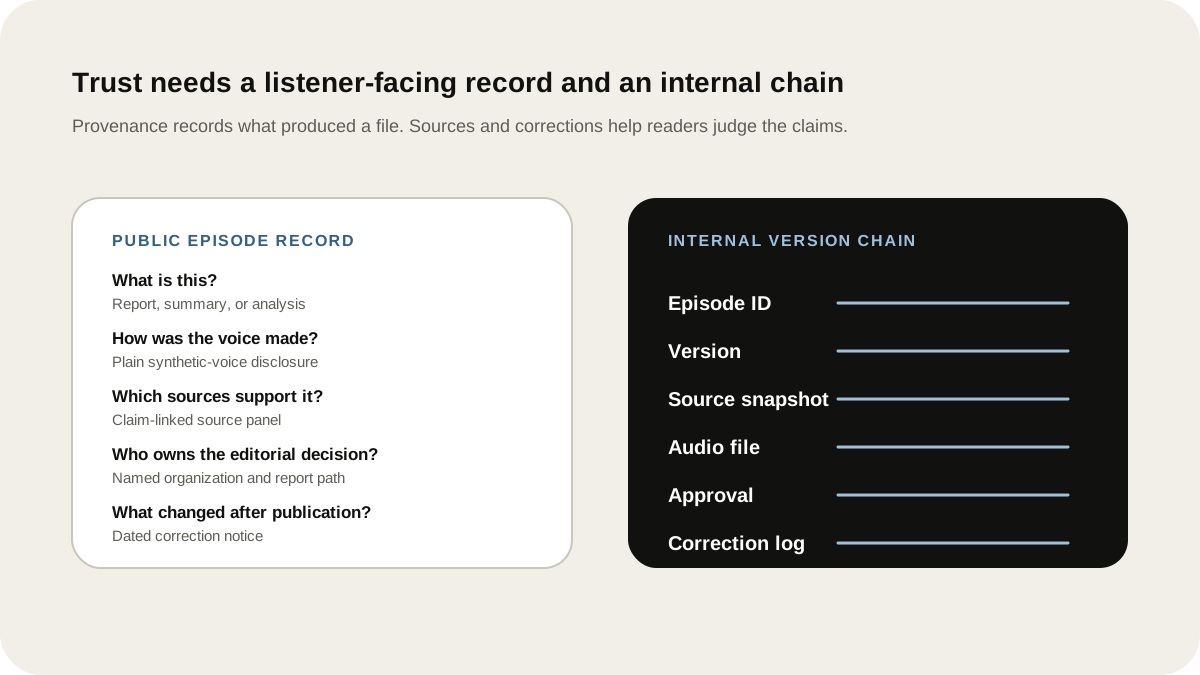
The production record should connect the pieces that matter: episode ID, version, source snapshot, audio revision, voice and model used, approval, and correction log. Hashes, signed manifests, or C2PA credentials can strengthen that chain when files move through multiple tools. They should support an understandable human record, not replace it. A listener should not need a developer console to learn that an episode changed.
Provenance also has a privacy boundary. A briefing may use a private document, note, or connector that contains more information than the episode needs. Public metadata should expose the minimum necessary for inspection. Do not publish raw prompts, private titles, email addresses, account identifiers, filenames, unredacted source material, or internal URLs merely because an AI system saw them. If a source is unavailable, say why and mark the limit. “Private source; not publicly linked” is more honest than a broken link or vague confidence score.
Versioning makes accountability visible
An episode should have a version, even if the audience never sees a software-style number. Record the publication timestamp, source set, audio revision, voice and model used, and the person or process that approved it. Give the public a simple “Published” or “Updated” date, plus a correction history when something material changes.
That record prevents a common failure: an editor changes the source notes, a worker re-renders audio from a different source set, and nobody can say what produced the file now in circulation. A compact episode manifest can bind the pieces together:
episode ID → version → source snapshot → audio file → approval → correction log
Versioning also protects the listener from silent drift. If a source is updated, a model changes its output, or a voice provider changes pronunciation, treat the new episode as a new revision. Keep the revision reason short and specific. “Updated for source correction” is better than “quality improvements” when a fact changed.
Personalized briefings make the version record especially important. A source list assembled for one listener may differ from the next listener’s list, and a later refresh may change the order or emphasis. The personalized-news-without-echo-chamber guide explains the editorial risk; the episode’s source panel and version history should show what happened in this particular case.
Four questions every episode should answer
A warm voice should not carry the burden of proof. Every episode should give the listener four answers:
- What is this: a report, summary, analysis, fiction, or experiment?
- Who made it, and what part did AI play?
- What sources support the important claims?
- What has changed since publication?
If the production team cannot answer one of those questions, the honest response is to mark the gap. A source may be private. A story may still be developing. A voice may be synthetic but not yet covered by durable provenance. Explain the limit instead of filling it with a generic “AI-generated” badge.
Where Lissin fits
Lissin separates the listener's request from the work needed to turn it into audio: research, structure, script, voice, and delivery. That workflow gives each episode a clear route back to the chosen topic or source and a defined editorial output instead of an anonymous clip in a feed.
The standard described here goes further. Public episode pages should keep source roles, voice disclosure, ownership, and material corrections close to the player. Those are editorial requirements for trustworthy audio, not a claim that every current Lissin episode exposes every field in the diagram. Explore audio on Lissin and use the source trail for any claim that could change a decision.
Sources
- Associated Press, “AP updates newsroom standards for artificial intelligence”
- Associated Press, “Standards around generative AI”
- Associated Press, “Telling the Story”
- BBC Editorial Guidelines, Section 3: Accuracy
- NPR Corrections
- Society of Professional Journalists, Code of Ethics
- The Trust Project, Trust Indicators
- Partnership on AI, Responsible Practices for Synthetic Media
- Coalition for Content Provenance and Authenticity, Specifications