
Personalized news without the echo chamber
A useful briefing remembers what matters to you without quietly deciding what you no longer need to see.
Imagine Sarah setting up a ten-minute morning briefing. She follows Bengaluru transport, Indian climate policy, and two technology companies. Remembering those choices is useful. Quietly deciding that she no longer needs national politics because she skipped three election stories is not.
Personalization should save Sarah time without making important reporting disappear. A useful briefing shows what shaped it, where the reporting came from, and how to widen the coverage when the subject matters.
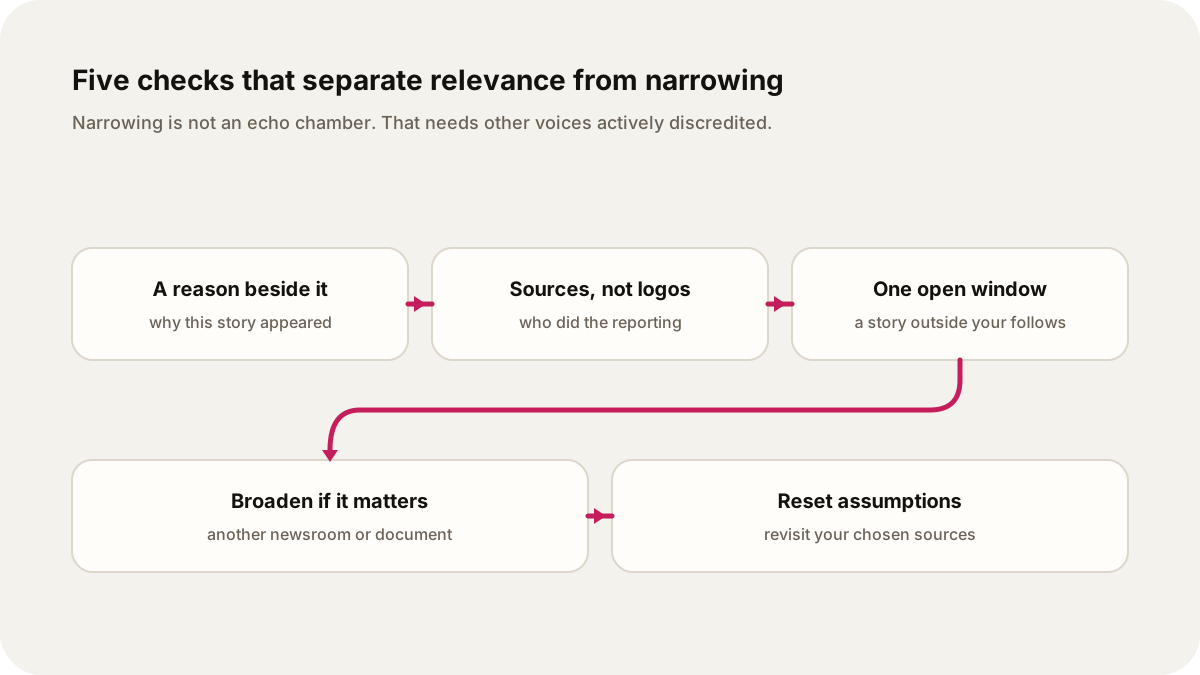
Original illustration: Lissin Editorial.
A quick test: relevance or narrowing?
Useful personalization responds to a choice you can see and change. It remembers a topic, place, language, duration, delivery time, or preferred format. Viewpoint narrowing is an outcome: fewer independent sources, fewer important topics, or less credible disagreement reaches you.
An echo chamber is a stronger claim. Philosopher C. Thi Nguyen distinguishes an information bubble, where outside voices are absent, from an echo chamber, where those voices are actively discredited. A short personal briefing can be narrow without becoming an echo chamber. That distinction matters because the remedy for a missing local story is different from the remedy for a community that teaches members to distrust every outside source. Nguyen explains the distinction in Episteme.
Before trusting a personalized briefing, ask four plain questions:
- Did I choose the topics and timing, or did the system infer them from a few clicks?
- Can I see why each story appeared?
- Does the edition still include a major story outside my usual interests?
- Can I broaden or reset the result without creating a new account?
Visible answers keep the listener in control. Without them, convenience and narrowing look the same.
What the research measures
Personalization does not have one uniform effect across platforms. These studies distinguish what a system offers, what users choose, and how much independent reporting reaches them:
| Study | Setting | What changed | What the result does not prove |
|---|---|---|---|
| Bakshy, Messing, and Adamic | Observed 10.1 million US Facebook users | Users' choices limited cross-cutting exposure more than ranking did in that setting | That ranking had no effect, or that the result transfers to every platform |
| Flaxman, Goel, and Rao | Browsing histories from 50,000 US news users | Search and social use were linked to both greater ideological distance and more exposure to the less-preferred side | A single direction of effect for online news discovery |
| Bryanov and colleagues | Randomized 12-day news-portal experiment | More congruent stories increased impressions; mainstream clicks fell as opportunities fell | A universal effect on beliefs or long-term behavior |
| Nechushtai and Lewis | Real-world Google News audit | Politically different users often received similar recommendations; links were concentrated among a few publishers | That similar feeds guarantee broad source diversity |
| PNAS Nexus YouTube study | Intervention adding verified news from across the political spectrum | News exposure rose and ideological congeniality fell | A detectable change in the tested attitudes during the study period |
The YouTube intervention changed recommendations and viewing without a detectable change in the tested attitudes and beliefs during the study. More varied exposure does not by itself demonstrate persuasion or trust.
If an AI turns a personalized stream into a summary, there is one more layer to inspect. Our guide to verifying an AI-generated news summary explains how to move from a spoken claim back to the underlying reporting.
Five checks for your daily briefing
1. Look for a reason beside the story
“You follow renewable energy” tells you something. “Recommended for you” does not. A useful reason names the chosen topic, location, source, or schedule that caused the story to appear. It should not pretend to know your politics from a skip or a pause.
2. Count reporting sources, not logos
Three publications may repeat the same wire report, company statement, or government release. Open the source notes and check who did the original reporting. A briefing with fewer stories from genuinely independent newsrooms can offer more range than a long list of duplicated headlines.
For a fictional example, a local paper publishes an interview, a national site quotes that interview, and a newsletter summarizes the national article. That is three logos but one interview. A second reporter checking a public record may add more evidence than a fourth retelling.
Record the distinction in a short note:
Story:
Who did the original reporting:
What a second source independently added:
Whose relevant evidence or experience is still missing:
3. Keep one window outside your follows
A personalized edition should leave room for a major local, national, or international development you did not request. Significance and evidence should determine that slot; it should never force equal time for a false claim. The extra window prevents yesterday's interests from deciding everything you can see today.
4. Use “broaden” on consequential stories
When a report could change how you vote, spend, work, or stay safe, find another newsroom, a primary document, or reporting from the affected place. Start with a factual question such as “What changed in the housing rule?” instead of asking for an abstract opposing side. Different sources may agree on the facts while adding different context.
5. Reset stale assumptions
Interests change. A news service should let you edit followed topics, pause history, or reset recommendations. If it cannot show what it has learned or let you correct it, treat the briefing as one limited view rather than a map of the day.
Where Lissin fits
Lissin lets you start a personal audio show from a topic, question, perspective, mood, or source, then choose how it sounds and when it arrives. Those choices let you state which sources and questions you want the show to address.
Name the sources you want the episode to use. If the story has consequences, open another newsroom’s account or the original document. The checks above are questions you can apply to a briefing; they are not extra controls hidden in the app.
Try making a show that includes credible disagreement, then check how the episode handles it. A request for balance does not guarantee balanced coverage. You can also listen to existing audio. For factual checks, see source links and corrections; for repeated coverage, see staying current with less repetition.
Sources
- C. Thi Nguyen, “Echo Chambers and Epistemic Bubbles,” Episteme (2020). DOI
- Eytan Bakshy, Solomon Messing, and Lada A. Adamic, “Exposure to ideologically diverse news and opinion on Facebook,” Science (2015). DOI
- Seth Flaxman, Sharad Goel, and Justin M. Rao, “Filter Bubbles, Echo Chambers, and Online News Consumption,” Public Opinion Quarterly (2016). DOI
- Kirill Bryanov, Brian K. Watson, Raymond J. Pingree, and Martina Santia, “Effects of Partisan Personalization in a News Portal Experiment,” Public Opinion Quarterly (2020). DOI
- Efrat Nechushtai and Seth C. Lewis, “What kind of news gatekeepers do we want machines to be? Filter bubbles, fragmentation, and the normative dimensions of algorithmic recommendations,” Computers in Human Behavior (2019). DOI
- “Nudging recommendation algorithms increases news consumption and diversity on YouTube,” PNAS Nexus (2024). DOI