The hidden cost of tapping “next show”: why a context reset is worse than a pause
Resume buttons restore playback position; nothing mainstream restores the comprehension a listener had built up, particularly the moment they move on to a different show entirely.
You listen to twenty minutes of a sixty-minute round-up on the way to work. Something comes up, you close the app, and the day fills in around it. That evening, or the next morning, you tap play again.
The app does its job. It resumes at minute twenty, to the second. What it cannot do is put back what you understood when you paused: which story was still developing, which name had just been introduced, which claim you were waiting to hear more about. You are standing at the right timestamp, holding none of the context that made that timestamp meaningful.
This is a different failure from losing your place. Losing your place is a bug; podcast apps have spent years and, going by their own support forums, more than one hard-won fix getting playback position right. Losing the thread is not a bug in the same sense. It is what happens by design whenever a show pauses long enough, or whenever a listener moves on to something else, and nothing in the product tries to rebuild what they knew.
Position and understanding are not the same problem
"Where did I leave off" is a single number: a timestamp, a percentage, a chapter marker. Apps have solved it well enough that most listeners take it for granted, cross-device sync included.
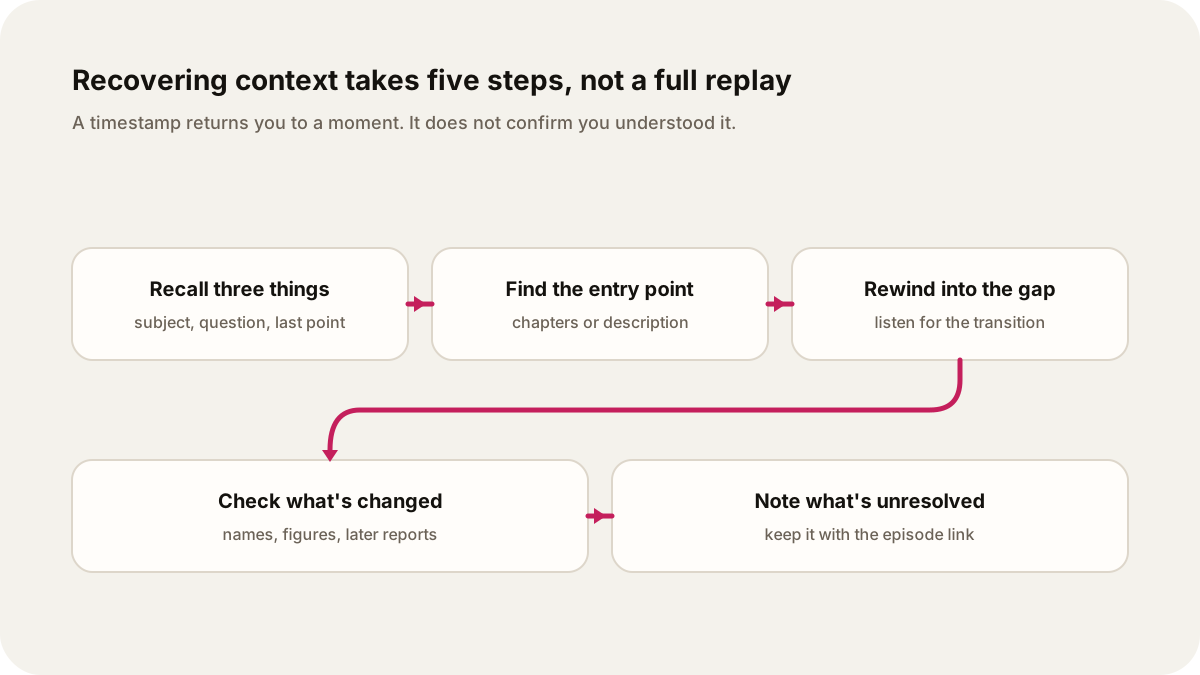
"What did I know when I left off" is not a number. For a long round-up-style show especially, it is a small working model: which segment you'd reached, which of the day's items had already been covered, which name or figure had just been introduced and hadn't yet been explained, which open question the host said they'd come back to. A show that gathers several stories into one longer episode, the kind built by research that turns a topic into a structured audio show, is exactly the format where this working model is largest and most perishable. Forty minutes of unheard content in a single-story episode is one thread to pick back up. Forty minutes of unheard content in a multi-item digest can be four or five threads, each with its own half-remembered setup.
A resume button restores the first kind of state. Nothing mainstream restores the second. That gap is the subject of this piece.
What the industry has actually shipped for this
It's worth being precise about what already exists, because real progress has been made on adjacent problems, just not the one described above.
Spotify announced AI-generated audiobook Recaps in beta on iOS in November 2025. Once a listener has heard 15 to 20 minutes of a title, a Recap button appears; tapping it produces a short summary of everything heard so far, similar to a "previously on" segment, and the summary updates as the listener progresses further into the book. Spotify has said the feature does not use audiobook content to train language models and does not generate or replace narration. Coverage at launch described it as aimed squarely at listeners returning to a book they'd abandoned weeks or months earlier.
Recaps is a genuine answer to "I lost the thread of this specific book." It is not an answer to anything beyond that one title. It works within a single piece of content a listener has already committed to returning to; it has no concept of a listener who instead moves on to a different book, show, or episode and never opens the abandoned one again.
Apple shipped something adjacent from the other direction. With iOS 26.2, Apple Podcasts added automatic chapters to English-language podcasts, generated automatically unless a creator supplies their own or opts out. Chapters make it easier to see an episode's structure and jump to a section, which helps a listener re-enter a long episode without scrubbing blindly through the timeline. But chapters are a map of one episode. They tell you where the segments are; they do not tell you what happened in the segments you already heard, and they have nothing to say about the episode that comes after.
Pocket Casts has offered Bookmarks for longer, as a paid feature that lets a listener manually mark a moment in an episode to return to later, synced across devices. It is useful and it is honest about what it is: a note you leave for yourself, not a summary generated for you. It requires the listener to have thought, in the moment, that this spot was worth marking. It says nothing about the material between bookmarks, and nothing at all about moving between shows.
Line these three up and the pattern is clear. Recaps rebuilds context, but only for the same title. Chapters aid navigation, but only inside one episode. Bookmarks preserves a moment, but only the moment you chose to flag, and only manually. None of them addresses what happens when a listener stops one piece of content and starts a different one.
The moment nothing is built for
Here is where I want to be careful about what I'm describing, because it isn't something I found stated in a company's release notes or a piece of reporting. It's a pattern I think is worth naming on its own: podcast and audio apps are built around a feed, and a feed's default behavior is to hand you the next thing. A round-up show ends, or a listener taps away from one partway through, and the interface offers the next episode in the queue with the same visual weight and the same one tap it would take to keep listening to the current one.
That tap is, functionally, a decision to abandon whatever context the previous show had built up, made with no more friction than skipping a song. There's no prompt asking whether the listener meant to finish the last one first, no summary of what they'd have missed by not finishing it, nothing that marks the switch as a switch at all. The interaction reads as continuous listening. What it actually is, most of the time, is one context ending and a new one starting silently, with the first one's unfinished material left to decay in a list of half-played episodes that will very likely never be reopened.
I don't think this is a flaw anyone shipped on purpose. It's closer to a byproduct of designing for a feed of independent items rather than for a listener's continuity across items. But it means the two things the industry has actually built, recapping a title and navigating an episode, sit on either side of the exact moment where context loss is most total and most silent.
A reasonable objection: maybe some friction is doing you a favor
It's worth taking the counter-case seriously rather than assuming more automatic context is obviously good. Writing about Spotify's Recaps specifically, a Tom's Guide opinion piece argued that some of the effort a format asks of you is the point, not a defect to engineer away: "Things feel better when you have to work for them." The piece's specific worry is that an AI summary flattens the texture a story built up in the listener's memory. If you have to reread or relisten to get back into something, you might notice the parts you'd have skipped past on a machine-generated recap, and that friction is part of why the material sticks.
There's a real version of this argument for news and information shows too. Forcing a listener to re-encounter the material they missed, rather than being told what they missed, can be the thing that makes a fact land rather than just pass through. Convenience and comprehension don't always point the same direction, and a product that removes every seam risks removing the moments where a listener actually engages rather than skims.
The distinction that keeps this from being a full argument against context-repair, though, is between choosing to relisten and being forced to relisten because the product gave you no other way back in. Recap, chapters, and bookmarks are all opt-in; nobody is forced to tap the Recap button. A listener who wants the slower, fuller reentry can still take it. The gap described above isn't about removing that option. It's about the much larger number of moments where no option exists at all, where the alternative to a machine-generated bridge isn't "relisten properly," it's "give up on the thread for good," which the long tail of unfinished episodes in most people's queues suggests is what actually happens.
The Spotify Community also has a long-running, multi-year thread of users reporting lost podcast progress — a report that opened in 2019 and was still drawing replies in 2023, about the literal timestamp resetting on pause. That thread is about the mechanical layer, not the comprehension layer this piece is about, but it's a useful reminder that even the "solved" problem of remembering where you stopped has taken years of chronic user complaints to mostly settle. The harder problem, rebuilding what a listener understood, hasn't had that multi-year public pressure yet, because most listeners don't have a name for it. It shows up as a vague sense of "I've lost track" rather than a bug report.
What a personalized show should promise, not what one already does
None of the above is a claim that a solution is simple, or that any product, Lissin included, currently tells a listener what changed since their last episode. It isn't, and it doesn't. What the pattern above supports is a short list of design standards worth holding any personalized, multi-day audio product to, stated as goals rather than as a feature list.
A listener returning to a show they've followed for more than a day should be told plainly what is new since they last checked in, in the show itself, rather than being left to guess or to relisten from the start to reconstruct it. This is close in spirit to the "since the last update" framing already useful for following a fast-moving story without rereading the whole background: the update should lead, and stable context should be available on request rather than repeated by default.
A product that lets a listener move on to a different show should treat that as a visible transition, not a silent one. What that should look like in an interface, whether it's a short marker, a distinct summary, or something else entirely, is a design question this piece isn't trying to settle. The standard is narrower: a listener shouldn't have to infer, after the fact, that they've left one context and entered another.
Playback position and comprehension state are different pieces of information and are worth treating as different pieces of information in a product's design, rather than assuming that solving the first one quietly covers the second.
These are standards to hold a design to, not a description of an existing interface. Lissin lets you choose a topic, question, mood, or source and decide when a personalized show should arrive, including shows built to run across several days. Whether and how its interface currently marks a return to an ongoing show, or the start of a new one, is a product detail outside the scope of this piece. Explore audio on Lissin to see the shows it can build today.
Sources
- Spotify Newsroom, "Bringing More Ways to Personalize Your Listening Experience: Audiobook Recaps Beta Test": official announcement of AI-generated audiobook Recaps, dated November 13, 2025, including the 15-to-20-minute threshold, iOS beta scope, and Spotify's statement on LLM training and narration.
- TechRadar, "Spotify will now use AI to recap your audiobooks for you – and I really need this for my Kindle": launch-day coverage confirming beta availability, activation method, and intended use case of re-engaging with an abandoned title.
- MacRumors, "iOS 26.2 Adds Three New Features to Podcasts App": reporting on Apple Podcasts' automatic chapters, creator opt-out, and episode-navigation scope.
- Pocket Casts, "Bookmarks": official support documentation describing Bookmarks as a manual, paid, cross-device feature for marking moments in an episode.
- Tom's Guide, "Spotify now uses AI to recap your audiobooks for you — here's why that makes me mad": opinion piece arguing that automated recaps remove desirable friction from reading and listening.
- Spotify Community, "Lost podcast progress": user-reported thread on lost playback position, opened in 2019 with replies continuing into 2023, cited as evidence of how long even the mechanical layer of this problem has persisted.