
Build a short audio guide from one museum object record
Give the listener the object, its documented history and the questions the record leaves open.
A museum object record contains more than a name and a date. It may give you a physical description, a maker or culture, an ownership history, a collection note, and a curator's interpretation. A short audio guide becomes trustworthy when it lets the listener hear which kind of statement they are hearing.
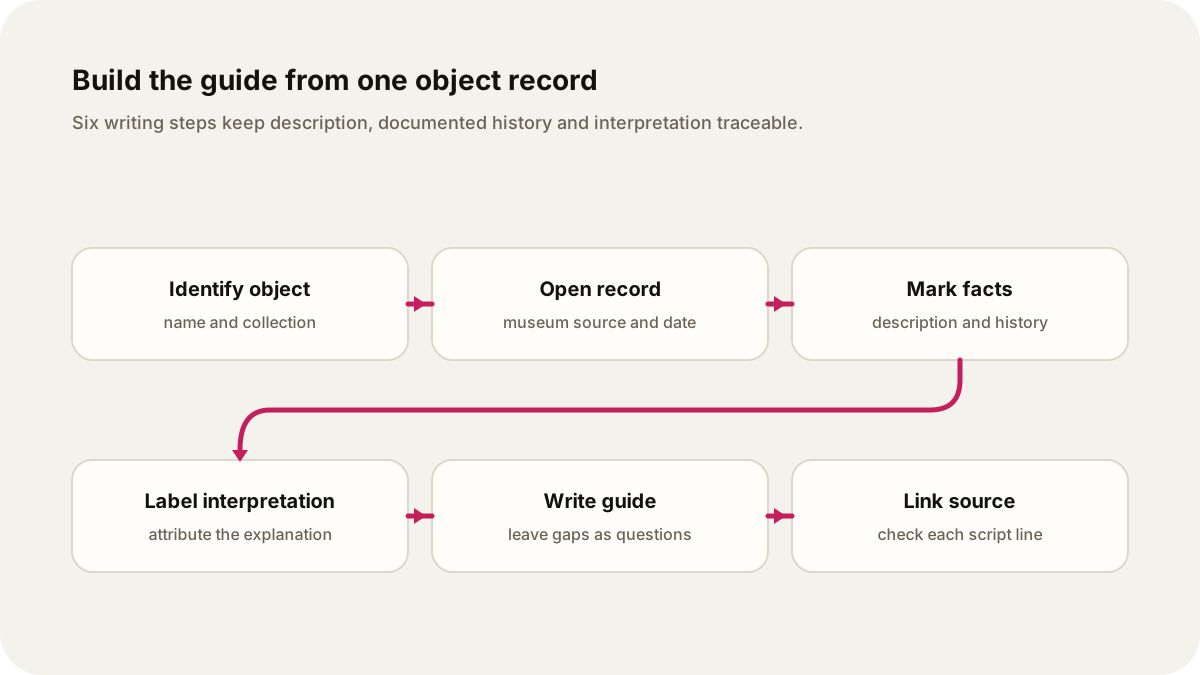
Start with one public collection record. Use its details to bound the story and attribute the museum's interpretations. A gap in the record can remain a question in the audio.
Read the record in three passes
First, collect what a listener could verify from the object or its catalogue entry. Shape, material, dimensions, inscriptions, condition, and visible marks belong here. A photograph can support a description of a broken edge or an engraved line, but it cannot establish every detail of the object's history.
Second, copy the record's documentation. This can include the date or period, place, maker, collection number, acquisition note, and provenance. Provenance means the history of ownership or custody. The Smithsonian's provenance guidance says that an object's ownership history is often incomplete and that research may leave gaps. An audio guide should keep those gaps visible rather than smooth them into a complete biography.
Third, identify interpretation. “This inscription is a decree” or “this object helped scholars read a script” is an explanation supported by curatorial or historical research. It is different from saying that the object has three visible bands of writing. Put the source beside the interpretive claim, and make clear whose reading it is.
Build a guide around one object
A useful three-minute script can use four movements, but the record should decide the order.
Name the object. Give the collection or museum, object name, and identifying number if the record supplies one. Tell the listener what source you are using and when you checked it.
Describe what is there. Start with details a listener can picture without a lecture. Mention material, shape, condition, visible writing, or a distinctive feature. Keep a physical description distinct from an explanation of what the feature means.
Trace the documented history. Read the known dates and transfers in order. If the record says that part of the history is unknown, say so. Do not turn a museum's current ownership into a complete account of how an object moved through the world.
Offer the interpretation. Explain what the museum says the object means, does, or helped researchers understand. Attribute that claim to the record or a named museum essay. End with a question that sends the listener back to the object: what can they see, and what must they learn from the record?
The sequence can be shorter for a simple object or longer when the provenance needs context. It should not become a generic biography of an entire culture when one record is the assignment.
The Rosetta Stone as a concrete example
The British Museum's object guide describes the Rosetta Stone as the surviving part of a stela, a larger stone slab. It dates the inscriptions to 196 BC. The museum's decipherment timeline identifies the three scripts as hieroglyphs, Demotic and Ancient Greek. They represent two languages: Egyptian and Greek.
Those are useful anchors for an audio guide because they mix observation and documentation in a way the script can label:
“This guide uses the British Museum's account of the Rosetta Stone. Part of the original slab is missing. The inscriptions, dated to 196 BC, record a decree in three scripts. Historians used the Greek text to help decipher the Egyptian writing. That history comes from the museum's explanation; the photograph alone cannot tell us how scholars worked it out.”
That paragraph is an illustrative script built from the linked sources. It does not claim that a listener or writer has inspected the stone in Room 4. It also does not imply that the record resolves every question about its movement or ownership. If you add a provenance sentence, use the museum's current collection record and keep its wording and uncertainty.
Keep the source trail inside the script plan
Make a small table before recording:
| Guide line | Evidence type | Source note |
|---|---|---|
| “The remaining piece is part of a larger stela.” | Catalogue description | British Museum object guide |
| “The surface carries an official decree.” | Curatorial interpretation | British Museum object guide |
| “The inscriptions date to 196 BC.” | Catalogue and historical description | British Museum object guide |
| “Ownership history has a gap.” | Provenance status | The current record, if stated |
Do not read the table aloud word for word. Keep it as an editing record so a listener can follow a link after hearing the episode. A second collection database can help you compare how different institutions structure their records. The Smithsonian Collections Search Center describes a large public search across museum objects, archives, library materials, and media. Its provenance database also makes clear that records can be updated as research finds new information.
For a source-to-audio workflow, see turning a PDF into a podcast. If the guide is generated, use how to verify an AI-generated news summary as a reminder to check dates, quotations, and claims against the source. Source links and corrections explains why the record should stay attached to the published audio.
Before recording, open the object record beside your script. For each sentence, point to its source or mark it as your question. If you cannot do either, leave it out until you have a source.
Sources
- British Museum, The Rosetta Stone: everything you ever wanted to know: object description, date, decree, and three writing systems.
- British Museum, How Egyptian hieroglyphs were decoded: the scripts and the role of Greek in decipherment.
- Smithsonian Institution, Provenance: definition of provenance, incomplete histories, and ongoing research.
- Smithsonian Collections Search Center: public collection-record search and record categories.
- Smithsonian Provenance, Covered Objects Database: current research status and updates to object records.