
What a 78 rpm record can tell you
A 78 rpm record can preserve a performance and its catalogue trail. Separate recording date, pressing, take, transfer, speed, and interpretation before turning one archive item into an audio guide.
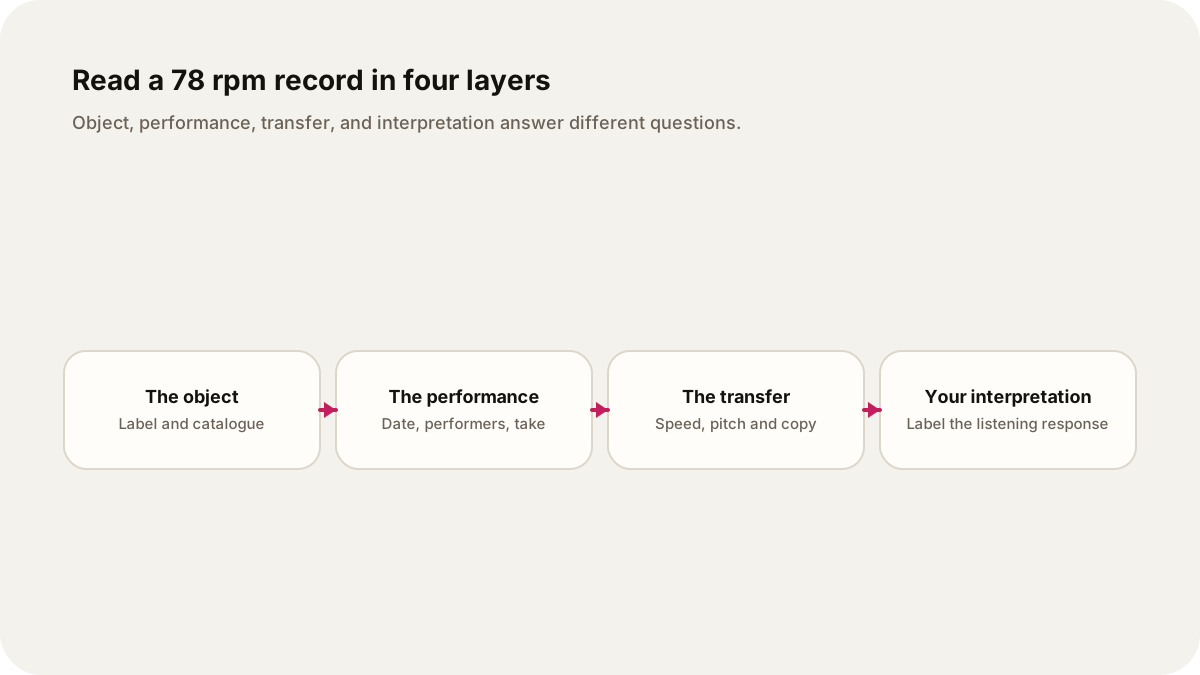
A 78 rpm record can give you a performance, a date, a label, and a trail of production choices. It cannot, by itself, tell you the whole story of a song, the room where it was heard, or what every listener thought. Build an audio guide by keeping the record's object data, the performance metadata, the transfer, and your own interpretation separate.
Key Takeaways
- Treat “78 rpm” as a useful description of a record era, not a promise that every disc used one exact speed or format.
- Separate recording date, release or pressing date, performer, take, and digital transfer.
- Use a real archive item to anchor the guide, then label any listening prompt or interpretation as hypothetical.
What a 78 rpm record can tell you
Start with the object in front of you. A record label may give a title, performers, composer, label, catalogue number, and side. A collection record may add a material, diameter, recording date, recording location, matrix number, take number, or release date. Those fields answer different questions.
“Recorded in 1921” describes when a session or take was made. “Issued in 1921” describes when a pressing reached the public. A later pressing can carry an earlier performance. The performance date is evidence about the session; the object date is evidence about the copy or release. Do not collapse the two into one date just because a catalogue page places them close together.
The Library of Congress National Jukebox glossary explains that its performance descriptions draw on Victor ledgers, record labels, and trade catalogues. The National Jukebox data package says that records commonly include title, performers, composers, recording information, location, matrix number, take number, and catalogue number. These are clues about a documented recording, not a transcript of every circumstance around it.
“78” is a family resemblance, not one exact setting
The name points to a class of shellac discs associated with the 78 rpm era. It does not mean that every disc was cut or played at exactly 78 revolutions per minute. The Library's account of making the National Jukebox says that early speeds and groove sizes were not precisely consistent. Engineers began with an estimated setting and adjusted speed and pitch during playback. They also selected a stylus suited to the individual disc.
That is why a guide should avoid saying that every old record “sounds slow,” “sounds fast,” or must be played at one universal setting. The transfer engineer may have corrected pitch or chosen a stylus that changes what reaches the digital file. A digital stream is an access copy made through a chain of decisions. It is not the shellac disc itself.
Material matters too. The Smithsonian's Jack Tar March record is described as a shellac 78 rpm record made by the Columbia Phonograph Company, with a date of about 1903 to 1905. A different Smithsonian record can have different dates attached to the performance and pressing. The Riders in the Sky object record, for example, lists side 1 as recorded in 1949, side 2 as recorded in 1940, and the pressing as issued in 1949. The object is one record; its two sides do not share one recording date.
A real National Jukebox example
Consider the Library of Congress item On the campus. Its public record names the title, Victor label, catalogue number 18752, matrix B-25137, take 2, recording date April 5, 1921, and recording location Camden, New Jersey. It credits Josef Pasternack and the Victor Band, with the record also indexed under Sousa's Band and composer John Philip Sousa. The record describes a performance and its catalogue trail. It does not prove who bought a particular copy or how a household played it.
Those fields give an audio writer a stable opening:
| National Jukebox field | What this item says | What it supports |
|---|---|---|
| Title and label | On the campus, Victor | The catalogued selection and label, not the complete history of a copy |
| Catalogue, matrix, take | 18752; B-25137; take 2 | A way to identify this recording event and distinguish it from another take |
| Recording date and location | April 5, 1921; Camden, New Jersey | The catalogued session date and place, not the date every pressing was sold |
| Credits | Josef Pasternack, Victor Band, John Philip Sousa | The credited conductor, ensemble, and composer, not proof of who was present in every role |
The item record is the source for each row. If an archive later corrects a field, preserve the old script's version in your notes and link the updated record in the episode's source and corrections trail.
“This guide uses the Library of Congress National Jukebox record On the campus, Victor 18752, take 2. The catalogue dates the recording to April 5, 1921, and places it in Camden, New Jersey. It credits Josef Pasternack and the Victor Band and lists John Philip Sousa as composer. The catalogue information identifies the recording; the listening response that follows is an interpretation of the accessible transfer.”
The last sentence matters. This is a hypothetical script built from the public record and source descriptions. It does not claim that I listened to this item, that you will hear a particular balance of instruments, or that the transfer reproduces the original event without change. If you listen to the linked item yourself, describe what you hear as your observation and keep it separate from the catalogue fields.
Keep the transfer audible in your notes
The Library of Congress describes a preservation workflow in which engineers inspect copies, clean discs, choose a stylus, adjust speed and pitch, and capture both groove walls before summing a monaural recording. Its National Jukebox data documentation says that preservation masters are made as 24-bit/96 kHz Broadcast Wave files, while web access files are produced for streaming. That information helps a listener understand why a stream is mediated. It does not give permission to copy or redistribute every item.
Rights need their own line in the guide. The National Jukebox item's rights panel says that the Library presents recordings under permissions from rightsholders and that users are responsible for deciding whether their use is legal. Some recordings published before 1923 may have entered the public domain under the Music Modernization Act, but a collection page's streaming availability is not a blanket answer for every reuse, territory, recording, or label image. Link the item's rights notice and do not promise that a listener can use the music in a new production without checking.
Make interpretation earn its place
An audio guide can ask what a record preserves beyond a melody. The label can show a commercial identity. The matrix and take can show that the performance was tracked as a particular recording event. A catalogue description can reveal how an institution classifies the performance. Those are sourced observations.
“The band sounds as if it is playing in a crowded parlour” is a listening interpretation. It may be useful if someone actually listened and can describe the acoustic evidence. It should not be presented as a fact about the original room. “This performance tells us exactly how 1921 audiences heard music” overreaches: the transfer, playback equipment, pressing, listener, and social setting all intervene.
For example, a bounded prompt could say:
“Using the Library of Congress record for On the campus, make a four-minute audio guide. First read the title, label, catalogue number, matrix and take, recording date, location, and credited performers. Then explain what each field can establish. If you listen to the accessible file, describe one audible feature as your own observation and label it as such. Explain that the digital transfer reflects preservation and playback choices. Do not invent a room, audience reaction, or performance detail that the source does not provide. Include the item's rights notice before suggesting any reuse.”
That prompt gives the listener a way to hear history without pretending the archive has answered every question. It also leaves room for disagreement. Two people may notice different features in the same transfer; neither reaction changes the catalogue date or take number.
The historical photograph audio guide uses a similar boundary between visible evidence, archive documentation, and interpretation. The museum object audio guide shows how material and provenance records can stay distinct from a curator's explanation. For the source trail around generated audio, see source links and corrections.
A practical record-to-audio checklist
Before drafting, copy the item URL and note the institution, title, performer, composer, label, catalogue number, matrix and take when available. Mark each date as recording, release, pressing, or approximate manufacture. Record the format and material exactly as the institution gives them.
Then write three short columns: “archive says,” “listener could observe,” and “my interpretation.” Put transfer details and rights in a fourth note. If a field is absent, say that the public record does not provide it. If a speed is estimated or adjusted, preserve that qualification. If you have not played the file, do not write as though you have.
A 78 rpm record is a compact archive of performance and commerce. Its label and catalogue can identify people, places, dates, and takes. Its transfer can preserve access while adding a technical layer. A careful guide lets all three remain visible, then makes interpretation a clearly marked invitation rather than a hidden fact.
Sources
- Library of Congress, National Jukebox glossary: catalogue fields and performance-description sources.
- Library of Congress, Making the National Jukebox: speed, stylus, groove, and transfer workflow.
- Library of Congress, National Jukebox data package: metadata scope, preservation files, access files, and collection limits.
- Library of Congress, On the campus: worked item metadata and rights notice.
- Smithsonian Institution, Jack Tar March: shellac 78 rpm object record and approximate date.
- Smithsonian National Museum of American History, Riders in the Sky: separate recording dates for two sides and pressing date.