
How to read a historical photograph as an audio guide
A photograph gives you a frame. The archive gives you a caption and record. A careful audio guide keeps those kinds of evidence distinct.
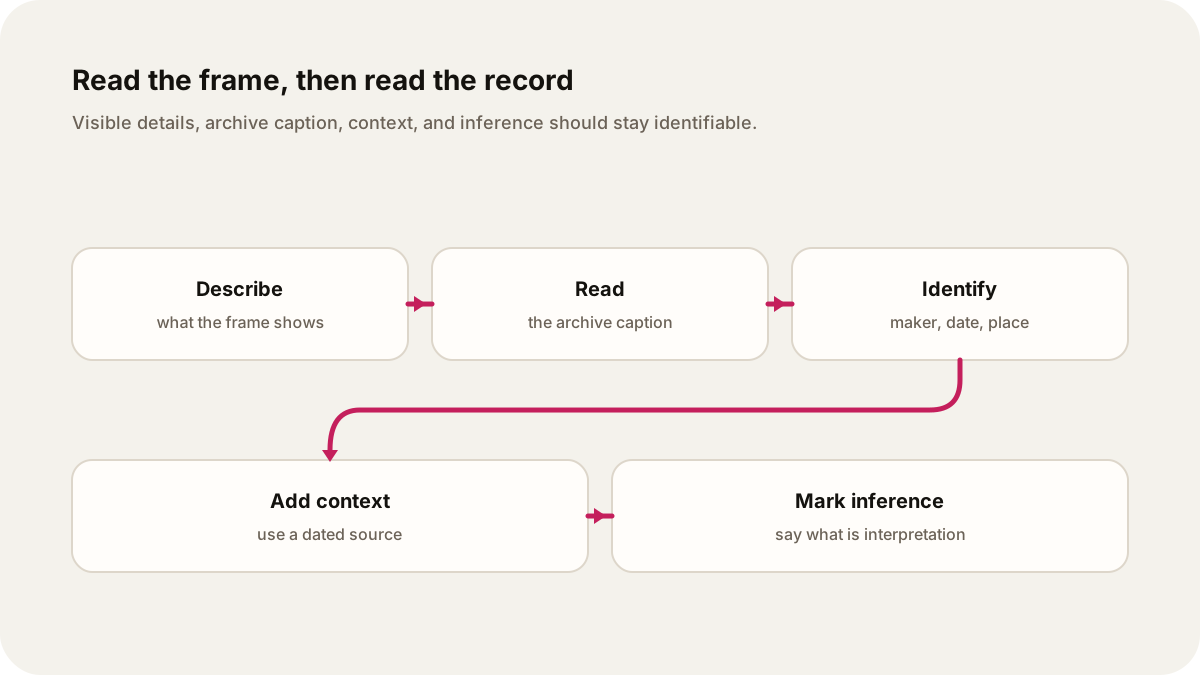
A historical photograph gives a listener a frame, not a complete event. Begin with what the image visibly contains. Then read the archive's caption and catalog record. Only after those steps should you offer historical context, and you should mark the difference between a documented fact and an inference.
Key Takeaways
- Describe the frame before you explain it.
- Keep the archive caption and catalog record separate from your own interpretation.
- A strong audio guide names what the image cannot prove.
Use one real archive record
This guide uses Dorothea Lange's 1936 photograph commonly called “Migrant Mother,” held by the Library of Congress. The archive's official title is “Destitute pea pickers in California. Mother of seven children. Age thirty-two. Nipomo, California”. The record identifies Lange as photographer and dates the negative to March 1936. It lists a 4 by 5 inch nitrate negative. It also names the Library's Prints and Photographs Division as the repository and gives “Migrant mother” as an alternate title.
Those catalog fields are the first part of the audio guide. They prevent a familiar image from floating free of a date, maker, place, and record identifier. The title people remember and the title the archive uses are related, but they are not the same piece of information.
Describe what is visible before explaining it
In the well-known frame, a woman faces slightly away from the camera. Her two children turn inward so that their faces are hidden against her shoulders. A third child is visible lower in the composition. The woman's hand rests near her face, and the image is tightly cropped around the group. These are descriptions of shapes, positions, faces, hands, clothing, and the frame. A listener can check them against the photograph.
The image does not prove every sentence a narrator might add. It does not show the family's entire camp, the full number of children, the day's weather, the family's conversation with Lange, or what happened after the shutter closed. “She looks worried” is an interpretation of expression and posture. It may be a reasonable response. The guide should label it as a reading of the image, not as a documented fact about her inner state.
The Library of Congress record supplies a second layer. Its summary says the photograph shows Florence Thompson with three of her children and belongs to the “Migrant Mother” series. The record's title card calls her a thirty-two-year-old mother of seven and a destitute pea picker in California. The archive caption is evidence about how the photograph was documented and circulated. It is not a transcript of everything Thompson experienced.
Read the caption as a historical document
The caption has its own history. The Library of Congress notes that the title comes from the caption card for the negative. It also notes that the title on a print reads “Destitute pea pickers in California. A 32 year old mother of seven children.” A guide can read the official wording, then explain that catalog titles, caption cards, later print titles, and popular names may differ.
The same record contains a detail that changes how a listener should treat the image file. The original nitrate negative was retouched in the 1930s. The change erased a thumb holding a tent pole in the lower right corner. The Library provides an unretouched file print for comparison. That is a documented production detail. It does not make every later copy deceptive. It does give the image a material history worth naming.
The Library of Congress guide to the Migrant Mother photographs places the famous frame within a series Lange made of Florence Owens Thompson and her children in Nipomo, California, in March 1936. The guide also records that Lange was completing a month's trip photographing migratory farm labor for the Resettlement Administration. This is context supplied by the archive, not something the single frame can establish by itself.
Separate evidence from inference
Use three labels while writing the script:
- Visible: “Two children turn their faces toward the woman, and a third child appears at the lower edge.”
- Archive caption: “The Library of Congress identifies the subject as Florence Thompson, age thirty-two, a mother of seven and a pea picker in Nipomo, California.”
- Inference: “The tight framing can make the group feel enclosed.” That is a response to composition, not a statement about Thompson's thoughts or the family's complete circumstances.
For example, this compact source check keeps the labels visible while you draft:
| Guide sentence | Evidence type | What it can support |
|---|---|---|
| “Two children turn their faces toward the woman.” | Visible detail | A description of the frame |
| “The Library of Congress identifies Florence Thompson.” | Archive record | A named subject and catalog context |
| “The group feels enclosed.” | Interpretation | A response to the composition, not a private fact |
The distinction matters because iconic photographs attract narratives that grow beyond their records. The Library's A Picture of Humanity page says that the photograph is one of a series and that seeing related images, the purpose of the work, and the views of photographer and subject suggests that no single meaning can be assigned to it. That sentence gives a useful stopping point for the guide. A strong interpretation can remain open to more than one meaning.
For example: a worked listening script
Consider this example opening:
You are looking at Dorothea Lange's March 1936 photograph from the Library of Congress, officially titled “Destitute pea pickers in California. Mother of seven children. Age thirty-two. Nipomo, California.” In the frame, a woman faces the camera at an angle while two children hide their faces against her shoulders. A third child is visible below. The archive identifies the woman as Florence Thompson and places the picture in a series made in Nipomo. The feeling of worry often associated with the image is an interpretation of posture and expression. The caption and the archive record document the subject and setting; they do not tell us everything she thought in this moment.
This script moves from visible evidence to archive evidence to interpretation. It does not invent a conversation or claim a private emotion as fact. It does not turn a single frame into a complete biography. If you quote the caption, keep it attached to the Library of Congress link. If you add context about Depression-era migration, add a dated source and call it later context.
The historical newspaper audio guide uses the same separation for a page's reporting, public message, and later history. The museum object audio guide separates physical description from provenance and curatorial interpretation. For a source-led episode workflow, see the oral history audio guide, which keeps a narrator's recollection distinct from documents around it.
Turn the method into an audio request
Make a five-minute audio guide to Dorothea Lange's 1936 “Migrant Mother” photograph using the Library of Congress item record and the Migrant Mother research guide. First describe only visible details. Then read the archive title, photographer, date, place, subject summary, series context, and the note about the retouched thumb. Label each sentence as visible evidence, archive documentation, or interpretation. Explain why a single frame cannot establish the subject's private thoughts or the whole history of the Depression. Do not invent dialogue or claim to have visited the archive.
Before recording, open the image and the item record side by side. Check whether a detail belongs to the frame, the caption card, the catalog summary, or a later essay. If the archive's record contains uncertainty or competing titles, preserve that difference in the episode notes. The source links and corrections guide offers a practical reminder to keep those links attached to generated audio.
A historical photograph becomes a better listening subject when its limits stay audible. The frame can show a gesture and a composition. The archive can identify a person, date, place, and series. Interpretation can ask what the image evokes, as long as it does not pretend that an inference was printed in the caption.
Sources
- Library of Congress, “Destitute pea pickers in California. Mother of seven children. Age thirty-two. Nipomo, California”: official item record, image details, title, subject summary, retouching note, and rights information.
- Library of Congress, Dorothea Lange's “Migrant Mother” Photographs: series context, Florence Owens Thompson, Nipomo, and March 1936.
- Library of Congress, A Picture of Humanity: related images, purpose, and the warning that no single meaning can be assigned to the photograph.