
Football offside: position and involvement
Check the halfway line, the ball, and the second-last opponent at the team-mate's touch, then ask whether the attacker became involved in active play.
Offside is easier to follow when you separate two questions: where the attacker is when a team-mate plays the ball, and what the attacker does next. Standing in an offside position is not, by itself, an offence. Under the current IFAB Law 11, the player must also become involved in active play.
This guide uses “football” in Britain and Australia, and “soccer” in the United States and Canada. It explains the Laws of the Game. It does not describe a real match or a particular league’s referee discussion. Keep the incident and the law page together in the episode notes.
Key Takeaways
- Check position when the team-mate plays or touches the ball.
- Compare the attacker with the halfway line, the ball, and the second-last opponent.
- A position becomes an offence only through active-play involvement, unless a direct goal kick, throw-in, or corner exception applies.
The short rule: position first, involvement second
At the moment a team-mate plays or touches the ball, an attacker is in an offside position only if both conditions apply:
- Some part of the head, body, or feet is in the opponents’ half. The halfway line itself does not count as the opponents’ half.
- That part is nearer to the opponents’ goal line than both the ball and the second-last opponent.
Hands and arms do not count. A player level with the second-last opponent is onside. A player level with the last two opponents is also onside. The goalkeeper is often one of those opponents. The law asks for the second-last opponent, not automatically “the last defender.”
That position is legal until the player becomes involved in active play. Law 11 gives three examples: playing or touching a team-mate’s ball, interfering with an opponent, or gaining an advantage. For an audio recap, say the order out loud: “The position was checked when the pass was played. The offence was judged when the player became involved.”
Mark the line with the ball and second-last opponent
The offside line is not always the last defender’s line. Use the ball and the second-last opponent, measured from the opponents’ goal line. If the ball is nearer the goal, use the ball. If the defender is nearer the goal, use that defender.
Imagine a hypothetical attack moving toward the north goal. The halfway line is behind the attackers. A midfielder plays a forward pass. At that instant, the striker’s foot is beyond the ball and the second-last opponent. The striker’s body is in the opponents’ half. That is an offside position. If the striker then touches the ball, the player is penalised for becoming involved.
Now change one detail. The striker’s head, body and feet remain level with the second-last opponent when the pass is played. The striker may run beyond that defender after the pass and receive the ball. The later movement does not turn the earlier position into offside, because the position was judged at the team-mate’s touch.
For a short audio description, use three anchors: “halfway line, ball, second-last opponent.” Say when the pass was played. Then name the reference point. “The attacker was ahead of the defender” leaves out both details.
Involvement includes more than touching the ball
An attacker can be penalised without making the final touch. Law 11 includes interfering with an opponent. Examples include blocking an opponent’s view or challenging for the ball. It also covers an obvious action that affects an opponent’s ability to play the ball.
Consider a second hypothetical example. A forward is in an offside position when a team-mate shoots. The forward does not touch the shot, but stands directly in front of the goalkeeper and blocks the goalkeeper’s view. The referee may penalise the forward for interfering with an opponent. The useful explanation is not “the forward was offside.” It is “the forward was in an offside position, then affected the goalkeeper, which made it an offside offence.”
The reverse also matters. An attacker who is away from the play has not committed an offence just by standing there. The player must not block, challenge, touch the ball, or gain an advantage. A real decision depends on the action, so describe that action instead of guessing from a freeze-frame.
A rebound or deflection can leave an earlier offside position relevant. Law 11 treats an opponent’s deliberate play differently from a deflection: receiving the ball from an opponent who deliberately plays it does not count as gaining an advantage, except when that play is a deliberate save. Describe what the opponent did before assigning a call.
Three direct restarts where there is no offside offence
Law 11.3 lists three direct restarts with no offside offence: a goal kick, a throw-in, and a corner kick. This is an exception to the usual team-mate-touch rule. It does not make every later action legal. A foul, dangerous play, or another Law can still apply.
The simplest worked example is a hypothetical corner. An attacker stands beyond the second-last opponent before the corner is taken and heads the corner directly into the goal. There is no offside offence because the ball came directly from a corner kick. The same direct-restart exception applies to a throw-in and a goal kick.
Say “directly from” in the explanation. If the corner is first headed by a team-mate and then reaches another attacker, the second attacker’s position is judged at that team-mate’s touch. The restart exception has ended because the ball was no longer received directly from the corner.
Here is a compact decision table for a replay or audio script:
| Check | What to ask | What it tells you |
|---|---|---|
| Position | Was any head, body, or foot in the opponents’ half and nearer the goal than both the ball and second-last opponent? | If no, the player was onside. |
| Involvement | Did the player touch the ball, challenge, block an opponent’s view, or gain an advantage? | If no, position alone is not an offence. |
| Restart | Did the player receive the ball directly from a goal kick, throw-in, or corner? | If yes, Law 11.3 removes the offside offence for that direct reception. |
| Restart after offence | Where did the active-play offence occur? | The restart is an indirect free kick there. |
A practical audio checklist
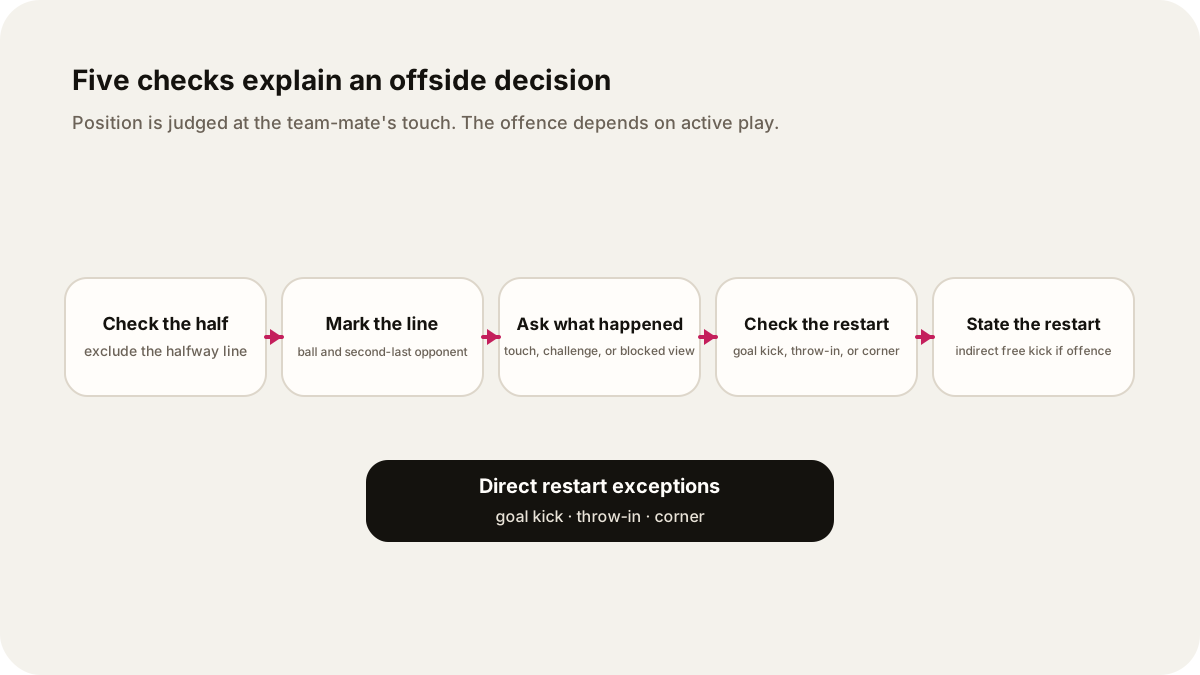
When turning a football or soccer incident into a short listening guide, use this sequence:
- Name the direction of attack and the moment the team-mate played or touched the ball.
- Check the attacker’s relevant head, body, or feet against the halfway line.
- Compare that part with the ball and the second-last opponent.
- If the player was in an offside position, describe the active-play involvement: touch, challenge, blocked view, or gained advantage.
- Check whether the ball came directly from a goal kick, throw-in, or corner kick.
- State the restart. For an offside offence, IFAB Law 11.4 specifies an indirect free kick where the offence occurred, including if that location is in the player’s own half.
An illustrative request could be: “Explain this soccer incident using IFAB Law 11. Give the offside position at the team-mate’s touch, identify the ball and second-last opponent, then say what active-play involvement occurred. Check whether the pass came directly from a goal kick, throw-in, or corner. Label every unknown detail instead of inventing a referee explanation.” That request makes the episode useful without pretending a hypothetical example is a match report.
For another source-led explanation of a sports rule, see how rugby union scoring works. A cricket follow-on guide shows the same habit of naming the competition and law before explaining a decision. When an episode includes several source links, keep corrections and sources with the audio so the listener can check the wording.
If you spot a source mistake in this guide, contact us. Our editorial standards explain how this Lissin guide uses original sources.
Sources
- IFAB Law 11: Offside: current definitions of offside position, active-play involvement, direct-restart exceptions, and the indirect-free-kick restart.
- IFAB Laws of the Game: the current law collection and context for reading Law 11 alongside other offences.