
Why eclipses do not happen every month
The phase cycle repeats about every 29.5 days. An eclipse also needs the Moon near an orbital crossing.
The Moon’s phase cycle repeats about every 29.5 days. Eclipses do not, because the Moon’s orbit is tilted and usually carries it above or below the line that matters.
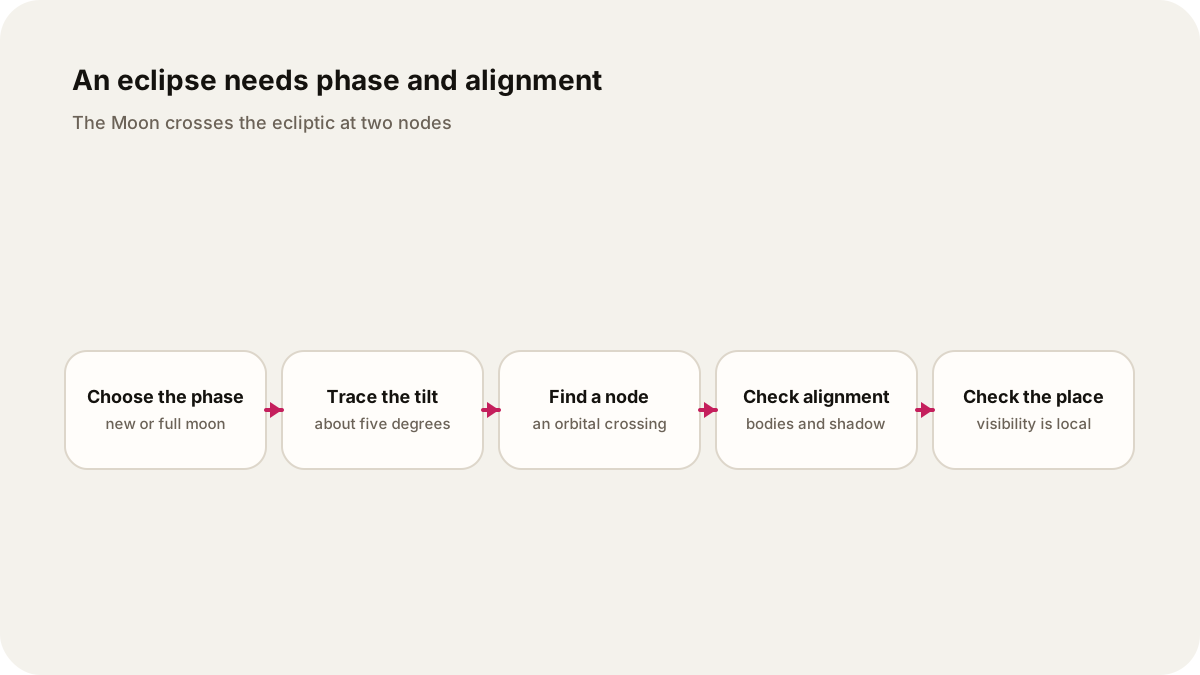
A new moon is necessary, not sufficient
A solar eclipse can happen only at new moon, when the Moon is between Earth and the Sun. That phase repeats about every 29.5 days. Yet most new moons pass with the Moon’s shadow missing Earth.
NASA explains why in its eclipse geometry guide: the Moon’s orbit is inclined about five degrees to the plane of Earth’s orbit around the Sun, often called the ecliptic plane. From Earth, the Moon therefore passes a little above or below the Sun during new moon. The shadow has no reason to cross the ground.
The same geometry works in reverse for a lunar eclipse. A lunar eclipse needs a full moon, with Earth between the Sun and Moon. The Moon can be behind Earth and still pass above or below Earth’s shadow. NASA’s eclipse guide for students shows this tilt in a diagram and warns that the drawing is not to scale.
The two crossing points are the nodes
Imagine the Moon’s tilted orbital plane as a slightly slanted ring crossing the ecliptic plane at two points. Those crossings are the ascending and descending nodes. A new moon near a node can put the Moon, Sun, and Earth into the alignment a solar eclipse needs. A full moon near a node can put the Moon inside Earth’s shadow.
NASA’s Frequently Asked Questions gives the short version: at most new moons, the shadow is too high or too low, and sometimes it is in the right place. The older NASA GSFC periodicity explanation adds a useful detail for an audio guide: the two eclipse zones around the nodes produce eclipse seasons, roughly twice each year. The nodes slowly move, so those seasons do not land on exactly the same calendar dates every year.
This is why a calendar can contain several eclipses in one stretch and none in the next several months. The phase cycle keeps running. The alignment window comes and goes.
Why a visible eclipse is a separate question
An eclipse can occur without being visible from your address. A solar eclipse’s umbra or penumbra touches only part of Earth, and a lunar eclipse requires the Moon to be above your horizon during the event. Cloud, daylight, a blocked horizon, and the event’s path all matter.
So an audio guide should say “NASA predicts an eclipse on this date” and then identify the local circumstances required to observe it. It should not turn the date into a promise that everyone will see darkness, a red Moon, or a total phase.
Example show request: “Explain why eclipses do not happen every month using NASA’s eclipse geometry and FAQ pages. Describe new moon, full moon, the five-degree tilt, nodes, and eclipse seasons. Separate the geometry from local visibility, and do not promise that a listener will see an eclipse from their location.”
The satellite orbits guide can supply a second orbital example, while the gravity-assist explainer shows how a carefully named path can change motion. For a short format, audio news briefing vs. news podcast explains when a brief beats a longer show. The structure still applies: answer the question first, then add the one diagram and caveat that make it stick.
Before recording, check the date against NASA’s current eclipse information and add the listener’s location only if the episode needs a viewing window. Keep the node explanation stable, but date any local forecast or visibility detail.
Sources
- NASA, Why Do Eclipses Happen?, retrieved October 5, 2026: orbit tilt, eclipse geometry, and eclipse seasons.
- NASA, Eclipses Frequently Asked Questions, retrieved October 5, 2026: alignment conditions and eclipse terminology.
- NASA GSFC, Periodicity of Lunar Eclipses, retrieved October 5, 2026: nodes, eclipse zones, and the roughly twice-yearly seasons.
- NASA Space Place, Lunar and Solar Eclipses, retrieved October 5, 2026: phase distinction and the not-to-scale orbit illustration.