
Juice's Earth flyby: how a gravity assist changes a spacecraft's path
The spacecraft bends around a moving Earth and changes its solar orbit through carefully planned geometry.
ESA's Jupiter Icy Moons Explorer, Juice, passed Earth on Sept. 28, 2026. The encounter was a gravity assist, a planned flyby that changed the spacecraft's path and speed relative to the Sun on its way to Jupiter. The spacecraft did not get a free burst of energy from nowhere. It exchanged a tiny amount of orbital energy with a moving planet, while Earth remained effectively unchanged.
The short explanation
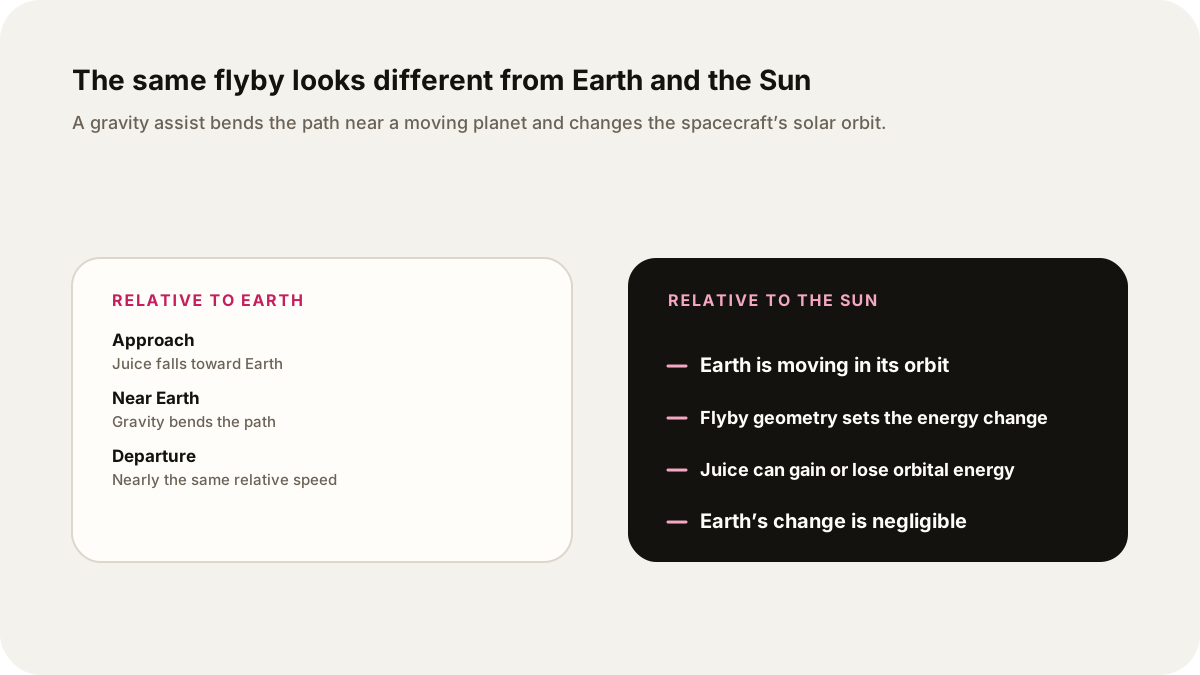
Imagine watching the flyby from Earth. Juice approaches, curves around the planet, and leaves with nearly the same speed relative to Earth. Earth pulls on the spacecraft on the way in and out, so the path bends. From the Sun's frame, Earth is moving along its own orbit. The spacecraft can leave with more or less solar orbital energy depending on which side of Earth's motion it passes.
ESA's gravity-assist explainer uses this change of reference frame to explain the apparent paradox. A spacecraft can speed up relative to the Sun while its speed relative to the planet is almost unchanged. The planet gives up an immeasurably small amount of energy, while the spacecraft gains a useful amount for its mission.
Why Juice needed Earth again
Juice launched from Europe's Spaceport in French Guiana in April 2023. ESA's mission update says the spacecraft had already completed a first lunar-Earth flyby and a Venus flyby. Those encounters shaped its route and changed its orbital energy before the 2026 Earth pass.
The Sept. 28 flyby was Juice's third gravity assist. ESA planned the spacecraft to come within 8,640 km of Earth. Flight dynamics teams used small trajectory corrections before the encounter so Juice would arrive at the required angle and velocity. Those corrections put Juice on the approach required for the flyby. A planet's gravity is always present, but the mission only gets the desired result from a carefully chosen approach.
Earth’s shadow interrupted sunlight on the spacecraft’s solar panels. ESA reported that Juice entered Earth's shadow from 21:24 CEST on Sept. 27 to 06:03 CEST on Sept. 28 and had to rely on its batteries. Controllers prioritized the most important instrument observations during that period. ESA also planned instrument observations of Earth and the Moon between Sept. 23 and Oct. 3.
Speed depends on the observer
“Speeding up” needs a reference point. Relative to Earth, Juice's incoming and outgoing speeds are close because the planet mostly deflects the spacecraft. Relative to the Sun, the spacecraft's orbit can gain energy when it flies in the direction of Earth's solar motion. A flyby in the opposite geometry can remove energy instead.
That is why the popular “slingshot” picture is useful only if it includes the moving planet. ESA's educational gravity-assist page explains that passing behind or in front of a planet can speed up or slow down a spacecraft and change its direction. The maneuver does not replace navigation. It gives the flight team another way to shape an orbit without spending the propellant that a direct change might require.
What the flyby did not do
A gravity assist did not point Juice directly at Jupiter in one step, and it did not mean the spacecraft entered orbit around Earth. Juice flew past Earth and departed on a new trajectory. ESA says the successful flyby redirected its path toward another Earth flyby in 2029. The mission still needs later navigation and operations before it reaches Jupiter's system.
The encounter also was not a measurement of Earth's gravity in isolation. The result depends on the spacecraft's approach, Earth's motion around the Sun, the closest-approach geometry, and the planned corrections. Describing those conditions keeps “free speed” from becoming a misleading claim.
Ask Lissin to explain the Juice flyby using the ESA sources. Give Earth-relative speed and Sun-relative orbital energy their own sections. Use ESA’s mission page for the current timeline and spacecraft status.
Sources
- ESA, Juice to fly past Earth for third gravity assist: Sep. 28, 2026 encounter, distance, corrections, shadow period, and observations.
- ESA, What are gravity assists?: reference frames and energy exchange with a moving planet.
- ESA Space for Kids, Gravity assists: accessible explanation of speed, direction, and flyby geometry.
- ESA, Juice images Earth during Earth flyby: post-flyby confirmation and the 2029 trajectory target.