
Why tides tend to happen later each day
The Moon moves as Earth turns, so the same tidal phase tends to return about 50 minutes later each solar day. Local coastlines then reshape that rhythm.
If high tide arrives at 8:00 this morning, why might the next day's high tide come later? The main reason is that the Moon keeps moving eastward while Earth turns. A place on Earth needs a little extra rotation to line up with the Moon again, so the lunar or tidal day is about 24 hours and 50 minutes rather than 24 hours.
That 50-minute figure is a useful average for understanding the pattern. It is not a promise that every beach will get its next high tide exactly 50 minutes later, or that every coast has two equal high tides. The shape of the coast, the seabed, ocean basins, and weather all change what a tide looks like at a particular place.
Key Takeaways
- A lunar day is about 24 hours and 50 minutes, so the same part of the tidal cycle tends to return later each solar day.
- In many places, two tidal bulges produce two high and two low tides in that lunar day. Some coasts have one daily high tide, or mixed unequal tides.
- Use a local tide prediction for a real time and height. The lunar-day calculation explains a tendency; it does not derive a guaranteed beach forecast.
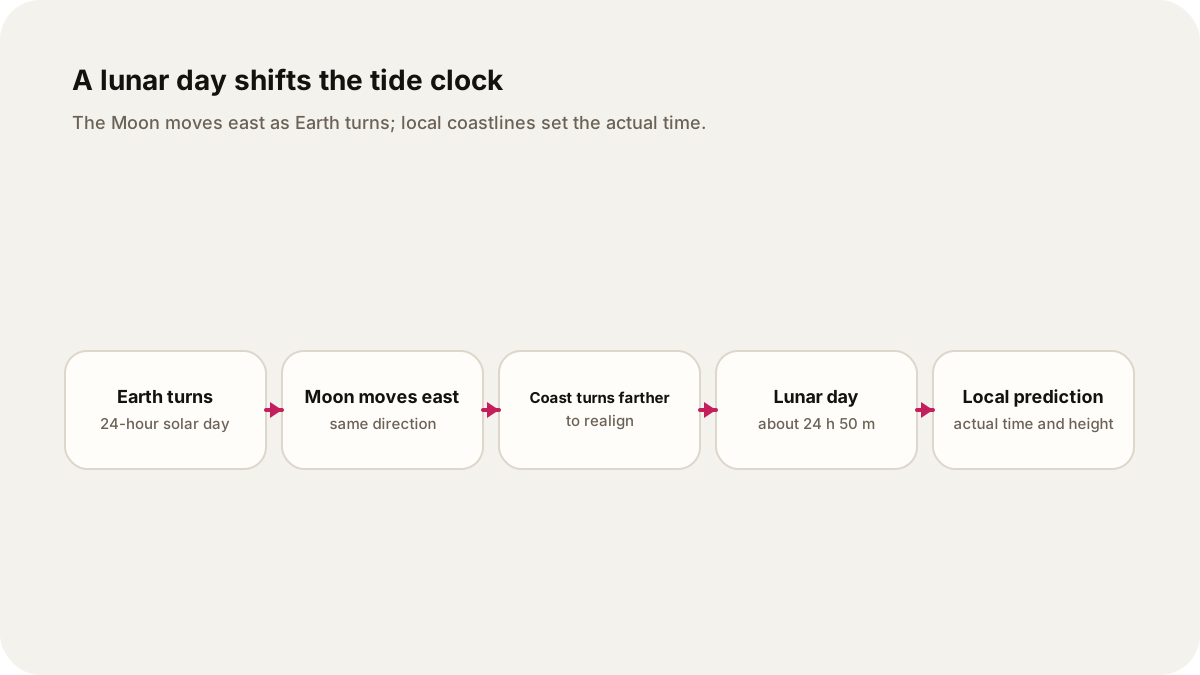
The Moon adds about 50 minutes to the day
Earth completes one rotation relative to the Sun in about 24 hours. During that same interval, the Moon moves in the direction of Earth's rotation around its orbit. When a coastline has returned to the same position relative to the Sun, it has not quite returned to the same position relative to the Moon. Earth must turn a little farther to catch up.
NOAA's National Ocean Service calls the resulting interval a lunar day, or tidal day, and gives it as 24 hours and 50 minutes. NOAA's tides and water levels tutorial explains that this is the average time for one place to return to the same position beneath the Moon. The NOAA frequency guide uses the same 24-hour-50-minute cycle.
The extra 50 minutes is spread across the day. If a location has a broadly semidiurnal pattern, with two high tides in one lunar day, successive high tides are separated by about 12 hours and 25 minutes. That means a morning high tide may be followed by an evening high tide, then by the next morning's high tide at a later clock time.
This is why the simple phrase “the tide is 50 minutes later each day” can mislead. It describes the return of the same phase in an idealized rhythm. A single high tide is only one point on a moving, complicated water level curve.
Two tidal bulges do not make every coast look the same
The familiar explanation starts with two broad tidal bulges: one on the side of Earth facing the Moon and another on the opposite side, arising from the combined effects of lunar gravity and inertia. As Earth rotates through those regions, a coastline can encounter two high waters and two low waters during a lunar day.
The model is useful, but continents interrupt the ocean. Basins have different depths and shapes. Narrow inlets can amplify a tide, while a broad coast can experience a different phase from a nearby open-water station. NOAA describes three broad patterns: semidiurnal tides with two similar highs and lows, mixed semidiurnal tides with unequal highs and lows, and diurnal tides with one high and one low each lunar day. Its tidal-cycle guide gives the comparison.
The pattern also varies by region. The UK mostly has two high and two low tides each day, according to the Met Office guide to beach and tide times. The Bureau of Meteorology notes that Australia has diurnal, semidiurnal, and mixed regimes, and that even the two sides of Torres Strait have different tidal regimes in its tide-prediction explanation. Canada's Fundy National Park offers a local example of two highs and two lows, with a lunar-day explanation for why the times move later.
Those examples cover the US, Great Britain, Australia, and Canada, but they do not establish one timetable for each country. “The tide in Australia” is not a single local event. The station and the coast around it matter.
A clock example: useful schematic, not a forecast
Consider a hypothetical location with a clean semidiurnal pattern. This is a teaching example, not an observation or a prediction for a real address.
| Day | Schematic high tide times | What the simple model shows |
|---|---|---|
| Monday | 08:00 and 20:25 | Two highs about 12 hours 25 minutes apart |
| Tuesday | 08:50 and 21:15 | The corresponding high tides return about 50 minutes later |
| Wednesday | 09:40 and 22:05 | The clock shift continues in the idealized cycle |
For example, someone comparing Monday morning with Tuesday morning would see 08:00 become 08:50. The evening high shifts by the same schematic amount. The table is deliberately regular so the lunar-day idea is easy to hear.
An actual tide table may show 07:42, then 08:36, then 09:31, with unequal heights. The difference might change because a real prediction combines many tidal constituents and local observations. NOAA says its predictions are calculated by summing the effects of 37 harmonic constituents for a station. The harmonic-constituent explanation also says those constants can only be calculated from tidal data collected at a location.
The same distinction applies in Britain, Australia, and Canada. The Met Office says published times and heights may come from the nearest tidal station rather than the exact beach, and that local conditions can differ. Australia's Bureau of Meteorology tide guidance says primary-location predictions use local tide measurements, while actual water levels are also affected by weather, wind, and waves. Parks Canada publishes local Fundy predictions alongside its explanation of the lunar day. A schematic clock progression teaches the mechanism; a station-specific prediction supplies the real number.
Why the delay can be hard to see
The Moon's motion sets one important rhythm, but it is not the only rhythm in the water. The Sun contributes its own tidal components. Their alignment changes the range over the month, producing larger spring tides near new and full Moon and smaller neap tides near the quarter phases. The height can change even when the timing follows a familiar pattern.
Local geography adds a second source of surprise. NOAA explains that a tidal wave travels through ocean basins and can lag behind the Moon by hours, or nearly a day in some places. Its guide to whether high tide occurs under the Moon points to continental shelves, ocean depth, and coastline shape as reasons for the local lag.
So “later” has two meanings. A location returns to the same alignment with the Moon about 50 minutes later on average each day. The local tide response can add its own phase offset, and that offset can differ between nearby harbours. A place with one daily high tide will not fit the two-high-tides clock example. A mixed tide may show two highs at different heights, making “the next high” ambiguous unless the station's table labels them.
How to ask for a clear audio explanation
Consider a request such as:
Make a six-minute science guide explaining why high tides tend to happen later each day. Start with the 24-hour-50-minute lunar day and the Moon's eastward motion. Explain the common two-high-tide pattern, then compare semidiurnal, mixed, and diurnal local responses. Work through the Monday 08:00, Tuesday 08:50, Wednesday 09:40 clock example as a schematic, not a forecast. Use NOAA, the Met Office, Australia's Bureau of Meteorology, and Parks Canada. End by saying that a real tide time and height must come from a local station prediction.
That prompt keeps three layers separate: the astronomy, the ocean response, and the local table. For example, an episode can say that NOAA's average lunar day explains the direction of the shift without claiming that a listener's harbour will move by exactly 50 minutes. It can also compare the local vocabulary used by a British beach guide, an Australian tide service, and a Canadian national park without pretending that their coastlines behave alike.
For a related space-science explanation, why eclipses do not happen every month separates a repeating phase cycle from the local visibility question. Why auroras have different colours makes a similar distinction between a physical mechanism and what an observer can see. The tidal example adds a measured coastal response: the Moon supplies a rhythm, and each coastline answers it in its own way.
Sources
- NOAA National Ocean Service, Frequency of Tides: The Lunar Day: 24-hour-50-minute lunar day and about 12 hours 25 minutes between high tides.
- NOAA National Ocean Service, How Frequent Are Tides?: two highs and two lows in the common lunar-day pattern.
- NOAA National Ocean Service, Types and Causes of Tidal Cycles: semidiurnal, mixed, and diurnal patterns.
- NOAA Tides & Currents, About Harmonic Constituents: station-specific harmonic prediction and measured constants.
- NOAA National Ocean Service, Are Tides Higher When the Moon Is Directly Overhead?: local lag from ocean depth, shelves, and geography.
- Met Office, Beach Forecast and Tide Times Explained: UK pattern, nearest-station limits, and day-to-day variation.
- Bureau of Meteorology, About Tide Predictions: Torres Strait: contrasting diurnal and semidiurnal regimes in one Australian region.
- Bureau of Meteorology, Tides and Sea Level: local measurements, astronomical predictions, and weather effects on actual water levels.
- Parks Canada, Tides in Fundy National Park: local two-high-tide example and lunar-day explanation.