
Celsius and Fahrenheit: read weather temperatures across units
20°C is 68°F, but a 10°C change is an 18°F change. Convert readings with the offset and scale factor, then convert intervals with the scale factor alone.
Weather apps can show the same air temperature in Celsius or Fahrenheit. The number changes, but the measured temperature does not. If a forecast says 20°C, the Fahrenheit reading is 68°F. If a US weather page says 68°F, the Celsius reading is 20°C.
That translation is useful when you read weather across the United States, Canada, Britain, Australia, or another country that uses a different display. This guide explains the conversion, shows what happens at 0°C and −10°C, and separates a temperature reading from a temperature change. It uses illustrative readings, not a live forecast.
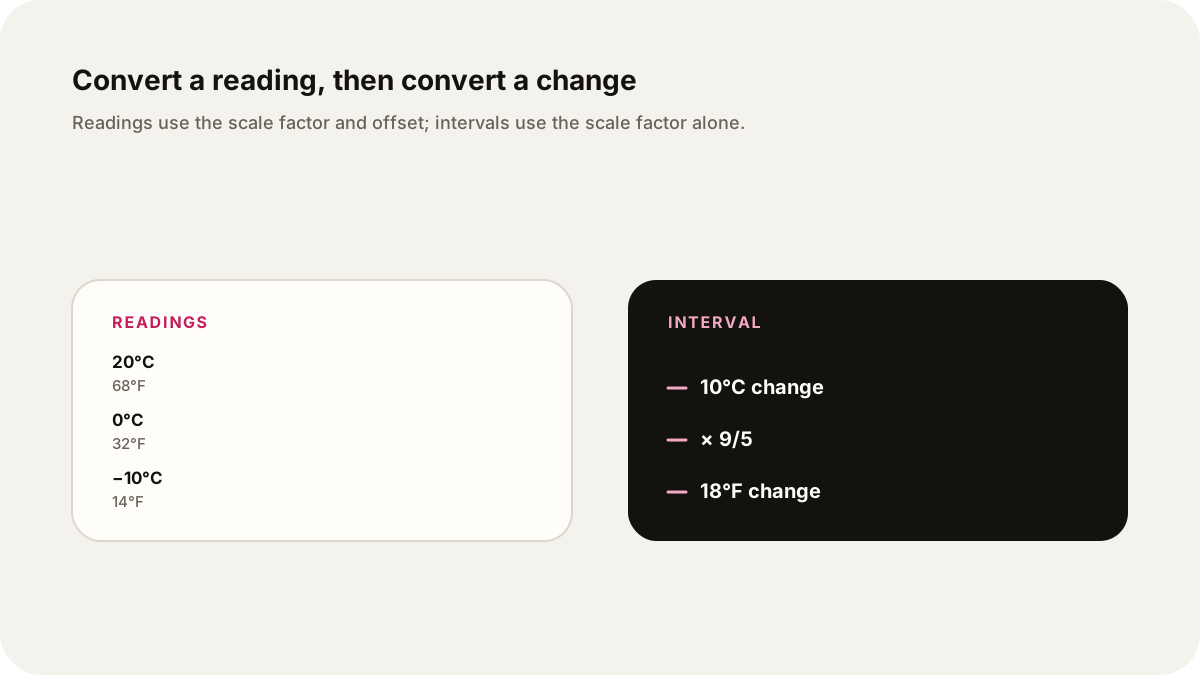
Key takeaway: To convert a Celsius reading to Fahrenheit, multiply by 9/5 and add 32. To convert Fahrenheit to Celsius, subtract 32 and multiply by 5/9. For a temperature change, use only the scale factor: 10°C of change equals 18°F of change. Do not add 32 to a difference.
Read the temperature before converting it
The Celsius and Fahrenheit scales use different zero points and different-sized degrees. The freezing point of water is 0°C and 32°F. A 100-degree Celsius span from freezing to boiling corresponds to a 180-degree Fahrenheit span, from 32°F to 212°F. That is why one Celsius degree equals 1.8 Fahrenheit degrees.
The National Institute of Standards and Technology gives the exact reading conversions as:
°F = (°C × 9/5) + 32
°C = (°F − 32) × 5/9
The NIST temperature page also lists the relationship with kelvin. NOAA’s National Weather Service gives the same Celsius-to-Fahrenheit rule in its weather glossary. These formulas convert a reading, such as today’s displayed air temperature.
Three weather readings to practise
Consider three hypothetical readings that might appear in a weather explanation:
| Celsius reading | Fahrenheit calculation | Fahrenheit reading |
|---|---|---|
| 20°C | (20 × 9/5) + 32 | 68°F |
| 0°C | (0 × 9/5) + 32 | 32°F |
| −10°C | (−10 × 9/5) + 32 | 14°F |
The first line is the common check: 20 × 1.8 is 36, and 36 + 32 is 68. At 0°C, the multiplication contributes zero and the offset gives 32°F. At −10°C, the multiplication gives −18, and adding 32 gives 14°F.
For example, if an audio briefing reads “the morning temperature is 20°C,” it can say “that is 68°F” after showing the conversion. If it reads “−10°C,” it should keep the minus sign on the original Celsius reading and in the calculation, then say “that is 14°F” for the converted result. The numbers here are illustrative. They describe conversion arithmetic, not a prediction for a place or date.
Convert back from Fahrenheit
The inverse conversion removes the Fahrenheit offset first. Consider a hypothetical reading of 68°F:
°C = (68 − 32) × 5/9
°C = 36 × 5/9 = 20°C
The subtraction comes before the multiplication. A quick mental check is useful: 32°F is 0°C, so a reading above 32°F should convert to a positive Celsius value. The OpenStax temperature-scale table gives both equations and worked conversions.
Here is a compact comparison for a listener moving between weather pages:
| Question | Correct operation | Example result |
|---|---|---|
| Convert a reading from Celsius | Multiply by 9/5, then add 32 | 20°C → 68°F |
| Convert a reading from Fahrenheit | Subtract 32, then multiply by 5/9 | 68°F → 20°C |
| Convert a temperature change | Multiply the change by 9/5 | 10°C change → 18°F change |
The third row is a different task from converting a reading. That difference prevents the most common mistake in this topic.
A change is not a new reading
Suppose a hypothetical city warms from 10°C to 20°C. The change is 10°C. To express that interval in Fahrenheit, multiply by 9/5:
10°C × 9/5 = 18°F
The Fahrenheit readings are 50°F and 68°F. Their difference is 18°F. There is no +32 in the interval calculation because the same zero-point offset appears in both readings and cancels.
If you add 32 to the 10°C change, you get 50°F, which is a temperature reading for 10°C, not the size of the change from 10°C to 20°C. Say whether you are converting a point on the scale or the distance between two points.
NIST states this distinction directly: an interval of one Celsius degree corresponds to an interval of 1.8 Fahrenheit degrees. It also notes that one Celsius degree has the same interval size as one kelvin. The NIST conversion tables separate temperature values from temperature intervals.
Where kelvin helps
Kelvin is useful when a source uses the scientific SI temperature scale. It starts at absolute zero, and the conversion from Celsius is:
K = °C + 273.15
Thus, 0°C is 273.15 K and 20°C is 293.15 K. Kelvin does not use a degree sign. A change of 10°C is also a change of 10 K, because the two scales have the same interval size.
For an everyday weather reading, Fahrenheit and Celsius are usually the practical pair. Kelvin helps when you are reading a physics or science source that reports an absolute temperature. It does not make a weather forecast more precise, and it does not change the conversion of a Celsius or Fahrenheit interval.
Read weather units across countries
The National Weather Service describes Fahrenheit as the standard scale used in the United States and Celsius as the standard scale in most areas outside the United States. A weather site may let the reader choose the display. The Met Office’s forecast guide says its temperature bars show air temperature and that users can select Celsius or Fahrenheit in settings.
That makes unit labelling part of a clear audio briefing. A US listener may expect 68°F; a listener in Britain, Australia, or much of Canada may expect 20°C. Say both units when the audience spans those conventions. Do not imply that one unit is a different measurement or that a conversion supplies a forecast.
For example, a useful request for a Lissin show is: “Read the weather source’s original temperature and unit. Convert each value to the listener’s chosen unit. Show one Celsius-to-Fahrenheit calculation and one Fahrenheit-to-Celsius calculation. If the source describes a rise or fall, convert the interval without adding 32. Label the date, place, and source, and do not invent a forecast.”
If a source mistake appears in a published guide, contact Lissin. The editorial standards explain how source links and corrections should accompany public guides. The listener chooses what they want to hear, and Lissin makes the show around that choice. You can choose an audio explanation built around a question.
For a related source-led guide, see how to turn a weather forecast into a clear audio briefing. The leap-year rules guide uses the same habit of checking a compact rule against worked examples.
Sources
- NIST, SI Units: Temperature: exact Celsius, Fahrenheit, and kelvin conversions; reading and interval relationships.
- NIST Guide to the SI, Appendix B.9: temperature-value and temperature-interval conversion tables.
- NOAA National Weather Service glossary: Fahrenheit: Celsius-to-Fahrenheit formula and US weather-unit context.
- OpenStax, Thermometers and Temperature Scales: equations, scale relationships, and kelvin context.
- Met Office, What does this forecast mean?: temperature display and Celsius/Fahrenheit settings in a weather service.