
How to turn a weather forecast into a clear audio briefing
Say what the percentage covers before you turn it into spoken audio.
A weather app can put a percentage beside a cloud icon and still leave you unsure what the number covers. To turn a forecast into a useful audio briefing, name the place, the forecast period, and the event before you explain the percentage. Then keep the forecast separate from what an observation later records.
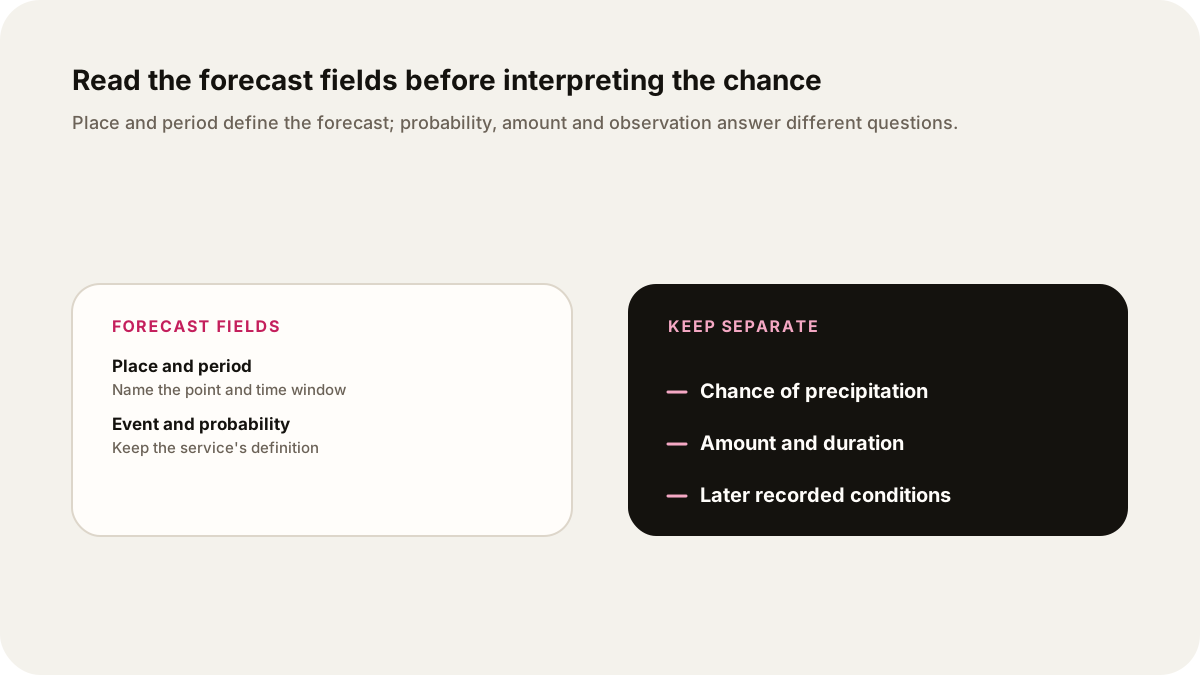
This is a method for explaining a forecast in plain speech. It is not a claim about forecast skill, and it is not a substitute for the current forecast from the relevant national weather service.
Start with the label, not the icon
Read the location and date first. A forecast for Bristol on Friday is not a forecast for the whole county at every hour. An hourly row, a three-hour block, and a day summary may describe different periods. The National Weather Service glossary defines forecast periods such as “This afternoon,” “Tonight,” and “Overnight,” while the Met Office explains that its location forecasts use hourly steps for the first two days and three-hour steps later in the forecast.
An audio briefing should say something like: “For Bristol, Friday from 6 pm to midnight, the forecast gives a 40 percent chance of measurable precipitation.” That sentence gives the listener four handles: location, date, time window, and event. Add the source and the time you checked it when freshness matters.
The weather symbol is a separate clue. The Met Office says its symbol should be read alongside the chance of rain or snow because the symbol describes the predominant weather type while the percentage communicates another part of the uncertainty. A cloudy symbol and a small rain probability can both be accurate descriptions of the same forecast period.
What a rain percentage means
The NWS defines probability of precipitation, or PoP, as the likelihood of measurable precipitation at a given point during a specified period in the forecast area. Its example threshold is 0.01 inches, or the water equivalent of frozen precipitation. The number describes whether the defined event occurs. It does not describe how much rain will fall or how long the rain will last.
That makes “40 percent chance of rain” different from three common interpretations:
- it does not mean rain will cover 40 percent of the day;
- it does not mean 40 percent of the area will receive rain; and
- it does not mean the rain will be 40 percent as heavy.
The exact product definition matters. The NWS page commonly describes a county or zone and a period that is normally 12 hours. The Met Office's public guidance uses its own thresholds and time steps. An audio explanation should preserve the source's definition instead of blending numbers from different services into one universal rule.
The Met Office gives a useful example: a 70 percent chance means a 7 in 10 chance that precipitation will fall at some point during the stated period. That is a statement about the forecast event. A single period still ends in one observed outcome, rain or no measurable rain at the defined point, and that outcome does not turn the original probability into a promise.
A worked example, clearly marked
Illustrative example, not a live forecast: imagine a weather service listing “Manchester, Saturday 12:00 to 15:00, 30 percent chance of precipitation.” A short briefing could say:
“The forecast is for Manchester on Saturday between noon and 3 pm. It gives a 30 percent chance that measurable precipitation will occur at a point during that window. The percentage does not tell us the amount of rain, its duration, or whether every part of Manchester will be wet.”
That explanation is deliberately modest. If the source also provides a temperature, wind, or precipitation amount, read each as its own field. Do not turn a low probability into “it will stay dry,” and do not turn a high probability into “it will rain continuously.”
When the period passes, describe the observation separately: “The station record for the defined place and period reports measurable precipitation,” or “The available observation does not report measurable precipitation.” A station, radar product, or later observation may represent a different point or time than the original forecast. Say which record you used and avoid using the observation to rewrite the forecast's wording.
Turn the page into a short listening script
A reliable script can follow the source's own fields:
- Source and check time: name the weather service and when you retrieved the forecast.
- Place: use the named town, station, or forecast point. Keep nearby places separate.
- Period: read the date and start and end time, including the time zone when the audience may be elsewhere.
- Event: say rain, snow, or precipitation and preserve the source's threshold when it provides one.
- Probability: give the percentage and explain what it applies to.
- Other fields: read temperature, wind, or amount as separate measurements or forecasts.
- Later check: if you compare the forecast with an observation, label the observation and its source as a new record.
This structure also makes corrections easier. If the source updates the forecast, you can replace the affected period without pretending that an earlier version predicted the later observation exactly. For a broader approach to source-led listening, see how to build a 15-minute morning news routine and audio news briefing vs. news podcast. The guide to source links and corrections covers the record that should travel with an episode.
A spoken forecast earns trust by being specific about what its number refers to. Keep the location, time window, probability, and observation in view, and the listener can hear what the source actually said.
Sources
- National Weather Service, Forecast Terms: probability of precipitation, measurable threshold, forecast area, and time periods.
- National Weather Service, Forecast glossary: definitions for probability and quantitative precipitation forecasts.
- Met Office, About our forecasts: location-specific time steps and why symbols and precipitation probabilities should be read together.
- Met Office, What does this forecast mean?: public explanation of chance of precipitation and thresholds for hourly and three-hour forecasts.
- Met Office, Using ensemble forecasts in decision-making: probability as a defined event and why one forecast cannot be judged from one outcome alone.