
Why do some time zones use half-hour offsets?
Half-hour offsets are legal civil-time choices. See how UTC+09:30 in Darwin and UTC−03:30 in Newfoundland work, and why daylight saving is separate.
Why do some time zones use half-hour offsets? The short answer is that civil time follows decisions about borders, communities and administration as well as longitude. The 15-degree rule is a useful starting model: Earth turns 360 degrees in roughly 24 hours, so 15 degrees corresponds to about one hour. It is not a requirement that every legal time zone be a whole number of hours from UTC.
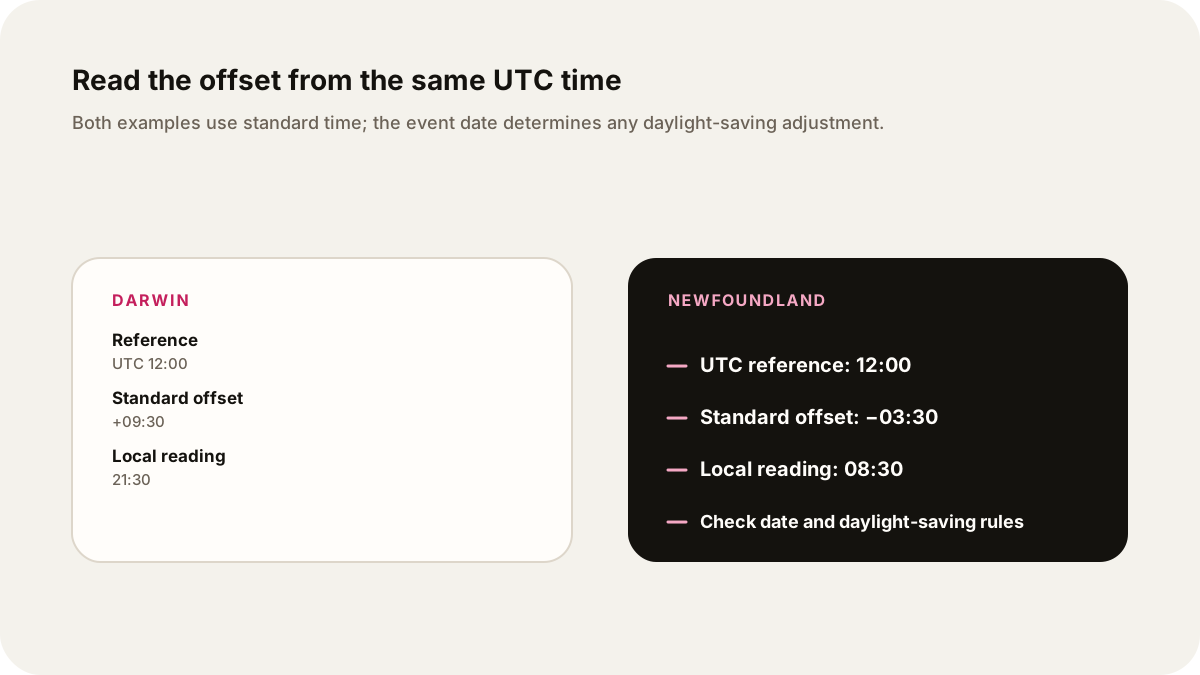
This guide explains how to read a half-hour offset, using two clear examples: Darwin in Australia and Newfoundland in Canada. It also separates standard time from daylight saving time, because a place’s seasonal clock change is a different rule from its base offset.
What does a half-hour offset mean?
A UTC offset is the amount added to or subtracted from Coordinated Universal Time to state a local civil time. UTC+09:30 means the local clock is nine hours and 30 minutes ahead of UTC. UTC−03:30 means it is three hours and 30 minutes behind UTC.
The offset is a clock rule. It does not claim that every point in the territory has exactly that local mean solar time. The NIST time and frequency reference describes the ideal arrangement as 24 zones, each 15 degrees wide and centred on a meridian. The same NIST page says real boundaries are set for practical reasons, including state lines and other landmarks. Governments can choose a civil boundary that is easier to administer than a series of straight longitude slices.
That is why the phrase “half-hour time zone” describes a legal clock offset, not a mistake in the map. The offset keeps a 30-minute remainder because the local standard-time choice sits between the whole-hour options.
Why does the 15-degree model only give an ideal?
The 15-degree model is a clean way to connect rotation and time. One hour of rotation corresponds to 15 degrees of longitude, and 30 minutes corresponds to about 7.5 degrees. A map made only from those meridians would still be awkward for people who cross a nearby border, share transport routes, or use one administrative calendar.
NIST’s Local Time FAQs says the basis of time zones is 15 degrees of longitude, then explains that countries choose their borders legislatively. A civil time zone can therefore include places on both sides of an ideal meridian, or use a half-hour offset that better fits the chosen region.
The distinction matters when an audio explanation turns a geographic model into a rule. Say “the ideal is 15 degrees per hour, but civil boundaries are legislated.” Do not say that every place must use the nearest whole-hour meridian. The legal clock is the rule people schedule against.
Darwin: Australian Central Standard Time is UTC+09:30
Darwin uses Australian Central Standard Time, or ACST, at UTC+09:30. The New South Wales Government’s definitions of time lists the Northern Territory with South Australia and Broken Hill at UTC+09:30 for standard time. The Australian Bureau of Meteorology also lists ACST as one of the selectable Australian standard time zones in its MetEye time-zone guide.
Darwin is in the Northern Territory, which does not observe daylight saving time. That means the standard offset remains the relevant clock rule there through the year under the current Australian arrangements. This is a useful contrast with a place that has the same half-hour base offset but changes seasonally.
The half hour does not mean Darwin’s clock is “wrong” by 30 minutes. It means the Northern Territory’s civil time is defined as nine hours and 30 minutes ahead of UTC. A weather bulletin, flight time or audio show intended for Darwin should label the time zone when the audience may be elsewhere.
Newfoundland: Newfoundland Standard Time is UTC−03:30
Newfoundland uses Newfoundland Standard Time, or NST, at UTC−03:30. The National Research Council Canada’s official time page lists Newfoundland’s standard-time changeover at 02:00 NST and the daylight-time changeover at 02:00 NDT. NRC’s official time-zone map identifies NST as UTC−3:30 and NDT as UTC−2:30.
This gives Newfoundland a half-hour base offset and a separate seasonal offset. When daylight saving time is in effect, the clock is one hour ahead of NST, so UTC−03:30 becomes UTC−02:30. The place has not acquired a new geographic relationship to the Sun; its civil clocks have changed under the daylight-saving rule.
Canada’s time rules are not one universal federal clock setting. NRC notes that time zones and daylight saving have usually been regulated by provincial and territorial governments. That is enough to explain why a civil map can preserve a distinctive Newfoundland offset without claiming a single political motive for every historical decision.
A worked example: if UTC is 12:00
The following is a deliberately hypothetical standard-time example. It is not a live time lookup and it does not account for a date in a current daylight-saving season.
| Place and rule | Calculation from UTC 12:00 | Local time |
|---|---|---|
| Darwin, ACST (UTC+09:30) | 12:00 + 9:30 | 21:30 |
| Newfoundland, NST (UTC−03:30) | 12:00 − 3:30 | 08:30 |
If the subtraction crosses midnight, the local date can differ from the UTC date. In this particular example it does not, so the dates stay the same. The arithmetic is easier to audit when the offset is written beside the place name. “Darwin time” alone is less precise than “Darwin, ACST, UTC+09:30.”
For an audio episode, read the operation aloud: “Start at 12:00 UTC. Add nine hours and 30 minutes for Darwin, giving 21:30. Subtract three hours and 30 minutes for Newfoundland, giving 08:30.” Then state the premise again: “These are standard-time conversions.”
Is daylight saving always a one-hour change?
Daylight saving time is a separate clock adjustment. In many jurisdictions it advances clocks by one hour for part of the year, but the amount and participation are local rules. Australia’s states and territories do not all observe it: the NSW Government says daylight saving is not observed in Queensland, the Northern Territory or Western Australia.
There is also a documented 30-minute daylight-saving change. The NSW Government explains that Lord Howe Island uses UTC+10:30 as standard time and adds 30 minutes during daylight saving, reaching UTC+11:00. That is why “daylight saving means one hour” is a useful common case, not a universal definition.
Keep the layers separate when explaining a schedule:
- Identify the place or IANA zone, such as
Australia/DarwinorAmerica/St_Johns. - Find the standard offset.
- Check whether daylight saving is observed for the date.
- Apply the seasonal adjustment, if any.
- Check whether the conversion crosses midnight.
The IANA Time Zone Database records the history of local-time rules for representative locations. Its theory and pragmatics page lists abbreviations including ACST, ACDT, NST and NDT. IANA data is useful for software and historical checking, while a government time page is the better source for explaining a current legal arrangement to a general reader.
How should you explain one in an audio guide?
Start with the answer: “A half-hour offset is a civil clock choice expressed from UTC.” Then explain the ideal 15-degree model, name the legal or administrative boundary, and show one conversion. Keep the standard offset and daylight-saving rule in separate sentences.
An illustrative Lissin request could be: “Explain why Darwin is UTC+09:30 and Newfoundland is UTC−03:30. Start with the 15-degree ideal, show the civil-time choice, and calculate a hypothetical UTC 12:00 as 21:30 in Darwin and 08:30 in Newfoundland under standard time. Mention that daylight saving is a separate local rule, including Lord Howe Island’s 30-minute change.”
For a related guide about reading a dated source without blurring observation and inference, see how to read a historical map as an audio guide. Why leap years skip centuries uses the same habit of applying a civil rule in the right order. When the finished episode includes a source link and a correction path, keep source links and corrections with AI-generated audio.
If a guide gives the wrong clock reading, contact Lissin with the original UTC time, event date and place. The editorial standards explain how source links and corrections should accompany the answer.
Sources
- NIST, Time and Frequency from A to Z: 15-degree ideal and time-zone definition.
- NIST, Local Time FAQs: legislative time-zone borders.
- National Research Council Canada, Time Zones and Daylight Saving Time: Newfoundland standard/daylight transitions and provincial or territorial regulation.
- NSW Government, Definitions of time and how time is regulated: Australian standard offsets, Northern Territory daylight-saving status and Lord Howe’s 30-minute change.
- Bureau of Meteorology, MetEye time-zone help: Australian standard-time labels.
- IANA, Time Zone Database: current database and representative location data.