
ERA versus WHIP: what baseball pitching rates mean
ERA scales earned runs to nine innings. WHIP counts walks and hits per inning. Both depend on reading baseball's outs-based IP notation correctly.
ERA and WHIP answer different questions about a pitcher. ERA estimates earned runs allowed per nine innings. WHIP counts walks and hits allowed per inning. Both use innings pitched as the denominator, so the notation in the IP column matters before you do any arithmetic.
What ERA measures
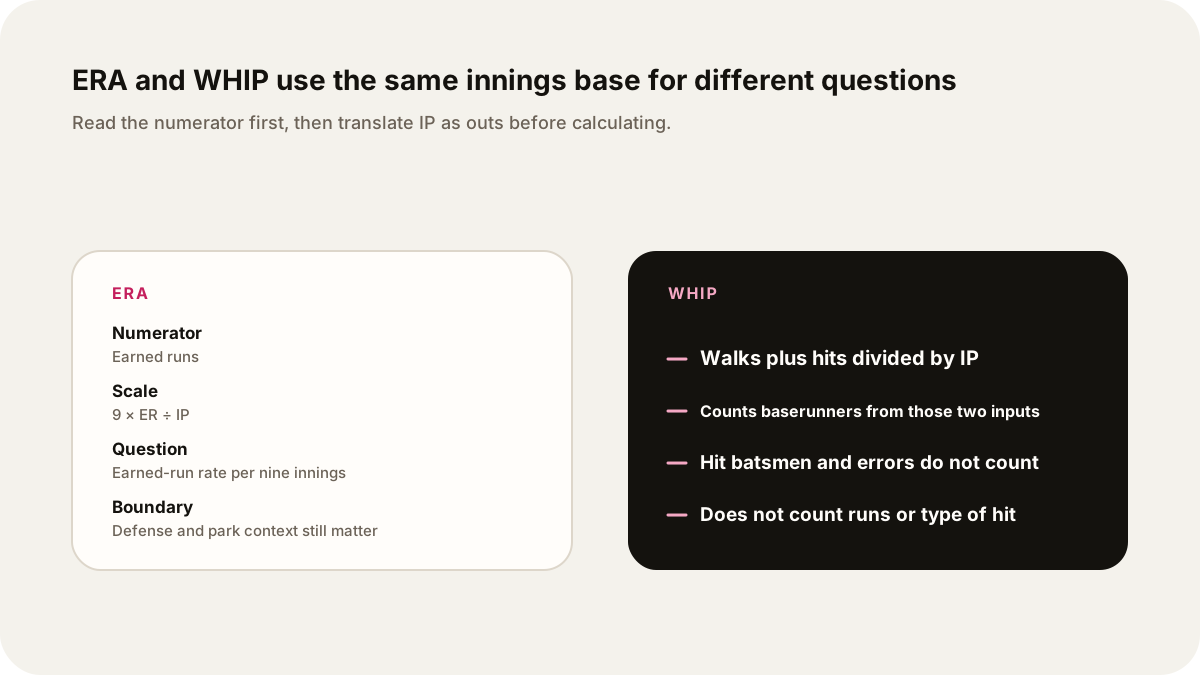
ERA stands for earned run average. MLB defines it as the number of earned runs a pitcher allows per nine innings and gives the formula 9 × earned runs ÷ innings pitched. An earned run is a run scored without the benefit of a defensive error or passed ball. The official scorer decides whether a particular run would have scored without the defensive mishap, and a runner left on base can still be charged to the pitcher who put that runner on base. MLB's earned-run glossary explains that responsibility rule.
ERA therefore asks: how many earned runs would this total represent over nine innings at the same rate? It is a rate, not a count of runs in one outing. A pitcher who allows two earned runs in five innings has not allowed “two runs per game” in the ERA sense. The formula scales that work to a nine-inning reference.
ERA also has context limits. MLB notes that defense, ballpark run-scoring conditions, league context, and the difference between starting and relief work can affect how the number reads. A lower ERA is not a complete causal explanation of a pitcher's performance, and it does not isolate every event the pitcher controlled.
What WHIP measures
WHIP means walks and hits per inning pitched. Its formula is (walks + hits) ÷ innings pitched. MLB says the statistic tracks how well a pitcher has kept runners off the basepaths, but it does not account for how a hitter reached base. The MLB WHIP glossary also specifies that hit batsmen, errors, and batters who reach on a fielder's choice do not count against WHIP.
WHIP therefore asks: how many walks and hits did the pitcher allow for each inning recorded? It does not count runs. A home run appears as a hit in WHIP, while the number of runs that score from it belongs to the run and earned-run record. A walk can raise WHIP without producing a run. Two pitchers can have the same WHIP and very different run totals if the hits, sequencing, defense, and other events differ.
ERA versus WHIP at a glance
| Stat | Numerator | Denominator | Main question | What it leaves out |
|---|---|---|---|---|
| ERA | Earned runs × 9 | Innings pitched | What would the earned-run rate be over nine innings? | Walks and hits that do not become earned runs, plus context such as defense and park |
| WHIP | Walks + hits | Innings pitched | How many walks and hits were allowed per inning? | Runs, hit batsmen, errors, fielder's-choice reaches, and the type of hit |
The two values overlap in their source line, but they are not interchangeable. Read ERA for the earned-run rate. Read WHIP for walks and hits allowed per inning. Then use the game sequence, pitch data, or a fuller stat set for questions the pair cannot answer.
Why innings pitched is written 5.1 or 5.2
Baseball's IP notation is based on outs. MLB explains that three outs equal one inning, and each out recorded is one-third of an inning pitched. The decimal-looking part is a code: 5.1 IP means five innings and one out, or 16 outs. 5.2 IP means five innings and two outs, or 17 outs. Neither means 5.1 or 5.2 ordinary decimal innings.
This distinction changes both formulas. For a pitcher with 5.1 IP, use 16 outs, or 5⅓ innings, as the denominator. For 5.2 IP, use 17 outs, or 5⅔ innings. A pitcher who appears but records no out has no increase in IP. An error that lets a batter reach does not create an out either. See MLB's innings-pitched glossary when translating a box score for audio.
In a spoken recap, say “five and one-third innings” or “16 outs,” then read the rate. That avoids making a listener treat the notation as ordinary decimal arithmetic. For a broader guide to connecting a box score's team line, pitching line, and scoring order, see how to read a baseball box score.
A made-up example: 18 innings, five earned runs, 14 hits, four walks
The following numbers are invented for this explanation. They do not describe a real pitcher, ranking, game, or current season.
| Input | Value | Used in |
|---|---|---|
| Innings pitched | 18.0 innings | Both denominators |
| Earned runs | 5 | ERA numerator |
| Hits allowed | 14 | WHIP numerator |
| Walks allowed | 4 | WHIP numerator |
The ERA calculation is:
9 × 5 ÷ 18 = 2.50
The WHIP calculation is:
(14 + 4) ÷ 18 = 1.00
The plain-English reading is “a 2.50 ERA and a 1.00 WHIP in this hypothetical 18-inning sample.” The ERA says the earned-run rate scales to 2.50 per nine innings. The WHIP says the pitcher allowed one counted walk or hit per inning in that sample. Neither statement says why those events happened or predicts what the pitcher will do next.
The denominator is part of the result. If the same five earned runs came in 9.0 innings, the ERA would be 5.00. If the same 18 counted baserunners came in 9.0 innings, the WHIP would be 2.00. A rate without its innings sample can hide how much work produced it.
How to compare two pitching lines fairly
Start by checking that the comparison uses the same kind of period: one game, a series, a season, or another explicitly defined span. Record each pitcher's IP, then translate partial innings into outs before calculating. Confirm that “ER” means earned runs and that “H” and “BB” are the columns used for WHIP. A season-to-date line and a single appearance answer different questions even if their formulas are identical.
Next, read the pair together without turning it into a verdict. A lower ERA with a higher WHIP could reflect different run sequencing, defense, or hit damage. A lower WHIP with a higher ERA could reflect runs allowed on hits, timing, or other events. MLB itself describes ERA as affected by factors outside a pitcher’s individual line and describes WHIP as blind to the way a hitter reached base. Treat those as boundaries on interpretation, not as a shortcut to a claim about quality or luck.
For an audio explanation, give the sample period and denominator first: “Over 18 innings, the hypothetical line produces a 2.50 ERA and 1.00 WHIP.” Then define each number and point to the inputs. If the listener wants the scoring sequence, return to the official game log or box score. A rate comparison cannot reconstruct which inning changed the game.
Sources and a practical listening prompt
The primary references for this guide are MLB's ERA glossary, WHIP glossary, innings-pitched glossary, and earned-run definition, checked October 9, 2026. They provide the formulas, the IP-as-outs convention, and the stated exclusions that this article uses.
When you ask for a personal audio brief, try: “Compare the ERA and WHIP for these two explicitly dated pitching lines. Show the earned-run, walk, hit, and innings inputs, translate any .1 or .2 IP into outs, and say what the numbers do not establish.” That prompt keeps the calculation separate from a claim about a pitcher's underlying ability.
Sources
- MLB's earned-run glossary, checked October 9, 2026.
- The MLB WHIP glossary, checked October 9, 2026.
- MLB's innings-pitched glossary, checked October 9, 2026.
- ERA glossary, checked October 9, 2026.