
Cricket follow-on: thresholds and innings order
The follow-on changes the order of innings. Work out the lead, apply the MCC threshold, and then keep the later result separate.
The follow-on is a captain’s option in a two-innings cricket match. It is available when the team batting first leads by the required number of runs, then asks the other team to bat again immediately. The order of innings changes. The result still depends on the runs scored afterwards.
This guide is for a listener in Britain or Australia who wants to follow a multi-day match without treating “follow-on” as a synonym for “innings defeat.” The thresholds below come from MCC Law 14. The arithmetic is invented to show the method, not to describe a real match.
Start with the lead and the match length
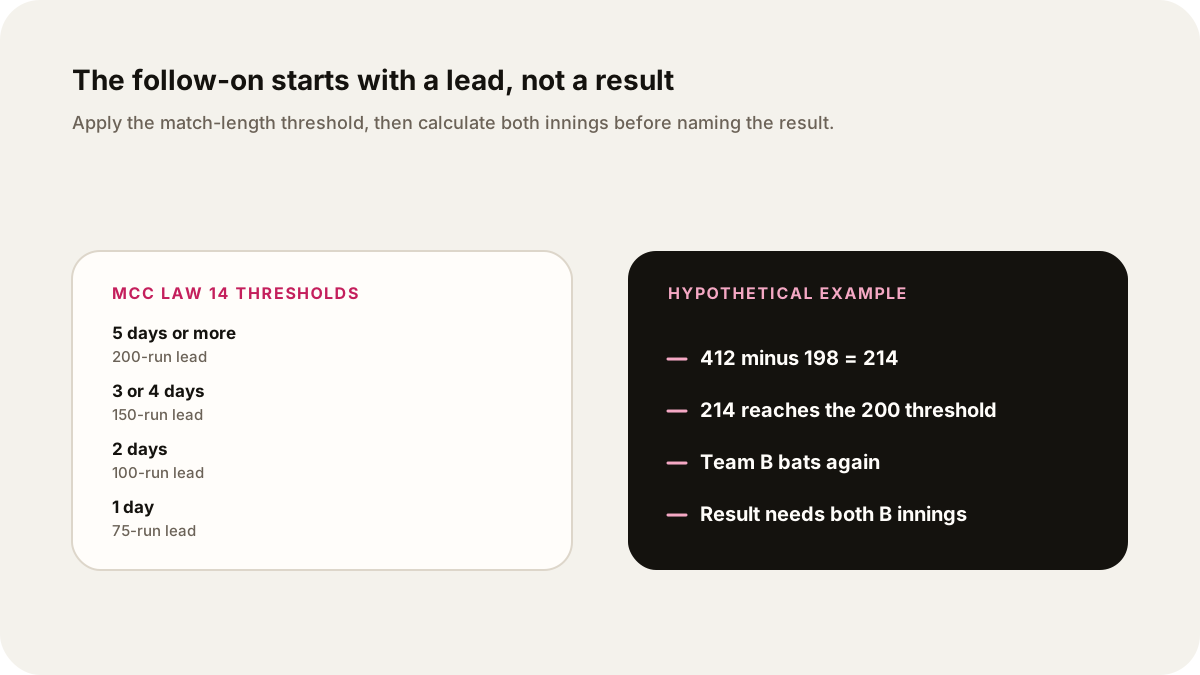
Under Law 14, in a two-innings match of five days or more, the side that bats first may enforce the follow-on when it leads by at least 200 runs. Shorter matches have different minimum leads:
- Three or four days: 150 runs
- Two days: 100 runs
- One day: 75 runs
These are thresholds for the option. Reaching one does not force the captain to use it. The captain must notify the opposing captain and the umpires, and MCC says that notification cannot be changed.
There is a timekeeping detail for rain affected matches. If no play takes place on the first day of a match longer than one day, Law 14 applies the threshold for the number of days remaining from the start of play. The first day on which play begins counts as a whole day, even if only part of that day is available. A five-day match with its first day entirely lost therefore uses the four-day threshold of 150 runs, provided the match is a two-innings match under the relevant playing conditions.
Work a hypothetical five-day example
Hypothetical example, not a match result: Team A bats first and scores 412. Team B is dismissed for 198. Calculate the first-innings lead:
Team A:       412
Team B:     - 198
Lead:         214 runs
The lead is 214, which is at least 200. In this five-day example, Team A has the option to enforce the follow-on. If the captain does so, Team B starts its second innings next. Team A does not bat between B’s two innings.
Now imagine Team B scores 140 in that second innings. Its two innings total is 198 plus 140, or 338. Team A’s single innings total is 412. The difference is 412 minus 338, or 74. If all other conditions for a completed match are met, the result would be an innings victory by 74 runs. The phrase “innings” describes the fact that Team A needed only one innings; “74” is the run difference after both of Team B’s innings are counted.
Change the second-innings score to 230. Team B’s combined total becomes 198 plus 230, or 428. That is 16 more than Team A’s 412, so the follow-on has not produced an innings defeat. Team A would need to bat again and chase the target set by the match situation. The order and the result are separate questions.
What the rain exception does and does not do
The lost-first-day clause changes which lead threshold applies. It does not erase the runs already scored, turn a four-day match into a five-day match, or guarantee that a captain will enforce the follow-on. It also applies to the first day only in the wording of Law 14. A later rain interruption may affect playing time and competition regulations, but it is not the same calculation.
International matches can also have playing conditions that sit alongside the Laws. For an audio explanation, name the competition and use its published conditions when they change a general Law. MCC notes that governing bodies can create subtle differences in playing regulations.
Build the explanation for listening
Say the match length, first innings scores, subtraction, threshold, and decision in that order. A listener can then hold one number at a time:
- “This is a five-day, two-innings match.”
- “Team A made 412 and Team B made 198, so A leads by 214.”
- “The five-day threshold is 200, so A may enforce the follow-on.”
- “The captain chooses it and notifies the captain and umpires.”
- “Team B bats again. The follow-on is the order; the final result depends on the second innings.”
An example Lissin request could be: “Explain this scorecard using MCC Law 14. State the match length, subtract the first-innings scores, identify the applicable threshold, and say whether the follow-on is an option. Then calculate whether the later score would produce an innings defeat. Label every invented score as hypothetical and link the law and the competition conditions.”
For another sport rule guide, see rugby union scoring. Baseball box-score listening shows a different way to turn a scorecard into a spoken sequence. For a source-led explanation workflow, see how to verify an AI-generated news summary.
Sources
- MCC, Laws of Cricket 2017 Code, 4th Edition 2026, Law 14: lead thresholds, notification, and the lost-first-day rule.
- MCC, About the Laws of Cricket: MCC’s role as custodian of the Laws and the relationship with governing-body playing conditions.
- MCC, Law 16: The result: the result law for a two-innings match.