
Rugby union points: a guide for an audio match recap
Name each scoring event, apply its point value and check the running total against the match record.
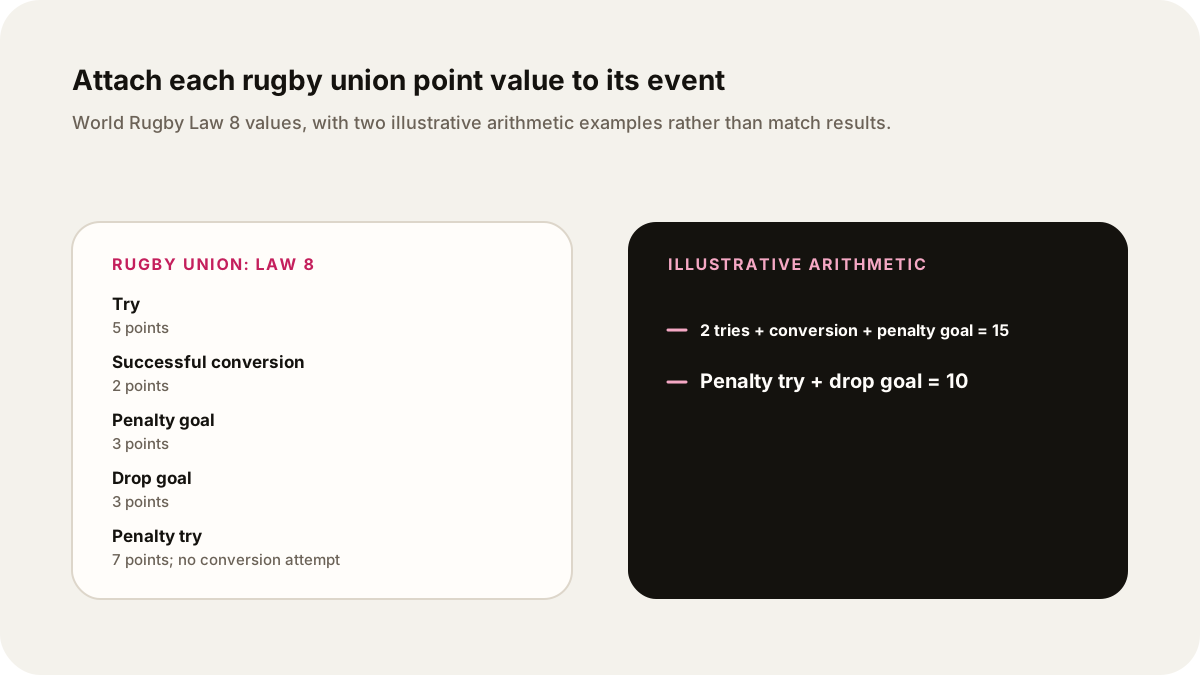
Rugby union has several ways to score, and the scoreboard makes more sense once each one has a name. A try is five points, a successful conversion is two, a penalty goal is three, and a drop goal is three. A penalty try is seven points and needs no conversion.
This guide is for a listener in Britain or Australia who wants to follow a union match without confusing a try with a penalty or carrying rules from another code into the explanation. The point values come from World Rugby Law 8. The examples below are invented arithmetic, not a real match report.
Name the scoring event first
World Rugby gives five point values in Law 8. A try is worth five points. The team that scores a try gets the right to attempt a conversion, worth two points if successful. A penalty goal is three points. A dropped goal, usually called a drop goal in everyday commentary, is also three points. A penalty try is seven points, and Law 8.3 says no conversion is attempted.
That last item is easy to miss in audio. A penalty try is awarded when foul play prevents a probable try, or prevents a try from being scored in a more advantageous position. It is not a try followed by a second kick. Say “penalty try, seven points, no conversion” in one sentence so the listener does not wait for a kick that will not happen.
The conversion belongs to the try that came before it. It is not a free-standing score. World Rugby explains that the kick is taken on a line through where the try was awarded, parallel to the touchlines. That location rule matters when a commentator says the kick is difficult because the try was scored near the sideline. The value stays two points; the angle changes.
Check the code and competition
“Rugby” can mean different codes, and their scoring systems are not interchangeable. This article uses rugby union and the current World Rugby law page. A source that discusses rugby league, rugby sevens variations, or another competition's modified rules needs its own label. Do not borrow a point value from a different code simply because the word rugby appears in the headline.
For a source-led audio briefing, open the competition and match source first. Record the code, competition, teams, date, and source check time. Then make a small event list: try, conversion, penalty goal, drop goal, or penalty try. If a report uses “penalty” without saying whether the kick was successful, leave the result open until the match record supplies it.
Work through a hypothetical score
Illustrative arithmetic, not a real match: imagine a union side scores two tries. The first conversion succeeds and the second conversion misses. The same side also kicks one penalty goal. Its score is:
try:             2 x 5 = 10
successful kick: 1 x 2 =  2
penalty goal:    1 x 3 =  3
total:                    15
The missed conversion contributes zero. The two tries remain ten points because a conversion is a separate attempt after each try. An audio recap can say: “In this example, two tries, one successful conversion, and one penalty goal add up to 15.” It should not call 15 a match result or imply that the events happened in a named fixture.
Here is a second illustrative example. A side receives one penalty try and later kicks a drop goal. The total is seven plus three, or ten points. No conversion is added to the penalty try. That sentence is enough for a listener to hear the distinction between a penalty try and a regular try with a conversion attempt.
Turn a score into a listening outline
Use the match record as the source of events and Law 8 as the rule source. A short episode can follow this order:
- Set the frame. Say “rugby union,” name the competition and match, and give the source and check time.
- Read the event. Identify the minute, team, and scoring method when the record supplies them.
- Apply the value. Explain five, two, three, three, or seven points, keeping a missed kick at zero.
- Show the running total. Add the event to the team's previous total instead of reading an unexplained final number.
- Check the exception. If it is a penalty try, say that no conversion is attempted.
- Link the sources. Put the match record and World Rugby law page in the notes so a listener can check the wording.
An illustrative request for a personal audio show could be: “Explain this rugby union score from the official match record. Name each scoring event, apply World Rugby Law 8, show the running totals, and mark any missing or unclear event. Keep the code as rugby union. Do not invent a result or borrow rules from rugby league. Put the match record and Law 8 in the episode notes.” That request keeps the explanation tied to the match record and the law page.
After adding each scoring event, compare your running total with the official match record. If they differ, check the sequence for a missed kick, an omitted event or a penalty try before recording the recap.
Sources
- World Rugby Passport, Law 8: Scoring: current point values, penalty try rule, and conversion conditions.
- World Rugby, Scoring points: beginner explanations of tries, conversions, penalty goals, penalty tries, and drop goals.
- World Rugby, Laws of the Game: official law library and code context.
For a different kind of source-led score explanation, see how to read a baseball box score. For a general research-to-audio workflow, see turning a PDF into a podcast. Source links and corrections shows how to keep the evidence with the episode.