
Indoor volleyball rotation positions: when players rotate and where they stand
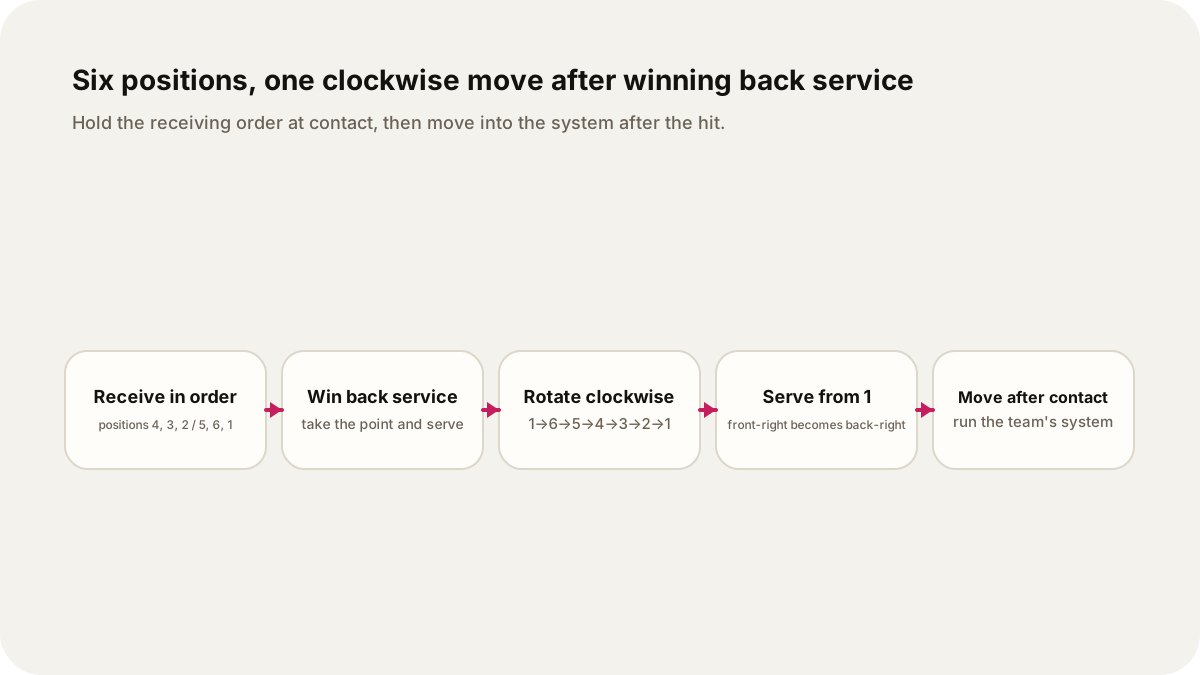
The receiving team keeps its rotational order until the service hit. After that hit, players may move, and a team rotates clockwise only when it wins back the right to serve.
If you watch indoor volleyball and wonder why six players shuffle before one serve, the short answer is this: the receiving team must keep its rotation order until the server hits the ball. After that hit, players can move to the places their tactics require. A team rotates when it wins a rally while receiving, earns the right to serve, and moves one place clockwise before the next serve.
This guide uses the current FIVB Official Volleyball Rules 2025–2028 for indoor volleyball. It explains the positions, the order at the service hit, and the moment when players may move. Competition organizers can adopt approved trials or local modifications, so check the event rules if a referee describes a special test.
The six positions have fixed numbers
The numbers describe court positions, not permanent jobs or player names. The three front-row positions are 4 at front-left, 3 at front-centre, and 2 at front-right. The three back-row positions are 5 at back-left, 6 at back-centre, and 1 at back-right. The FIVB rules use this numbering in Rule 7.4.1.
| Row | Left | Centre | Right |
|---|---|---|---|
| Front | 4 | 3 | 2 |
| Back | 5 | 6 | 1 |
Think of the six places as a loop. A complete clockwise rotation is 1 to 6, 6 to 5, 5 to 4, 4 to 3, 3 to 2, and 2 to 1. In plain language, the player at back-right moves to the back-centre, the back-centre player moves to back-left, and the front-right player eventually becomes the next server when that team wins back the serve.
The numbers do not tell you who is the setter, middle blocker, outside hitter, or libero. Those are playing roles. A lineup uses the numbered positions to control the order, then players often move after the service so they can perform their normal jobs.
When does a team rotate?
Under rally scoring, every rally awards a point. If the serving team wins, it keeps the serve and does not rotate. If the receiving team wins, it gets a point and the right to serve. Before that service, it rotates one position clockwise. The player who moves from position 2, front-right, to position 1, back-right, serves next.
That timing matters. A receiving team does not rotate simply because the other team served. It rotates only when it wins the rally and takes back service. Once it has rotated and the referee has authorized the next serve, the player in position 1 is the server.
There is a libero qualification. Under FIVB Rule 19.3.1.3, a libero may not serve, block, or attempt to block. So “the player in position 1 serves” means the eligible player assigned to that service turn. If a libero has replaced that back-row player, the libero must leave before the service turn and the eligible player returns to serve. The rotation order still tells you which service turn it is; the libero rule tells you who may take it.
Why the competition rulebook matters
This is where a quick internet explanation can mislead a listener. USA Volleyball’s 2025–2027 indoor rules include a libero-serving provision for one rotation position, and its rulebook describes a second-position libero serve as a rotational fault. The current FIVB rule used in this guide is stricter: Rule 19.3.1.3 says the libero may not serve at all. If you are watching a USAV event, use the USAV rulebook; if you are following an FIVB competition, use the FIVB edition. The court numbers may look identical while the libero service answer differs.
What must be true at the service hit?
The FIVB rule is about relative position. At the instant the server hits the ball, each team must be in its own court, apart from the server. The receiving team must be in its recorded rotational order. The serving team is free to occupy any position at that instant under the current 2025–2028 edition.
For the receiving team, each back-row player must be level with or farther from the centre line than the corresponding front-row player. Players in the same row must also keep their left-to-right order. Referees judge the positions by the players’ feet and the last contact with the floor. The question is not where a player’s shoulders point or where a player will run next.
As soon as the service hit happens, both teams may move around their own court and free zone. That is why a setter can appear to start in an unusual place and then run to the setting position, or why a middle blocker may cross behind a teammate after the ball is served. The pre-serve order protects fairness; the post-serve movement enables tactics.
A six-player trace: two rally outcomes, two different decisions
For example, in an illustrative sequence rather than a real match, six eligible Blue players start a set in this receiving order:
             net
       Ana        Brooke       Chen
       Diego      Elena        Farah
        4           3            2
        5           6            1
The names are only a way to hear the sequence. FIVB Rule 7.4.1 supplies the numbered positions; Rule 7.6.2 supplies the clockwise move.
Case one: Blue wins while receiving
Blue wins the rally. Under Rule 6.1.3.2, Blue scores and must serve next. Before the serve, Blue rotates one place clockwise:
- Farah moves from 1 to 6.
- Elena moves from 6 to 5.
- Diego moves from 5 to 4.
- Ana moves from 4 to 3.
- Brooke moves from 3 to 2.
- Chen moves from 2 to 1.
Chen is the eligible player in position 1, so Chen serves. That is the service-order result, not a claim that the player must stay at back-right after the hit. Rule 7.4.4 allows Blue to move after the service hit, so Chen may move toward the setting area while another player covers the back court.
Case two: Blue wins while already serving
Blue serves again with Chen as the service-turn player. If Blue wins this rally, Rule 6.1.3.1 says Blue scores and continues to serve. Blue does not rotate. Chen serves again under Rule 12.2.2.1. If Blue loses the rally instead, the other team scores and serves next. Blue does not rotate because it is returning to receive; the other team rotates before its service.
For instance, add a libero without changing the service order. Suppose libero Lina has replaced Farah in back-row position 6. Lina may play that back-row spot, but Rule 19.3.1.3 says a libero may not serve, block, or attempt to block. If the rotation later brings Farah's service turn to position 1, Lina leaves and Farah returns to serve. The lineup order identifies the turn; eligibility identifies the server.
| Rally result | Does Blue rotate? | Who serves next? | Rule-backed reason |
|---|---|---|---|
| Blue wins while receiving | Yes, one place clockwise | The eligible player moving from 2 to 1 | FIVB Rules 6.1.3.2, 7.6.2, 12.2.2.2 |
| Blue wins while serving | No | The same service-turn player | FIVB Rules 6.1.3.1, 12.2.2.1 |
| Blue loses while serving | No | The opponent rotates and serves | FIVB Rules 6.1.3.2, 7.6.2, 12.2.2.2 |
Rotation fault versus tactical movement
A positional fault happens when a player is out of the correct relative position at the service hit. Rule 7.5.4 awards the opponent a point and service and requires the positions to be rectified. A rotational fault is different: under Rule 7.7.1, the service was made out of the recorded rotational order. That fault concerns who served and when, rather than whether two receiving players were standing in the right left-to-right and front-to-back relationship. Movement after the hit is allowed under Rule 7.4.4, so a player crossing the court after contact is not automatically either fault.
Keep two questions separate when listening to commentary:
- Did the team rotate at the right time? It rotates after winning back service, before serving.
- Were the receiving players in the right relative order at contact? If yes, they may move immediately after the hit.
The server also has a separate service-zone requirement. At the service hit or jump-service takeoff, the server must not touch the court or the floor outside the service zone. That is a service fault question, not a rotation-position question.
An audio-friendly way to follow rotation
If you are making a personal listening guide, state the rule before naming the players: “Receiving team holds its order at service contact; both teams can move after the hit.” Then describe positions by number and row. “Blue has 2 at front-right and 1 at back-right” is easier to follow than a rapid list of names without a court reference.
An illustrative request for an audio show could be: “Explain indoor volleyball rotation positions using the FIVB Official Volleyball Rules 2025–2028. Name positions 1 through 6, show the clockwise move after a receiving team wins the rally, and explain that the receiving team must keep its order at the service hit while the serving team is free to stand anywhere. Use the FIVB PDF and link it in the notes. If the competition uses a rule test, label that separately from the current edition.” This is a hypothetical prompt for a source-linked explanation, not a claim about a real match.
For another source-led sports explanation, see how rugby union scoring works, how a tennis tiebreak is scored, and how to read a football offside decision. When you turn rules into audio, keep source links and corrections with the episode so a listener can check the exact edition.
Sources
- FIVB Official Volleyball Rules 2025–2028, English PDF, especially Rules 6.1.3, 7.4–7.7, 12.2.2, and 19.3.1.3.
- FIVB Official Volleyball Rules page, which identifies 2025–2028 as the current edition and lists previous editions separately.
- FIVB Basic Rules, a plain-language explanation of rally scoring and the clockwise rotation.
- USA Volleyball 2025–2027 Abridged Indoor Rules Book, including the one-position libero-serving provision and the rotational-fault wording.