
Tennis tie-break scoring and serving: an audio guide
Name the target, serving order and format before reading a tie-break score aloud.
At 6 games all, a tennis set can turn into a small scorekeeping puzzle. A tie-break is easier to follow when an audio recap names the target, the serving rotation, and the format before it reads the points. The rules below use the 2026 ITF Rules of Tennis. A tournament can announce an approved alternative, so check the event regulations before calling a result.
What the tie-break score means
In the standard tie-break game, points are called as zero, 1, 2, 3 and so on. The first player or team to reach 7 wins the game and set only with a lead of two points. At 7-6, play continues. At 8-6, it ends. The ITF also says that a tie-break set is used when each player or team has won six games, if that set method was announced for the event. ITF Rule 5 describes the point target and margin; Rule 6 describes the 6-6 set trigger.
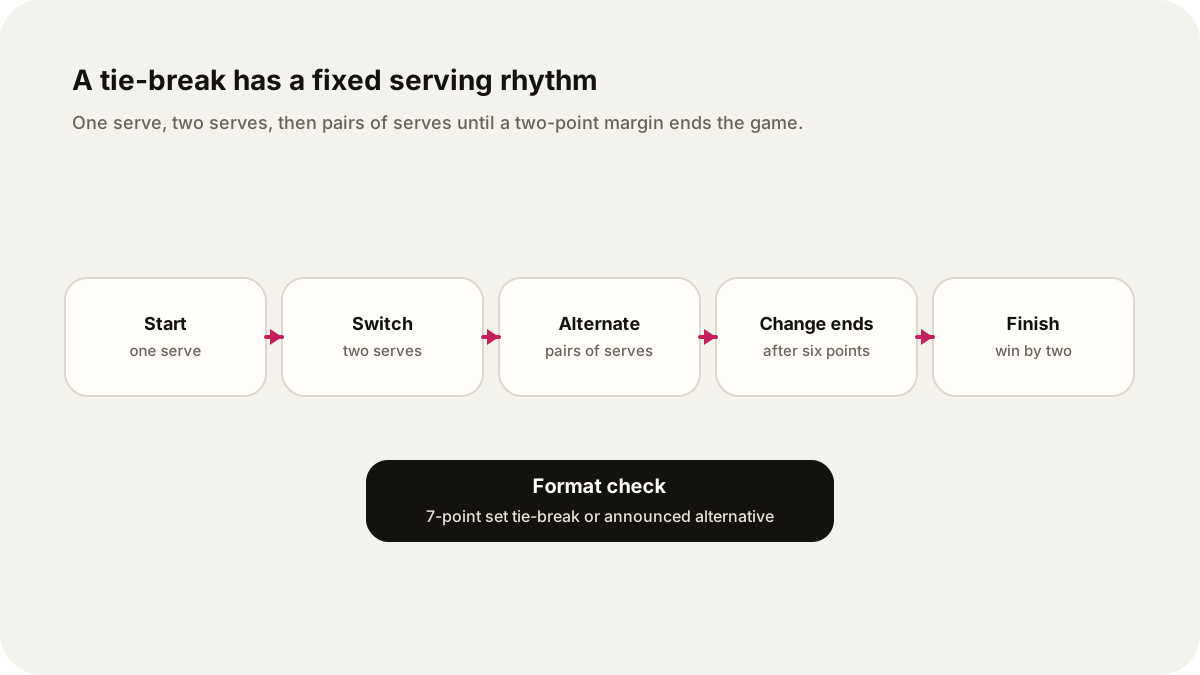
The score is a running count of points, not the familiar love, 15, 30, 40 sequence. Say “five points to four” rather than “30-15.” Players change ends after every six points under the standard procedure. That change does not add a point. It changes which side of the court each player uses for the next service and return.
How serving rotates
The player whose turn it is to serve starts the tie-break with one point. The opponent serves the next two points. After that, players alternate two serves each until the tie-break ends. In doubles, the opposing player due to serve next takes those two points, and the partners keep the same service rotation they used during the set. The player or team that served first in the tie-break receives in the first game of the next set.
Here is a spoken way to keep the sequence audible:
“At 6-6, Alex serves point one. Blake serves points two and three. Alex serves points four and five. Blake serves points six and seven. The players change ends after point six. Alex serves points eight and nine.”
The example describes the order only. It does not claim that a real match happened. If the score reaches 6-6 in the tie-break, the two-point margin still applies. A score of 7-7 means at least two more points are needed, while 8-7 does not finish it.
A worked example, clearly hypothetical
Imagine a singles tie-break in which Alex wins points 1, 3, 4, 6, 8 and 10. Blake wins points 2, 5, 7, 9, 11 and 12. The running score after point 11 is Alex 6, Blake 5. Blake wins point 12, making it 6-6. Alex then wins points 13 and 14, so the final tie-break score is 8-6. The set score becomes 7-6 to Alex.
For an audio recap, keep the set and tie-break scores separate: “Alex won the set 7-6, taking the tie-break 8-6.” If you say only “Alex won 8-6,” a listener may mistake the tie-break score for the set score.
Tournament formats can change the target
The ITF rules include approved alternatives in Appendix VI. A match tie-break can replace a deciding final set. The listed match versions use either 7 points or 10 points, always with a two-point margin. A final-set tie-break may also be played at 6-6 in the deciding set, with the first to 10 by two. Appendix VI separately lists an approved change-of-ends procedure: change ends after the first point and then every four points. Treat that as the announced event procedure, distinct from the standard change after every six points.
Appendix VI also includes short sets and a five-point short-set tie-break. In that five-point version, the sanctioning body determines the order and number of serves. The ITF foreword says limited tournament trials can also receive approval, and those variations may not appear in the published rules. A recap should therefore name the event's format: “This match uses a 10-point match tie-break instead of a third set.”
For a Lissin show, try this example request: “Explain this tennis tie-break from the official match sheet. State whether it is a standard 7-point set tie-break, a 10-point match tie-break, or another announced format. Read the serving rotation, change-of-end points, final set score and tie-break score. Mark invented examples as hypothetical and link the ITF rule.”
For related score-reading practice, see the baseball box score audio recap, the rugby union points guide, and how to explain a chart aloud.
Sources
- ITF 2026 Rules of Tennis: Rules 5, 6 and 10, plus Appendix VI on alternative scoring methods.
- ITF Rules and Regulations: current rules page and links to the 2026 rulebook and Grand Slam rulebook.