
What makes a number prime? Why 1 is not prime
A prime number has exactly two different positive factors. See why 1 is excluded, how prime factorisation stays unique, and how to test 29 without checking every smaller number.
Is 1 a prime number? It looks like a good candidate at first. It can be divided by 1, and it can be divided by itself. The catch is that those are the same divisor. A prime number must have exactly two different positive factors: 1 and the number itself. That is why 2, 3, 5, and 7 are prime, while 1 is not.
Key takeaway: A prime number is a whole number greater than 1 with exactly two different positive factors. The number 1 has only one positive factor, so it is neither prime nor composite.
What does “prime” mean in mathematics?
A factor is a whole number that divides another whole number evenly. The factors of 12 are 1, 2, 3, 4, 6, and 12 because each one leaves no remainder when dividing 12.
A prime number is a whole number greater than 1 with exactly two different positive factors. Cambridge Dictionary describes the same rule as divisibility by no number except 1 and itself. Cambridge University Press’s mathematics material states the factor version directly.
The University of Cambridge’s Underground Mathematics glossary uses the same definition. These sources describe the standard positive-integer convention used in this guide.
The word different matters. For 1, the two phrases “1” and “itself” point to the same number. Its factor list is just [1]. It does not have two factors, so it does not meet the definition.
Prime, composite, or neither?
Numbers greater than 1 fall into two useful groups:
- A prime number has exactly two positive factors.
- A composite number has more than two positive factors.
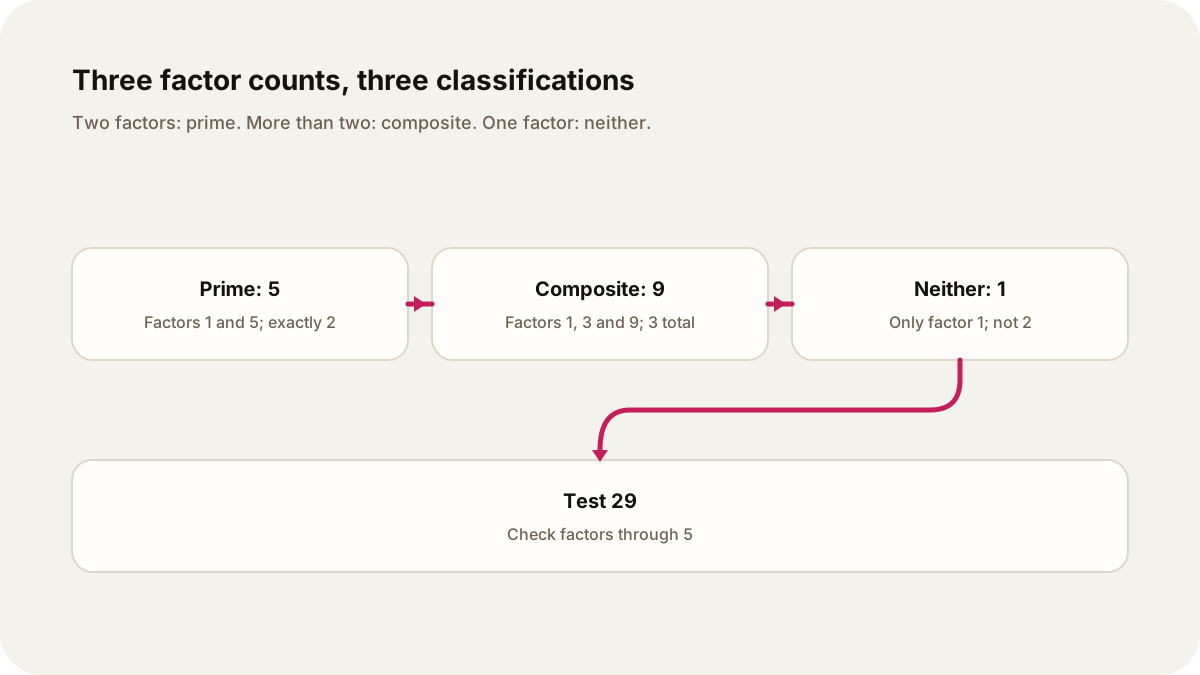
The number 5 is prime because its only positive factors are 1 and 5. The number 9 is composite because its positive factors are 1, 3, and 9. The number 12 is composite because it has six positive factors.
The number 1 sits outside both groups. It is not composite because it does not have more than two factors. It is not prime because it does not have exactly two. Saying “neither” is more precise than trying to force every whole number into one of those two labels.
Why 1 cannot be prime
The definition settles the question, but there is also a useful reason mathematicians keep 1 out of the prime list: unique factorisation.
Every whole number greater than 1 can be built by multiplying primes. For example:
12 = 2 × 2 × 3
18 = 2 × 3 × 3
45 = 3 × 3 × 5
These are prime factorizations. Apart from changing the order of the factors, each number has one prime factorisation. This is the idea behind the Fundamental Theorem of Arithmetic. NRICH’s introduction to number theory points out that 1 must not be counted as prime, or this uniqueness would fail.
If 1 were prime, the same number could be written in endlessly many ways:
6 = 2 × 3
6 = 1 × 2 × 3
6 = 1 × 1 × 2 × 3
The extra 1s would not change the value, but they would make the list of prime factors ambiguous. Leaving 1 out gives factorisation a clean stopping point: once the remaining factors are prime, the breakdown is finished.
How to test a number with a worked example
To test a small whole number, look for a divisor other than 1 and the number itself. If you find one, the number is composite. If you find none, the number is prime.
Take 29 as a hypothetical example. We could test every whole number from 2 through 28, but there is a shortcut.
If 29 had a factor pair, at least one factor would be no larger than the square root of 29, which is a little more than 5. Two factors both starting at 6 would already make 36. So any factor pair for 29 must include 2, 3, 4, or 5.
Testing the primes among those candidates means checking only 2, 3, and 5.
- 29 is not even, so 2 does not divide it.
- Its digits total 11, so 3 does not divide it.
- It does not end in 0 or 5, so 5 does not divide it.
No possible factor up to the square root works. Therefore 29 is prime. This test is a practical shortcut for applying the definition.
Now compare 21. It is not even, but 2 is not the only test. Its digits total 3, and 3 divides 21:
21 = 3 × 7
That extra factor proves that 21 is composite. We do not need to list every factor before reaching the answer.
A few patterns that help
The first prime is 2. It is the only even prime because every other even number can be divided by 2 as well as by 1 and itself. All other primes are odd, but an odd number is not automatically prime. The odd numbers 9, 15, and 21 are composite.
The Sieve of Eratosthenes is a way to find many primes in a range. Write down the numbers starting at 2. Cross out multiples of 2 after 2 itself, then do the same for the next number that remains, 3. Continue with 5, 7, and the later survivors. NRICH explains why the process only needs primes up to the square root of the upper limit. After that point, a composite number’s factor pair would already have been found in reverse order.
Patterns can narrow the search, but they do not replace testing. A number ending in 1, 3, 7, or 9 might be prime, or it might have a less visible factor. Check the candidate before calling it prime.
Explain primes clearly in audio
An audio guide should say the definition before listing patterns. Keep the factors audible: “one and five,” rather than only showing the symbols. Then use one prime and one composite example, and give 1 its own sentence so a listener does not mistake it for a special kind of prime.
For another numerical explanation, read area versus perimeter, which keeps two similar measurements separate. Mean versus median names the question before choosing the calculation. Litres and millilitres keeps units beside every number when a rule is spoken aloud.
The example below is hypothetical. It is a copyable prompt for an audio explanation:
Explain what makes a whole number prime for a general listener. Define factors, show why 5 is prime and 9 is composite, explain why 1 has only one positive factor and is neither prime nor composite, and test 29 by checking possible factors up to its square root. Say every arithmetic step aloud and keep the examples separate from real-world measurements.
Sources
- Cambridge Dictionary, “prime number”: plain-language definition of a prime number.
- Cambridge University Press, Cambridge IGCSE International Mathematics coursebook excerpt: definition using exactly two different factors and a Sieve of Eratosthenes investigation.
- University of Cambridge, Underground Mathematics glossary: “Prime number”: university mathematics glossary definition.
- NRICH, “An Introduction to Number Theory”: prime factorisation and why 1 is excluded from the primes.
- NRICH, “Sieve of Eratosthenes”: finding primes by crossing out multiples and stopping at the square root.