
Area vs perimeter: what a rectangle's measurements tell you
Perimeter measures the boundary. Area measures the surface inside it. A worked rectangle example keeps metres and square metres separate.
Perimeter measures the distance around a shape. Area measures the surface inside it. For a rectangle, the first uses P = 2L + 2W; the second uses A = L × W. The units change too: metres around the edge become square metres inside the shape.
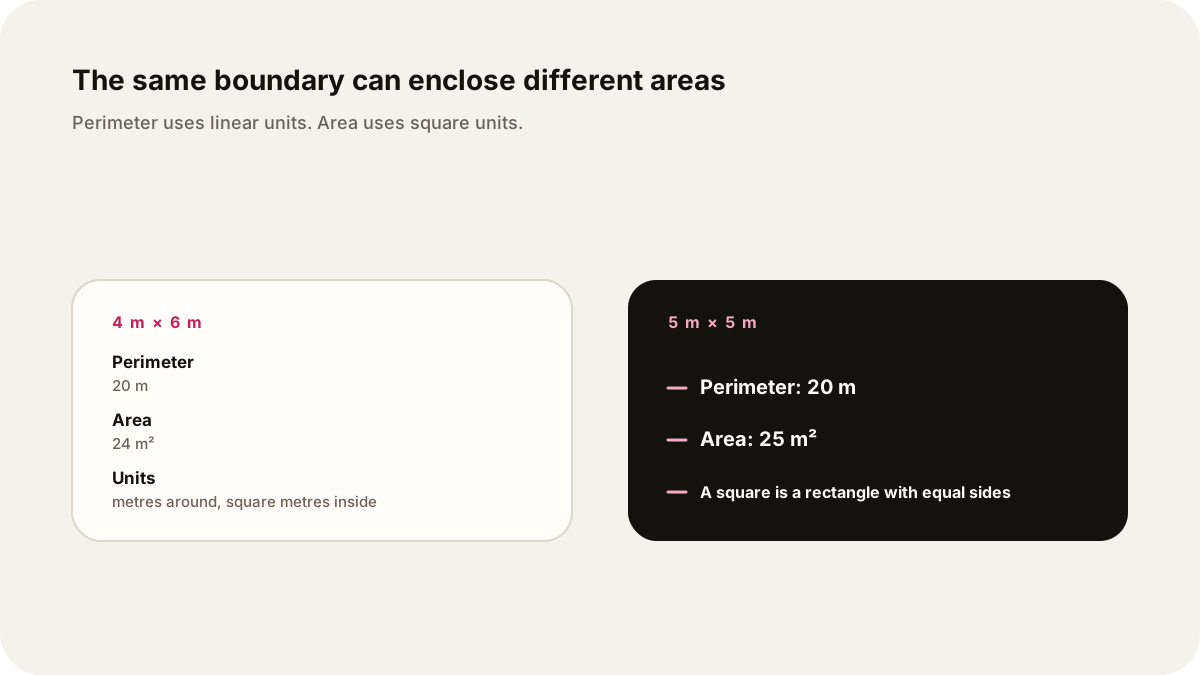
Key takeaway: Use perimeter for a length around an edge and area for the surface inside it. A 4 m by 6 m rectangle has a 20 m boundary and a 24 m² area. A different rectangle can have the same boundary length and a different area.
What perimeter and area measure
Perimeter is the total length of a closed boundary. If you trace all four sides of a rectangle, you add the length twice and the width twice. NIST defines perimeter as the continuous line forming a closed figure's boundary and area as the amount of space inside that boundary. Its measurement guidance also says to keep dimensions in the same unit and to express area in squared units.
Area counts the flat surface inside the shape. A rectangle that is 4 metres long and 6 metres wide has an area of 24 square metres because 4 m × 6 m = 24 m². The multiplication is why the result is square metres, rather than metres.
OpenStax gives the same rectangle formulas: P = 2L + 2W and A = L × W. Those formulas answer different questions. Perimeter tells you how long the boundary is. Area tells you how much surface lies inside it.
A 4 m by 6 m example
For example, take a hypothetical rectangle used only to show the arithmetic. Assume its sides are exactly 4 metres and 6 metres. No property or physical space is being measured.
The perimeter is:
P = 2L + 2W
P = 2(6 m) + 2(4 m)
P = 20 m
The area is:
A = L × W
A = 6 m × 4 m
A = 24 m²
The numbers are both correct because they describe different measurements. Saying “20 metres” answers the boundary question. Saying “24 square metres” answers the inside-surface question.
Same perimeter, different area
A perimeter by itself does not tell you a rectangle's area. It tells you the sum of its length and width after the sides are paired. Many pairs can have the same sum.
Compare these two hypothetical cases:
| Rectangle | Perimeter calculation | Area calculation |
|---|---|---|
| 4 m by 6 m | 2(6) + 2(4) = 20 m | 6 × 4 = 24 m² |
| 5 m by 5 m | 2(5) + 2(5) = 20 m | 5 × 5 = 25 m² |
Both boundaries measure 20 metres. Their areas differ by 1 square metre. The second shape is a square, which is a rectangle with equal sides. The examples show why “the perimeter is 20 m” is not enough information to calculate one area unless you also know the dimensions or another condition that fixes them.
If you know a rectangle's perimeter and one side, you can find the other side. For a 20 m perimeter and a 6 m length:
20 = 2(6) + 2W
20 = 12 + 2W
W = 4 m
Then the area is 6 m × 4 m, or 24 m². Without that extra side length, the area remains undetermined.
Why doubling lengths makes area four times larger
Suppose the 4 m by 6 m rectangle is enlarged so every linear measurement doubles. Its new sides are 8 m and 12 m.
The new perimeter is:
2(8 m) + 2(12 m) = 40 m
That is twice the old perimeter of 20 m. The new area is:
8 m × 12 m = 96 m²
That is four times the old area of 24 m². Algebra shows why. If the original sides are L and W, the original area is L × W. Doubling both sides gives (2L) × (2W) = 4LW. The perimeter doubles because each length in its sum doubles. The area quadruples because two multiplied lengths each double.
This scaling rule applies to a shape when all its linear dimensions change by the same factor. Doubling only one side changes the result differently, so say which measurements changed before comparing areas.
Keep the units audible
Units are part of the answer, especially in audio. Say “20 metres” for the perimeter and “24 square metres” for the area. A listener should hear the distinction between a length and a surface measurement.
Convert both rectangle dimensions to the same unit before multiplying. If one side is in metres and the other is in centimetres, convert first. OpenStax's area guidance states that both measures must use the same unit to produce a correctly labeled square unit. NIST gives the same practical instruction for measurement calculations.
Do not turn a worked example into a claim about an actual garden, room, plot, or building. These dimensions are hypothetical. An actual boundary may have curves, corners, openings, or an irregular outline, and a rectangle formula would then be only a model of part of the situation.
A short audio explanation
An episode can answer the question in this order:
- Define perimeter as distance around the boundary.
- Define area as the surface inside the boundary.
- State the rectangle formulas and their units.
- Work through 4 m by 6 m: 20 m around and 24 m² inside.
- Compare it with 5 m by 5 m: the same 20 m perimeter but 25 m² of area.
- Repeat the scaling rule: double every side, and perimeter doubles while area becomes four times larger.
An example Lissin request could be: “Explain perimeter and area for a general listener. Use hypothetical 4 m by 6 m and 5 m by 5 m rectangles, say the units aloud, and explain why the same perimeter does not determine one area. Do not imply that these dimensions describe a real property.”
The mean or median guide also keeps a formula tied to the question it answers. The percentage points guide uses the same habit of stating the starting values and units before comparing results. For map distances, see what 1:25,000 map scale means, which explains why a measured line and the ground distance it represents need separate labels.
If an audio explanation mixes metres with square metres, return to the dimensions and units in the original source. Lissin’s editorial standards cover source links and corrections; contact Lissin with the line that needs checking.
Sources
- NIST, Circumference, Area and Volume, accessed 9 October 2026. Definitions of perimeter and area, rectangle area, and same-unit and squared-unit guidance.
- OpenStax, Prealgebra 2e, section 9.4, accessed 9 October 2026. Rectangle perimeter and area formulas and worked examples.
- OpenStax, Contemporary Mathematics, section 9.2, accessed 9 October 2026. Same-unit requirement for multiplying rectangle dimensions and square-unit explanation.
- University of Oxford, mathematics diagnostic, accessed 9 October 2026. University example treating perimeter and area as separate properties of a rectangle.