
Why Earth has seasons, and why June reverses in Australia
The seasons follow Earth’s tilt. June turns the Northern Hemisphere toward the Sun and the Southern Hemisphere away from it.
June can mean beach weather in Toronto and winter coats in Melbourne. The date is the same. The season is different because Earth’s axis stays tilted as Earth travels around the Sun.
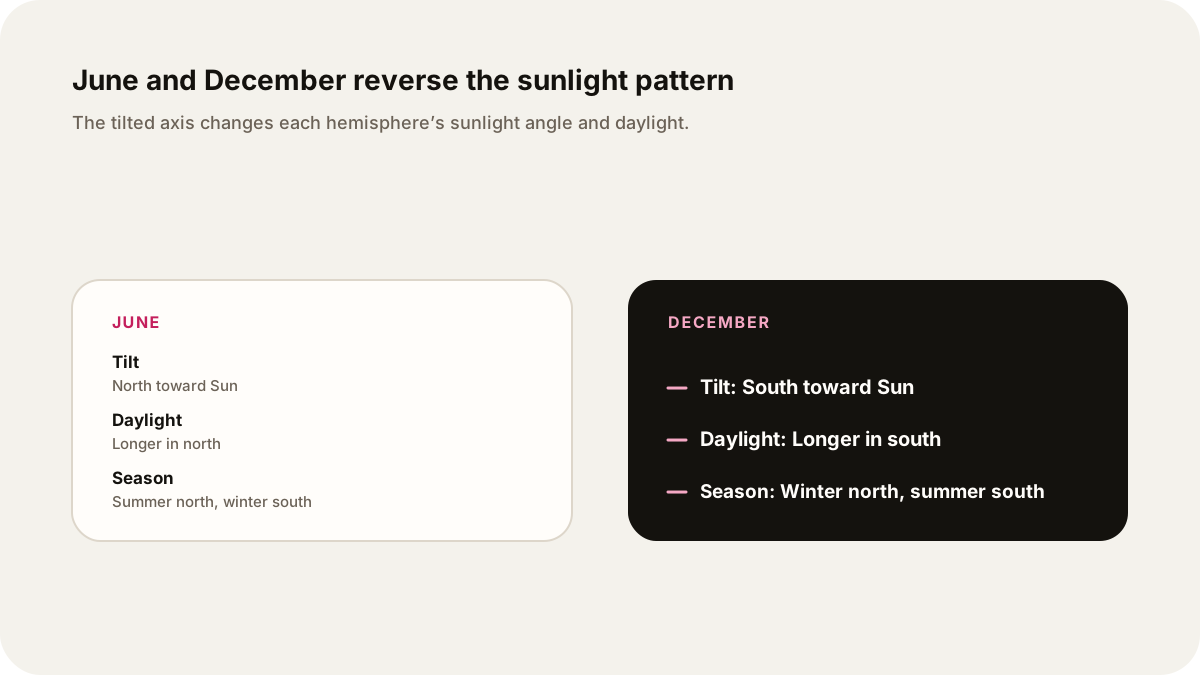
That tilt changes two things at each location: how directly sunlight arrives and how long the Sun stays above the horizon. In June, the Northern Hemisphere tilts toward the Sun, so the United States, Canada, and the United Kingdom move into their summer. The Southern Hemisphere tilts away, so Australia moves into winter.
Key takeaways
- Earth’s axis is tilted about 23.4 degrees from a line perpendicular to the plane of its orbit.
- June brings longer days and more direct sunlight to the Northern Hemisphere, while the Southern Hemisphere gets shorter days and less direct sunlight.
- December reverses the arrangement.
- Earth is actually a little closer to the Sun in January than in July. Distance is not the main cause of the seasons.
- “Summer” and “winter” can describe astronomical seasons or local weather patterns. The labels need a hemisphere and a definition.
Earth’s tilt changes the angle of sunlight
Earth rotates around an imaginary line from the North Pole to the South Pole. That line is tilted about 23.4 degrees from the line perpendicular to Earth’s orbital plane. NASA says the tilt causes the yearly cycle of seasons: when a hemisphere points toward the Sun, the Sun is higher in that hemisphere’s sky and its light is more direct.
More direct light puts the same solar energy over a smaller area. Slanting light spreads the energy over a larger area. This is one reason a Northern Hemisphere location receives stronger heating in its summer and weaker heating in its winter. The atmosphere, ocean, land, snow, and local circulation also affect weather, but they do not replace the geometry that starts the yearly pattern.
The tilt does not switch on and off. Earth keeps the same general orientation as it orbits. In June, the North Pole leans toward the Sun. About six months later, in December, the South Pole leans toward the Sun. Earth’s position in its orbit changes which hemisphere receives the more direct light.
Longer days add more sunlight
The Sun’s angle is only half the explanation. A hemisphere tilted toward the Sun also has longer daylight hours. The Sun rises earlier, reaches a higher path across the sky, and sets later. A place receives solar energy for more of the day, while the opposite hemisphere has shorter days and longer nights.
NOAA describes the combined effect as a change in the amount of radiation each place receives over the year. NASA’s Earth facts page gives the same summary: higher Sun angles produce greater solar heating, while less direct heating produces winter in the other hemisphere.
The effect is strongest away from the equator. Near the poles, the difference in daylight can become extreme. Around a Northern Hemisphere summer, parts of the Arctic can receive nearly continuous daylight. Around the Northern Hemisphere winter, the same region can have very long darkness. Near the equator, day length changes less, so local wet and dry seasons may matter more than a four-season calendar.
Why June reverses between Australia and North America
For example, imagine June 21, near the Northern Hemisphere summer solstice. The Northern Hemisphere is tilted toward the Sun. A listener in London, Toronto, or California has longer daylight and a higher midday Sun than during that location’s winter. Astronomically, this is northern summer.
At the same moment, Australia is in the Southern Hemisphere. Its half of Earth tilts away from the Sun. A listener in Melbourne, Sydney, or Perth has shorter daylight and a lower midday Sun than during Australian summer. Astronomically, this is southern winter.
| Question | June in the Northern Hemisphere | June in the Southern Hemisphere |
|---|---|---|
| Axis direction | Hemisphere tilted toward the Sun | Hemisphere tilted away from the Sun |
| Sunlight angle | More direct | More slanted |
| Daylight | Longer days, shorter nights | Shorter days, longer nights |
| Season label | Astronomical summer | Astronomical winter |
| Examples | US, Canada, UK | Australia |
The table describes astronomical geometry. It does not promise a particular temperature on a particular day. A cold June day in London and a warm June day in Melbourne can happen without changing the reason the seasons are opposite.
December reverses the picture
In December, the South Pole tilts toward the Sun. Australia receives more direct sunlight and longer daylight, so it enters astronomical summer. The United States, Canada, and the United Kingdom receive less direct sunlight and shorter days, so they enter astronomical winter.
The June and December solstices mark the two points when one hemisphere has its longest day and the other has its shortest day. The exact calendar date and clock time vary by year and time zone. A guide should name the solstice and the hemisphere instead of treating “summer solstice” as a worldwide season label.
Earth’s distance from the Sun is a distraction
Earth’s orbit is slightly oval, so its distance from the Sun changes during the year. NASA and NOAA both point out why this does not explain the opposite seasons. Earth is closest to the Sun in early January and farthest in early July, roughly the reverse of the Northern Hemisphere’s warmest and coldest seasons.
Distance does affect the total sunlight Earth receives, but it changes the whole planet in the same direction. It cannot make June summer in Canada and winter in Australia at the same time. The tilt changes the angle and duration of sunlight by hemisphere, which is why it explains the contrast.
Equinox does not mean exactly 12 hours everywhere
At the March and September equinoxes, neither hemisphere tilts toward the Sun. The Sun is over the equator, and the two hemispheres receive roughly equal illumination. NASA describes the equinox as a moment when the Sun crosses the plane of Earth’s equator.
That does not guarantee exactly 12 hours of daylight and 12 hours of darkness at every location. NASA explains that the Sun is a disk, not a point, and that atmospheric refraction bends its light near the horizon. Latitude also changes when the day and night appear equal. The plain version is “near equal daylight,” with the local sunrise and sunset details checked separately.
NOAA also distinguishes astronomical seasons from meteorological seasons. Astronomical seasons follow solstices and equinoxes. Meteorological seasons use complete calendar months to make weather statistics easier to compare. Both systems are useful, but they answer different questions.
Turn the explanation into an audio guide
Ask Lissin for a source-linked episode that starts with the listener’s hemisphere:
Explain why Earth has seasons using NASA and NOAA sources. Define axial tilt, direct sunlight, solstice, and equinox in plain English. Compare June in the US, UK, and Canada with June in Australia using a small table. Explain why Earth’s distance from the Sun is not the main cause. Say that equinox daylight is near equal rather than exactly 12 hours everywhere. Separate astronomical season labels from local weather, and do not make a temperature forecast.
The satellite orbits guide gives a related example of turning orbital geometry into a listener-friendly comparison. The eclipse guide explains a different alignment problem, involving the Moon’s tilted orbit. For a current skywatching question, the October skywatching guide shows why an event explanation should stay separate from a promise about local visibility.
Keep NASA and NOAA links with the episode. They support the tilt, solstice, equinox, and distance explanations. A local weather service is still needed for a forecast, because the geometry of a season does not determine tomorrow’s temperature.
For a correction, use Lissin’s editorial standards or contact Lissin. The listener chooses what they want to hear, and Lissin makes the show around that choice.
Sources
- NASA, Facts About Earth: Earth’s 23.4-degree axial tilt, seasonal sunlight, and reversal between hemispheres. Observed 8 October 2026; overview page, not a local weather source.
- NOAA, Why does Earth have Seasons?: tilt, June and December hemispheres, and why Earth’s distance does not cause the seasons. Observed 8 October 2026; educational explanation with approximate distances.
- NASA, Seeing Equinoxes and Solstices from Space: 23.5-degree illustration, solstice orientation, and equinox geometry. Observed 8 October 2026; visual explanation, not a sunrise calculator.
- NASA, Embracing the Equinox: equinox timing, near-equal daylight, refraction, and latitude limits. Updated March 2026; observed 8 October 2026.
- NOAA, Meteorological Versus Astronomical Seasons: distinction between astronomical and meteorological season definitions. Observed 8 October 2026; definitions do not predict local temperatures.