
Why does a sundial disagree with a clock?
A sundial follows the Sun's apparent motion. A clock follows mean solar time and civil-time rules, so their readings can differ even when both work.
A sundial can be working perfectly and still disagree with the clock on your wall. The sundial tracks the Sun's apparent motion. A clock keeps a uniform mean day, then adds the time-zone and daylight-saving rules used for civil time. The difference is a question of reference, date, and longitude.
This guide helps interpret a sundial, museum label, or old time reference. It separates the corrections so “solar noon” does not get confused with 12:00 on a clock.
Key Takeaways
- A sundial shows apparent solar time: the Sun's actual position at that place.
- The equation of time changes through the year because the apparent solar day is not exactly uniform.
- Longitude creates a constant local offset. In a time zone, one degree east or west of the defining meridian changes mean solar time by about four minutes.
- Daylight saving time follows local civil-clock rules, often a one-hour change. It is separate from the astronomical corrections.
What time does a sundial show?
A correctly installed sundial shows apparent solar time. When the Sun crosses the local meridian, the sundial reaches local solar noon. That event does not have to happen at 12:00 on a clock. The Royal Observatory Greenwich describes the time given by a sundial as true solar time.
The clock uses a different idea of a day. Mean solar time imagines a “mean Sun” moving at a steady rate, so noon follows a regular schedule. That steady rate makes clocks useful for appointments and timetables. The U.S. Naval Observatory explains that the equation of time measures the variable part of the difference between apparent solar time and mean solar time.
Two physical effects drive the seasonal variation. Earth's orbit is not a perfect circle, so the Sun's apparent eastward motion changes speed. Earth's tilted equator also changes the Sun's projected motion across the sky. Together they make some apparent solar days a little longer than the mean day and others a little shorter.
The equation of time, with its sign labeled
Sign conventions are the quickest way to get this topic backwards. In this article, use the U.S. Naval Observatory convention:
E = apparent solar time − mean solar time.
With that definition, a negative E means the sundial is behind the mean Sun. To convert a sundial reading to local mean solar time, use:
mean solar time = sundial time − E
For example, suppose a table for an illustrative date gives E = −7 minutes. If the sundial reads 12:00, local mean solar time is:
12:00 − (−0:07) = 12:07
The premise is deliberately stated as a worked example. The seven-minute value is not a forecast for every date. The USNO notes that the equation of time can put a sundial several minutes ahead of or behind local mean solar time, with the exact value depending on the date. Its July example gives about −7 minutes near the end of the month.
Older tables may define the correction in the opposite direction and tell you to add it. The arithmetic can be identical, but check the table's label before applying a sign. NIST's historical material is an example of a table that adds its values to a sundial reading.
Longitude adds a constant offset
The equation of time is only one part of the conversion. A time zone gives one civil-time reference meridian. Local mean solar noon occurs earlier or later according to the site's longitude.
The longitude difference is commonly expressed as about four minutes per degree, because Earth turns 360 degrees in 24 hours, or 15 degrees per hour. A site west of a zone's defining meridian reaches solar noon later on the shared zone clock; a site east reaches it earlier. Treat that as a location correction, and keep its reference meridian explicit before doing arithmetic.
NASA's StarChild timekeeping explanation gives the same four-minutes-per-degree relationship and notes that clock noon averages across a roughly 15-degree time-zone strip.
That offset is constant for the location. It does not rise and fall like the equation of time. A sundial can differ from a clock because of both corrections.
A complete worked example
Here are the premises for one deliberately simplified calculation:
- The sundial reads 12:00 apparent solar time.
- The equation of time is E = −7 minutes, using E = apparent − mean.
- The sundial is on the time zone's defining meridian, so there is no longitude correction in this example.
- The example first uses standard time, then assumes a one-hour daylight-saving shift for the civil-clock comparison.
First apply the equation of time:
Local mean solar time = 12:00 − (−0:07)
                      = 12:07
For this example, assume daylight saving advances the civil clock by one hour:
Daylight clock time = 12:07 + 1:00
                    = 13:07
So, under these premises, a sundial reading of 12:00 corresponds to a standard clock reading of 12:07 or a daylight clock reading of 13:07. The example is about the sign and order of corrections. It does not identify the correct equation-of-time value for a future date or promise that a physical sundial is perfectly aligned.
Other places use different daylight-saving shifts. The NSW Government lists Lord Howe Island’s 30-minute advance. The half-hour time-zone guide separates that shift from the island’s standard offset.
Why the clock may be right for its job
The sundial answers, “Where is the real Sun in this local sky?” The civil clock answers, “What time does this time zone and date convention assign to this instant?” A difference does not make either instrument wrong.
Mean solar time made uniform clocks possible. Standard time gave neighboring towns a shared schedule, and daylight saving can shift it for part of the year. Modern civil time is tied to UTC, while local solar time still varies with longitude. The USNO notes that civil time is close to local mean solar time only near a zone's defining meridian and when daylight time is not in effect.
This is why a museum sundial can be historically accurate without matching today's phone. It may predate a standardized time zone or include an equation-of-time curve. Read the inscription and sign convention before judging it.
How to interpret a sundial without recalibrating it
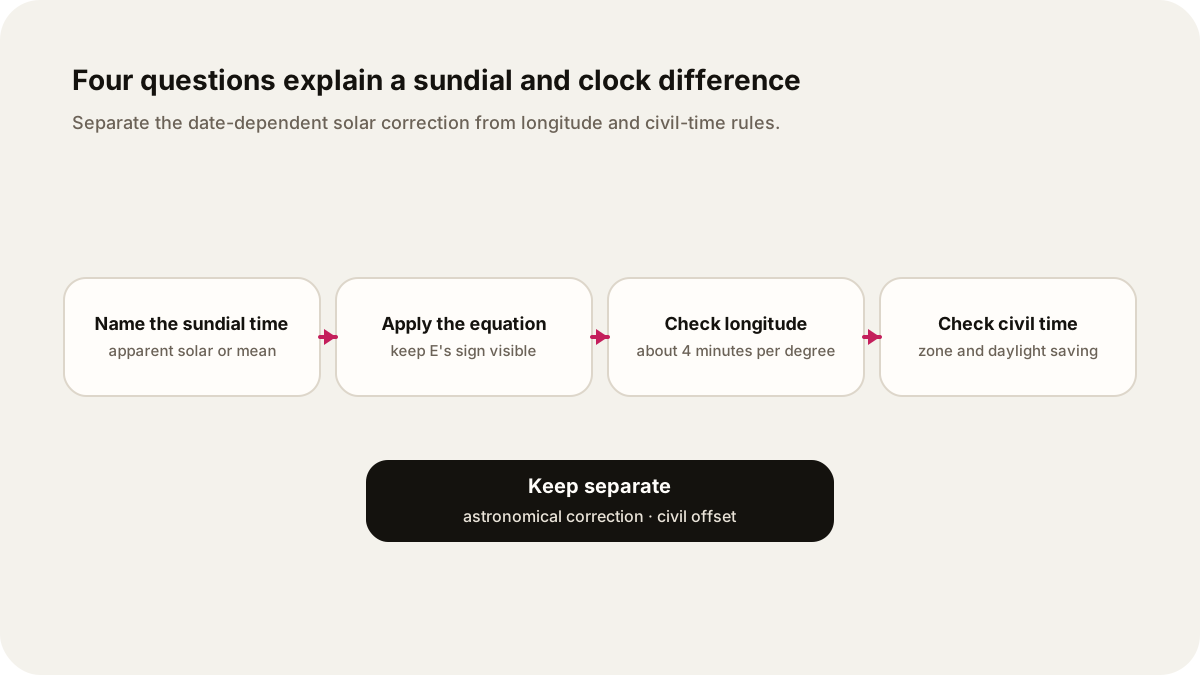
When you encounter a sundial, ask four questions:
- What does the dial claim to show? Look for apparent solar time, local mean time, or a correction graph.
- Where is it located? The longitude matters, especially if you are comparing it with a time-zone clock.
- What date is it? The equation of time varies across the year.
- Is civil time shifted? Check the time zone and whether daylight saving time applies.
The gnomon also has to be aligned for the place and latitude for the dial to give a meaningful reading. This guide does not infer an unverified latitude, installation angle, or current weather condition from a clock difference. A discrepancy alone cannot establish which part of a physical installation needs adjustment.
For a related astronomy explanation, why eclipses do not happen every month explains how orbital geometry limits a repeating sky event. The October skywatching guide takes a date-based approach to observing without turning a calendar into a forecast. If you want an audio explanation that keeps its source trail, keep source links and corrections with an AI-generated audio episode.
Sources
- U.S. Naval Observatory, The Equation of Time: definition, sign convention, seasonal correction, and longitude context.
- Royal Observatory Greenwich, The determination of precise time: true solar time and sundials.
- NIST, Recalibration continued: equation-of-time correction on sundials and the history of mean solar time.
- NIST, Time and Frequency from A to Z, S to So: seasonal range and the role of mean solar time.
- NASA StarChild, Get a Straight Answer: longitude and the four-minutes-per-degree solar-time relationship.
If a source or calculation needs correcting, contact Lissin with the passage and source link. See the editorial standards for correction handling.