
Duckworth-Lewis-Stern cricket targets: par score versus winning target
Rain can produce a par score and a winning target. Learn which question each number answers, and why wickets and overs both matter.
Rain removes time from a one-day cricket match and changes how much scoring and wicket-taking opportunity remains. A revised target can look strange if you compare it only with the first innings total. The Duckworth-Lewis-Stern method, usually called DLS, compares each side's resources.
This guide explains the two numbers you may hear during a rain-affected match: the par score and the winning target. The example is invented. It is a way to follow the calculation on a scoreboard, not a forecast or a match result.
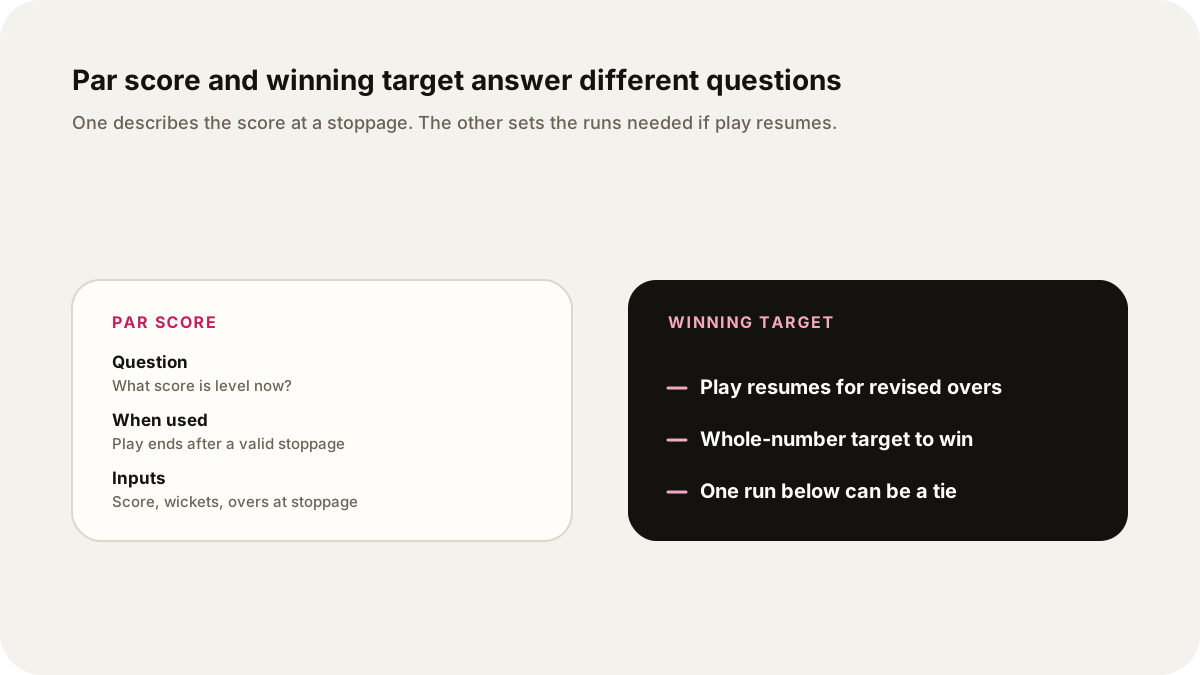
Key takeaway: Par asks what score is level at a stated match position. The winning target asks what total the chasing side must reach in the revised innings. Keep the overs, wickets and official number with the label; a target for future overs is not simply the earlier live par score plus one.
The short answer: DLS measures resources
The ICC uses DLS in interrupted limited-overs matches to recalculate a result when weather or another stoppage takes away playing time. Its inputs include overs available and wickets lost. Those two things represent the resources a batting side has left: time to score and batters able to use it.
The method is not a table of old run rates for every match. The ICC publishes a DLS methodology page with the current methodology, standard edition tables, and frequently asked questions. Officials and scoring systems use the applicable version and competition conditions.
That matters for listeners in Britain, Australia, the United States, and Canada. A local league, an international ODI, and a T20 competition can have different conditions. The ICC playing-conditions page lists current documents. Check the match document before treating a general explanation as the rule for a particular game.
Par score and winning target are different numbers
The par score answers this question: if play stopped at this exact moment, how many runs would the chasing side need to be level according to the DLS resource comparison?
The winning target answers a different question: if the chase is going to continue for a stated number of overs, how many runs does the chasing side need to win?
For a defined innings state, the target is normally one run above the par score. In an official T20 example, the target is a whole number and one run less produces a tie. When the innings ends permanently after the minimum conditions for a result are met, officials can compare the score with the par score at the stoppage. When more overs remain, they set a target for those revised overs, which reflects that future state rather than adding one to an earlier live par score.
So a broadcast may show a par score during a stoppage and later show a new target when the umpires confirm how many overs can be played. Do not treat the first number as the final chase requirement.
A hypothetical scoreboard, one interruption at a time
Imagine a fictional T20I. Team A scores 180 in its full innings. Team B reaches 72 for 2 after 8 overs when rain stops play. The score is not yet a DLS target. It is Team B's score and resource position at the interruption. Eight overs also clears the five-over minimum in the current ICC men's T20I playing conditions, although the exact result procedure still comes from that competition's document.
Suppose the officials decide that Team B can resume with 8 overs remaining. The DLS system compares the first innings with the resources available to Team B for the revised innings. The scorer might publish a revised target of 121 runs in total for Team B's innings. “121” is the total score Team B must reach, not 121 additional runs on top of its 72. That number is hypothetical; officials would produce the real number from the current DLS system.
If the match ends permanently at the 8-over, 72-for-2 state, the scorer may instead report a par score for that same moment, such as 78. If Team B has 72, it is six runs below par. If it has 78, it is level. If it has 79, it is one run above par. These figures illustrate the distinction only. They are not a reconstruction of a real match or an official DLS output.
The useful listening sequence is: “Team B has scored 72 for 2 after 8 overs. The officials have set a revised winning target of [official total] for the overs available.” If play stops for good, replace “winning target” with “par score at the stoppage.” A future target reflects its future resource state, so it is not a live par score plus one from an earlier stoppage.
Why wickets and overs both matter
Two chases with the same score can have different DLS positions. A side at 72 for 2 has more batting resources than a side at 72 for 7, because losing wickets removes future scoring capacity. A side with 8 overs left has more time than one with 3 overs left. DLS combines those facts rather than treating a run as worth the same in every game state.
This is also why a rain adjustment can feel unintuitive. A team may be ahead of the first innings' scoring rate and still be below par after losing several wickets. The comparison is about the resources available at that point, not a simple projection from runs per over.
The method does not predict what either side will score next. A batter can score faster than its expectation, or a bowling side can take wickets quickly. DLS gives officials a result rule when time has been removed; it does not settle the contest in advance.
What to check on a live scorecard
When rain interrupts a match, listen for five pieces of information:
- Which competition and format is this? The playing conditions establish the minimum overs and interruption procedure.
- What is the chasing score and how many wickets are down? Record both, not just the runs.
- How many overs were completed before the stoppage and how many will be available after it?
- Is the number on screen a par score, or a target to win?
- Did the officials revise the number after a further delay or a change in available overs?
The MCC explanation of Laws and playing conditions makes the broader point: the Laws are universal, but competition playing conditions can vary. It also notes that DLS uses overs, wickets, and other match restrictions. That is a reason to keep the official competition document beside a general explainer.
Turn a scoreboard into an audio question
If you are asking for an audio explanation, give the system the scorecard and the question you actually need answered. For example:
“Explain this rain-affected men’s T20I scorecard using the ICC playing conditions for this competition. Tell me the chasing score, wickets lost, overs completed, overs available after the interruption, and whether the number shown is the DLS par score or the winning target. Explain the comparison in plain language. Do not recreate the formula or use an old standard table. Mark any missing official number as unknown.”
That request helps a listener follow the game without pretending that a generic formula can replace the officials' calculation. It also preserves the distinction between a rule-based number and a prediction.
For a related cricket explanation, Cricket follow-on: thresholds and innings order separates an innings-order option from the result that may follow. Baseball box-score listening shows another way to turn a changing scoreboard into a spoken sequence. If you are checking an audio answer, How to check a claim you heard in an audio show gives a source-and-timestamp method.
If an audio recap gives the wrong target or mixes formats, contact Lissin with the scorecard and match date. The editorial standards explain source links and corrections. The listener chooses what they want to hear, and Lissin makes the show around that choice.
When the next shower arrives, hold on to the two questions: “What is par right now?” and “What is the target if play resumes?” They may produce different numbers because they describe different match states.
Sources
- ICC, Duckworth Lewis Stern, published 7 November 2023 and accessed 8 October 2026: ICC adoption statement and links to the methodology, standard edition table, and FAQ.
- ICC, Playing Conditions, current page accessed 8 October 2026: current ODI and T20I competition documents, including October 2026 editions.
- ICC, Men’s Twenty20 International Playing Conditions, effective October 2026, section 16.4, document retrieved 8 October 2026: revised target, minimum five overs, par-score comparison, and tie wording.
- MCC, Laws and playing conditions, accessed 8 October 2026: DLS resource inputs and the need to check competition-specific conditions.