
An audio guide to NASA's October 2026 skywatching dates
Put the place and local viewing window beside each event before recording the guide.
NASA's October 2026 skywatching guide gives a listener four dates to put on a calendar. Turning that guide into a useful short audio show takes one more step: add the listener's location, local time, horizon, and a clear limit on what the source can promise.
Start with the dates NASA gives
NASA's October 2026 skywatching guide was published on October 1 and updated on October 2. It lists four moments:
- October 4: Saturn reaches opposition. NASA explains that opposition places Saturn opposite the Sun in our sky, so it rises around sunset and stays visible for much of the night.
- October 6: a thin crescent Moon appears close to bright Jupiter before sunrise.
- The night of October 21 into the morning of October 22: the Orionid meteor shower peaks. NASA says moonlight may wash out fainter meteors, so the hours before dawn after moonset may be the better window.
- The night of October 27 into October 28: the Moon passes close to the Pleiades, also called the Seven Sisters.
Those are source dates, not a promise that every listener will see every object. A six-minute show can explain the event, then tell the listener what still depends on their place and sky.
Turn one calendar entry into a listening segment
Choose a date whose local viewing window is still ahead. Saturn’s October 4 opposition has passed; use it as background, then check the October 6, 21 to 22, or 27 to 28 windows before making a new guide.
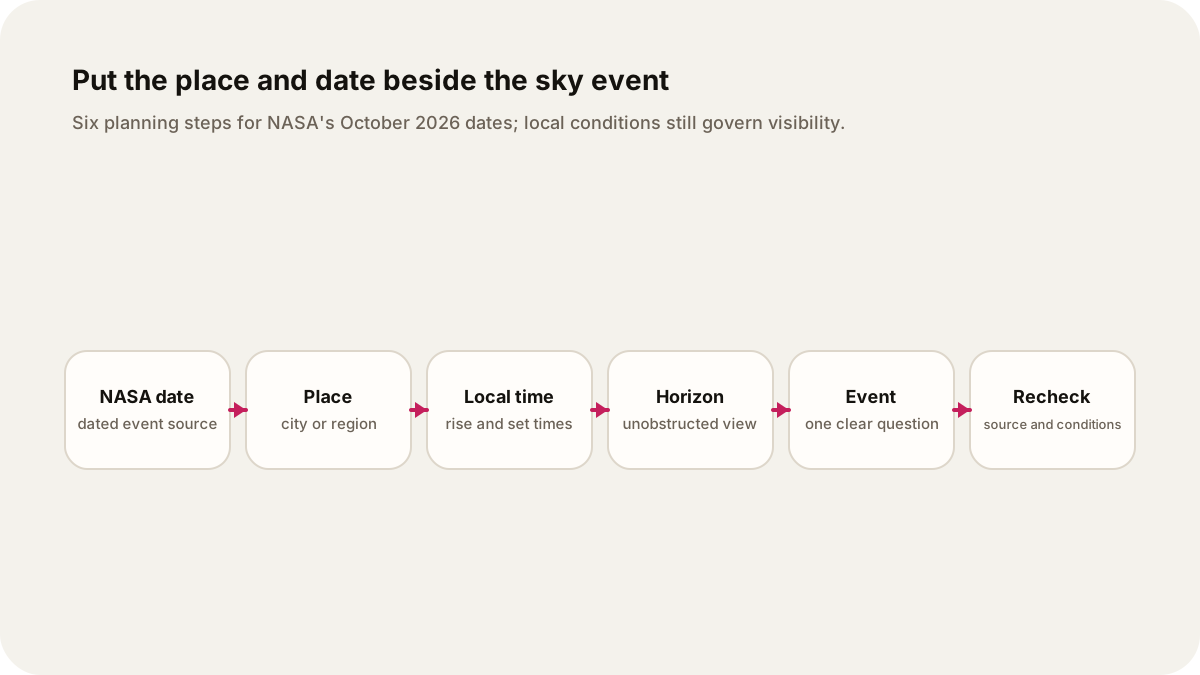
Use this order for each segment:
- Name the date in the listener's local calendar.
- Say what NASA reports, such as opposition or a meteor-shower peak.
- Give a practical direction and time window only after checking a reputable local sky tool for the listener's city or region.
- Explain what can reduce visibility: a blocked horizon, cloud, light pollution, moonlight, or daylight.
- End with a small action, such as finding an unobstructed eastern view or giving your eyes time to adjust.
For example, NASA says the Pleiades and Moon will be in the eastern sky as they climb higher on the night of October 27 into October 28. A finished episode can tell a listener in Manchester to check the local evening rise time and find an eastern view. It should not invent a universal clock time or say the cluster will look the same from every US or UK address.
Keep US and UK guidance separate
The US and UK have the same NASA dates, but a useful recording still needs two local versions. A listener in Arizona and a listener in Scotland may face different twilight, horizon, light pollution, and weather conditions. NASA supplies the event facts. A local astronomy or sky-position tool supplies the time and direction for a named place.
Label the recording clearly: “US, Boston, October 6, before sunrise” or “UK, Cardiff, October 6, before sunrise.” If the listener has not supplied a city, ask for one before giving a precise time. A broad version can say “check your local rise and set times” and leave the clock out.
Weather is another boundary. A forecast can tell someone whether clouds are likely at a given time, but it cannot prove that an object will be visible. Keep the forecast separate from NASA's astronomy facts and date it in the episode notes.
Draft a six-minute orientation
Four dates can fit in a six-minute orientation, but each date needs room for its caveat. A tighter first episode could use this outline:
Opening, 30 seconds: “NASA lists four October nights worth checking. This guide is for [place], and visibility depends on the horizon, cloud, light pollution, and moonlight.”
Saturn, 90 seconds: explain the October 4 opposition as background and check any later viewing window separately.
Jupiter and the Moon, 60 seconds: place the thin crescent before sunrise and remind the listener that daylight and a clear horizon matter.
Orionids, 90 seconds: explain that the meteors appear to radiate from Orion but can streak across the sky. Mention moonset and the pre-dawn window from NASA.
Pleiades, 60 seconds: point east, name the Seven Sisters, and describe the cluster as a slightly fuzzy group of six to seven stars, as NASA does.
Source check, 30 seconds: read the NASA publication date, the Orionids facts page, and the local sky tool used for times.
For weather context, use the weather briefing guide to keep a forecast separate from an observation. The gravity-assist explainer covers a different space-science question, while audio news briefing vs. news podcast compares a short format with a longer one.
A prompt that keeps the facts in place
Make a six-minute personal audio skywatching guide for a listener in [US city or UK region]. Use NASA's October 2026 skywatching guide, published October 1 and updated October 2, and NASA's Orionids page as the primary sources. Treat October 4 as a past opposition date. Cover the remaining October 6, October 21 to 22, and October 27 to 28 windows only if they are still upcoming at recording time. Give dates in the listener's local time only after checking a reputable local sky tool. Explain that visibility depends on horizon, cloud, light pollution, and moonlight. Separate NASA's facts from practical observing suggestions. Do not promise visibility, invent weather, or describe an observation that did not happen. End with a short checklist and a dated source list.
Read the source links before recording. NASA's page supplies the four event descriptions and the useful caveats about the Orionids. The NASA Orionids facts page supplies background on the shower and its activity window. A source check keeps a changing calendar item from becoming a confident but stale script.
Save the local rise and set times beside NASA's dated guide, then recheck both before the selected night. Keep the place and date in the recording's title so an older episode does not sound like tonight's forecast.
Sources
- NASA, What's Up: October 2026 Skywatching Tips, published October 1, updated October 2, 2026: event dates, directions, and visibility caveats.
- NASA, Orionids: meteor-shower background and activity information.