
Why auroras have different colours
Aurora colour comes from energized oxygen and nitrogen. The gas and the altitude of the emission help explain why one display can show green, red, blue, and pink.
An aurora can look green, red, blue, pink, purple, or almost white. The colours are not a palette painted onto the sky. They are light released when energetic particles transfer energy to oxygen and nitrogen in the upper atmosphere. The gas matters, and so does the altitude where the collision happens.
Key Takeaways
- Oxygen often produces green light lower in the aurora and red light higher up.
- Nitrogen can add blue, pink, or purple, especially toward the lower edge.
- A colour explanation describes the light. It cannot promise that a person will see an aurora.
What makes an aurora glow?
The short answer is excitation. Charged particles from the solar wind interact with Earth's magnetic field and can travel down magnetic field lines toward the upper atmosphere. When those particles collide with atmospheric atoms and molecules, they leave them with extra energy. As the oxygen or nitrogen returns toward a lower-energy state, it releases that energy as light. NASA describes this process in its auroras overview, which also explains why the colour depends on both the gas and its location in the atmosphere.
That is why an aurora is useful to hear as a layered explanation. “The sky turned green” describes an appearance. “Excited atomic oxygen released green light at a particular range of altitude” describes the mechanism behind it. A recording can give a listener both, in that order.
Why oxygen can make green or red
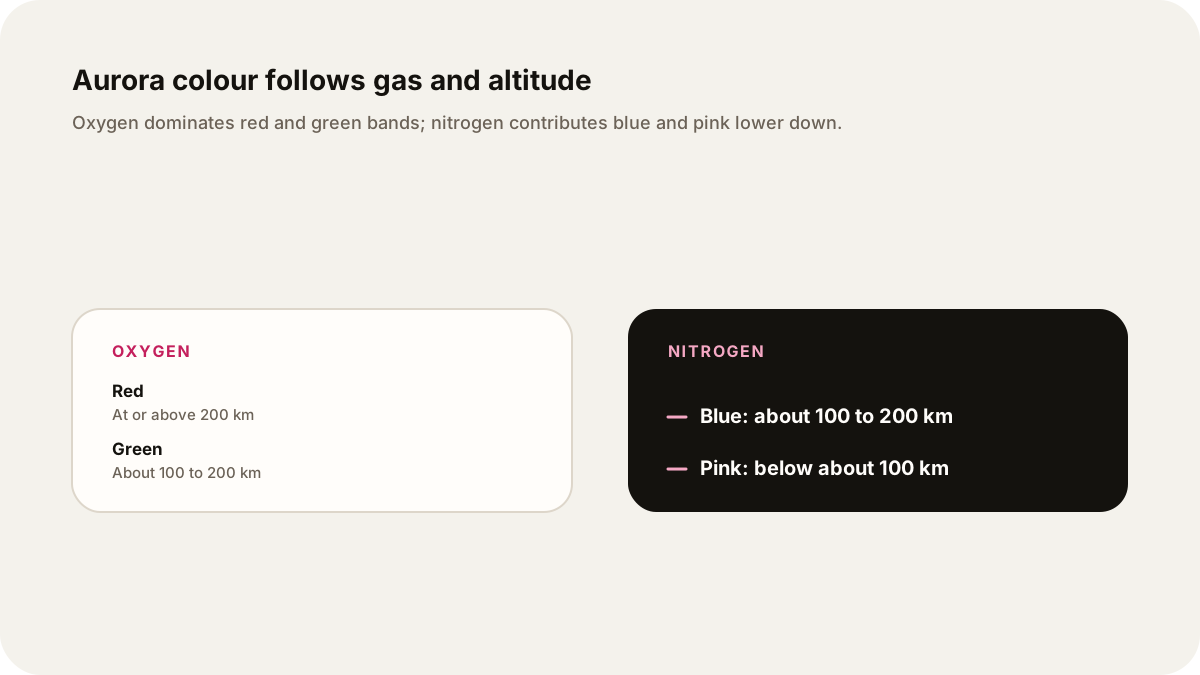
Atomic oxygen produces two of the best-known aurora colours, but it does not make them at exactly the same height. NASA places green oxygen emission roughly between 60 and 120 miles, or 100 to 200 kilometres, above Earth's surface. Red oxygen appears above about 120 miles, or 200 kilometres. NASA's table gives the useful shorthand: red and green are both oxygen, separated in part by altitude and the energy state involved.
Altitude changes the colour for more than one reason. An excited atom has a certain lifetime before it emits a photon. At lower heights, collisions can interrupt some long-lived transitions. Higher up, collisions are less frequent. The same transition can then produce red light that would be quenched lower down. NOAA's Space Weather Glossary gives an overall auroral range of about 80 to 1,000 kilometres. Many aurorae occur around 100 to 250 kilometres. The usual yellow-green colour comes from a transition in atomic oxygen.
So a red upper band and a green lower band are not two unrelated lights. They can be two oxygen emissions from different atmospheric conditions. A guide should say “often” or “roughly” for these altitude ranges. The bands overlap in real displays, and a photograph may intensify a colour that looks faint to the eye.
Why nitrogen adds blue, pink, and purple
Nitrogen contributes other colours. NASA says excited nitrogen between about 60 and 120 miles can glow blue. At lower altitudes, below about 60 miles, nitrogen can give an aurora's lower edge a reddish-purple or pink appearance. Depending on the particle energy and the type of nitrogen emission, blue and pink can occur in related parts of a display.
This is a useful correction to the idea that every blue or purple aurora must come from a single, simple source. The colour can result from nitrogen emission, oxygen emission, or the way several emissions mix along the line of sight. NASA notes that mixed light can appear purple, pink, or white. NOAA likewise explains that oxygen, nitrogen molecules, and nitrogen atoms emit particular colours and that atmospheric composition varies with altitude.
The lower edge can be especially instructive. Faster incoming particles can penetrate deeper, where nitrogen emissions contribute blue or purple tones. The altitude is still high by everyday standards, but it is lower relative to the oxygen emissions above it. “Lower edge” means lower in the auroral structure, not a light hovering just above a person's roof.
A worked example: reading one colour band
Imagine a photograph showing a broad green curtain with a narrow red arc above it and a pink fringe along its lower edge. Do not begin by treating the whole image as one colour event. Read it in layers:
- Green middle: connect the main green curtain to excited atomic oxygen around 100 to 200 kilometres, using NASA's approximate range.
- Red upper arc: connect the higher red emission to oxygen above about 200 kilometres. Keep the altitude approximate because the image is a projection, not a ruler.
- Pink lower edge: treat the pink as a likely nitrogen contribution in the lower part of the aurora, while allowing that mixed emissions and camera processing can affect the appearance.
- What the photograph cannot tell you: it cannot by itself provide the particle energy, exact altitude, or local magnetic conditions. Those need measurements and a dated space-weather record.
That four-part reading gives a listener useful questions. Which gas is involved? Which emission is higher or lower? Is the colour a single band or a mixture? What evidence would move a visual description toward a precise measurement?
The satellite-orbits audio guide uses a similar habit of connecting a physical quantity to what a listener can observe. Its low Earth orbit and geostationary comparison is about altitude, speed, and coverage. The October skywatching audio guide adds a separate caution: an astronomy source can establish an event without promising that every person will see it.
Colour is not a visibility forecast
An explanation of aurora colour answers “why would the light be green or red?” It does not answer “will I see it tonight?” Visibility depends on the event's intensity and geometry, the observer's location, darkness, cloud, haze, local light, the direction of the display, and the sensitivity of the observer's eyes or camera. A strong-looking photograph can also contain colours that the unaided eye would perceive differently.
Keep those questions separate in an audio script. NASA and NOAA can explain the physical mechanism and typical altitude ranges. A current space-weather service can provide a forecast or alert, but a forecast remains a forecast. It cannot guarantee a clear view from a specific garden or road. If a guide names a location, date the observation conditions and say what remains unknown.
Turn the science into a short audio guide
Try a request such as:
Make a six-minute audio explanation of why auroras have different colours. Start with particle collisions and explain oxygen's green and red emissions, then nitrogen's blue, pink, and purple contributions. Use NASA's auroras page and NOAA's Space Weather Glossary. Work through a hypothetical image with a green middle, red upper band, and pink lower edge. Keep altitude ranges approximate, separate visible description from physical inference, and do not promise that a listener will see an aurora at a particular time or place.
The source links belong in the episode notes. A listener should be able to check whether a colour claim came from NASA's table, NOAA's glossary, or the script's own interpretation of a hypothetical image. For a broader source-to-audio method, see turning a PDF into a podcast, which keeps the source document beside the listening brief.
Aurora colour is a story about gas, energy, and height. The green curtain is not merely “the northern lights” in a different shade. It is evidence of a particular kind of emission in a particular layer of the atmosphere, interpreted with the limits of a view from the ground.
Sources
- NASA Science, Auroras: particle collisions, oxygen and nitrogen colours, and approximate altitude bands.
- NOAA / NWS Space Weather Prediction Center, Space Weather Glossary: auroral altitude range, oxygen transition, gas composition, and particle penetration.
- NOAA / NWS Space Weather Prediction Center, Aurora Tutorial: emission lifetimes, altitude effects, oxygen states, and nitrogen's lower border.