
Why rainbows form: primary and double rainbow colours explained
A primary rainbow uses one internal reflection. A secondary bow uses two, appears outside the primary, and reverses the colour order. Both arise from refraction and dispersion in water droplets.
Rainbows form when sunlight enters water droplets. The light bends, separates by wavelength, reflects inside the drops, and bends again as it leaves. A primary rainbow has one internal reflection. A secondary rainbow has two. It exits at a different angle and reverses the colour order.
Key takeaways
- Refraction changes the direction of light as it crosses air and water. Dispersion makes different wavelengths bend by different amounts.
- In the usual ground view, the Sun is behind the observer and the rain or spray is ahead. The red ray of the primary bow is approximately 42 degrees from the antisolar point.
- A secondary bow follows a two-reflection path, is usually fainter, sits outside the primary, and reverses the colour order. NOAA gives about 50 degrees for its red ray.
- A rainbow is a continuous spectrum. “Seven colours” is a familiar set of names, not seven sharply separated bands.
What changes when sunlight enters a raindrop?
Refraction is the change in direction that happens when light crosses from one medium into another. NASA explains that light travels at different speeds in different materials. It also explains that different wavelengths can bend by different amounts. A spherical water drop therefore acts a little like a curved prism, although the full path also includes reflection.
Sunlight looks white because many visible wavelengths arrive together. Water does not send every wavelength along exactly the same path. Red light bends less than violet light when it enters and leaves the drop. This wavelength-based separation is dispersion. The result is a spread of wavelengths, rather than a row of seven physical strips.
The Met Office describes a rainbow as an arc-shaped spectrum made by refraction and reflection. It says the Sun must be behind the observer and water droplets in front. The source establishes the mechanism. It does not establish that a particular forecast, location, or weather event will produce a visible rainbow for a particular person.
Why does the primary rainbow curve?
The curve comes from geometry around the direction opposite the Sun. Imagine a hypothetical observer with the Sun behind them and a curtain of droplets ahead. For one colour, droplets in many positions can send a concentrated group of rays toward the observer at nearly the same angle. From the ground, those directions form an arc around the antisolar point, the point in the sky directly opposite the Sun.
NOAA gives a useful approximation for the red ray of the primary bow: about 42 degrees. This is an angle measured from the antisolar direction, not from the horizon. Violet bends differently, so its band appears inside the red edge of the primary bow. The visible order changes gradually across the spectrum.
Whether a person sees an arc depends on the full geometry. That includes the Sun's position, the droplet field, obstructions, and the observer's location. Those conditions belong to a separate visibility question. This article uses the geometry to explain the angle, not to predict an outing.
The primary droplet path
The primary path has three important optical events:
- Sunlight enters the water drop and refracts.
- The separated light reflects once from the inside back surface of the drop.
- The light exits, refracts again, and travels toward the observer.
NOAA calls the primary rainbow the result of one reflection inside the droplet. NASA's explanation of refraction and dispersion supplies the wavelength part of the story. The reflection redirects the separated light toward the observer. The different bending of the wavelengths keeps the colours in order.
Why does a double rainbow reverse its colours?
Some light follows a second path through a drop. It refracts on entry, separates by wavelength, reflects twice inside the drop, and refracts again as it exits. NOAA identifies this two-reflection path with the secondary rainbow.
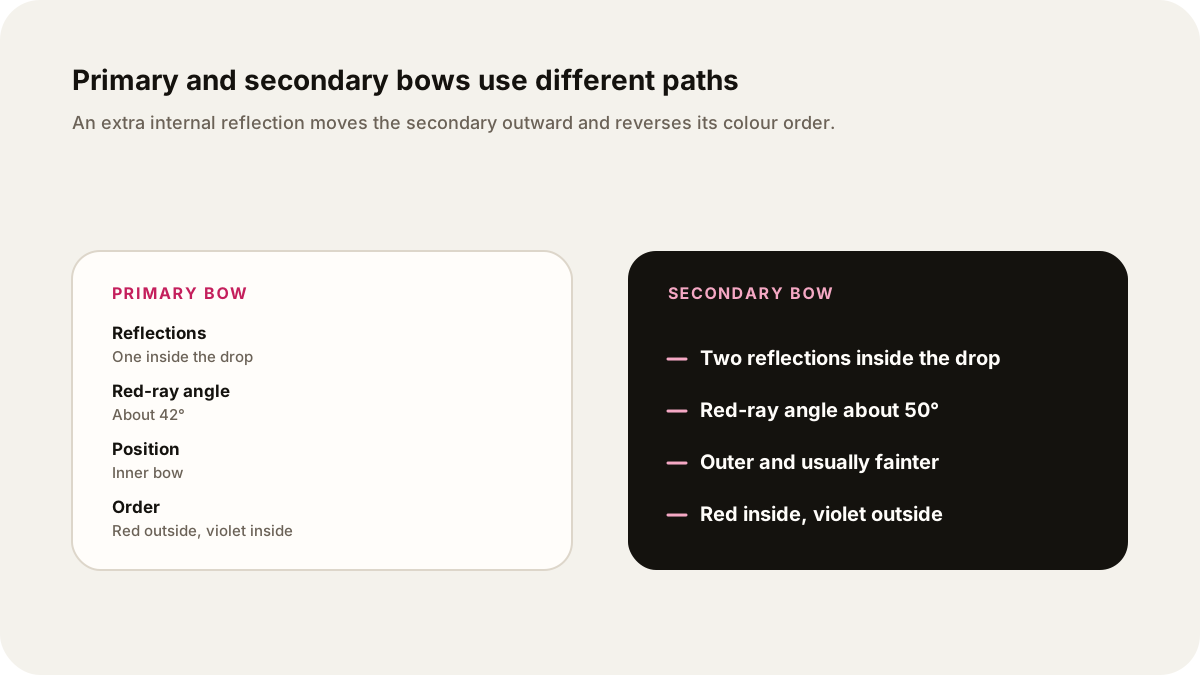
The extra reflection changes the outgoing direction. For the red ray, NOAA gives an approximate angle of 50 degrees for the secondary path, compared with about 42 degrees for the primary. Because the secondary angle is larger, its bow appears farther from the antisolar point, outside the primary bow.
The colour order reverses because the second internal reflection sends the separated wavelengths out in the opposite sequence around the bow. In the primary rainbow, red is on the outside and violet is toward the inside. In the secondary rainbow, red is on the inside edge, which is the lower edge when the bow is seen above the horizon, and violet is on the outside or upper edge.
The wording “lower” and “upper” describes the usual sky view. The physical rule is about the secondary bow's position around the antisolar point. A complete circle seen from a high viewpoint would still have the same colour order around its circumference.
A worked droplet-path comparison
Consider a hypothetical observer and one hypothetical spherical water drop in front of them. This is a ray-path comparison, not an experiment and not a photograph analysis.
| Feature | Primary bow | Secondary bow |
|---|---|---|
| Internal reflections | One | Two |
| Approximate red-ray angle | 42 degrees | 50 degrees |
| Position in the usual view | Inner bow | Outer bow |
| Colour order | Red outside, violet inside | Red inside, violet outside |
| Relative appearance | Usually brighter | Usually fainter |
Each reflection and refraction step can reduce the amount of light travelling along the secondary path toward the observer, so the secondary tends to be fainter. NOAA describes it as fainter. The table follows the path, not a claim that every double rainbow will have identical brightness or crisp edges.
Between the bows, the sky can look darker than the regions inside and outside them. That region is commonly called Alexander's band. It follows from the different ray directions and the way the primary and secondary paths distribute light. It is a feature of the optical geometry, not an indication that the atmosphere has a solid dark strip.
Why the spectrum is not exactly seven colours
Visible light covers a continuous range of wavelengths. A rainbow does not contain seven sealed compartments. Red gradually gives way to orange, yellow, green, blue, and violet. There is no exact border where one named colour must stop. People often use seven names because that is a convenient traditional description. The names help a listener orient themselves, but they do not change the continuous spectrum.
This is similar to the distinction in the sound pitch versus volume audio guide: a physical quantity and a human label can describe related parts of the same signal without turning a continuous property into a fixed number of bins. For a source-linked visual explanation, the why auroras have different colours guide also keeps the appearance of a colour separate from the physical process that produced it.
How to explain a rainbow in audio
An accurate short script can follow the ray instead of listing colour names first. Start with sunlight entering a drop. Say that refraction bends it, dispersion separates wavelengths, one internal reflection produces the primary path, and a second reflection produces the secondary path with reversed order. Then add the geometry: Sun behind the observer, droplets ahead, a primary red-ray angle of about 42 degrees, and a secondary red-ray angle of about 50 degrees.
For example, a bounded request could be:
Make a six-minute audio guide explaining how primary and secondary rainbows form. Use NOAA's rainbow explanation, NASA's refraction explanation, and the Met Office's rainbow explanation. Describe a hypothetical observer with the Sun behind them and droplets ahead. Compare one and two internal reflections, explain the approximate 42-degree and 50-degree red-ray angles, describe the continuous spectrum rather than exactly seven colours, and do not promise that the listener will see a rainbow in particular weather.
Keep the source links beside the episode. The listener should be able to tell which claims come from NOAA, NASA, or the Met Office, and which sentences describe the hypothetical ray path. For source handling, see turning a PDF into a podcast, which keeps source notes beside the spoken explanation.
Sources
- NOAA NESDIS, What Causes a Rainbow?, published September 2, 2025: refraction, colour separation, observer geometry, primary and secondary reflection counts, approximate 42-degree and 50-degree red-ray angles, reversed colour order, and relative brightness.
- NASA Science, Wave Behaviors: refraction and wavelength-dependent bending.
- NASA Science, Spectroscopy 101: spectra as separated patterns of wavelengths and rainbows as natural spectra.
- Met Office, Rainbows: optical wonders: rainbows as refraction and reflection, colour separation, and observer geometry.