
How to read a historical letter without inventing its meaning
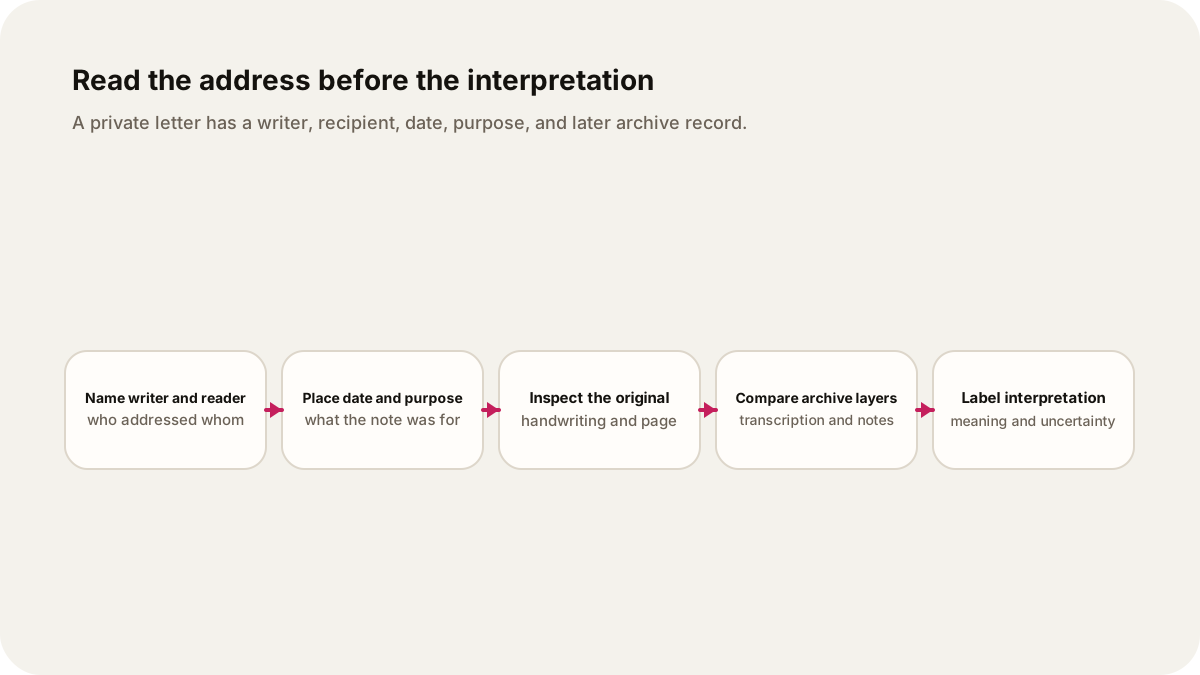
A letter is an addressed act of writing. Start with author, recipient, date, purpose, and context, then keep the original page, archive transcription, annotation, and interpretation distinct.
A historical letter can become one famous sentence after it leaves the page. An audio guide should keep the basic exchange in view. Who wrote it? Who received it? When and why? What does the page leave unsaid? Start there. Then compare the original page with the archive's typed copy and added notes before you explain what the letter can show.
Key Takeaways
- Name the author, person receiving the letter, date, purpose, and context before interpreting a line.
- Keep your reading of the handwriting separate from the archive's typed copy and added notes.
- Treat an unwritten meaning as your reading, not as the writer's private intention.
Start with the letter's address
Ask “Who was this written to?” before asking “What famous sentence is here?” A private letter has a reader. Its salutation, date, closing, and form of address can show whether the writer was petitioning, answering, advising, thanking, or keeping up a relationship. That purpose limits what a line can mean.
An oral history is a later speaker recalling an event for an interviewer. A newspaper was written for public circulation. A photograph may be addressed to no one in particular. A letter is an exchange between people, even when an archive later makes it public.
For example, the Library of Congress exhibition record for Grace Bedell's letter to Abraham Lincoln identifies a holograph letter dated October 15, 1860. The record says it is on loan from the Detroit Public Library's Burton Historical Collection. It gives the digital identifiers al0069_01, al0069_02, and al0069_03. These are catalog facts. They identify the item before you quote it.
Record the basic facts
Make a five-line header for your script:
| Field | What to establish | Grace Bedell example |
|---|---|---|
| Author | Who wrote or signed the page? | Grace Bedell |
| Recipient | Who was meant to read it? | Abraham Lincoln |
| Date | What date appears in the record or on the page? | October 15, 1860 |
| Purpose | What does the writer ask, answer, report, or offer? | Advice about Lincoln's appearance and its political appeal |
| Context | What surrounding event does the archive document? | Lincoln was a Republican presidential candidate; the archive places the letter in the campaign period |
The Library's typed copy preserves Bedell's basic argument. She says some of her brothers will vote for Lincoln already. She suggests that growing whiskers might improve his appearance and appeal. Those words show what she wrote. They do not prove that her brothers changed their votes, that “all the ladies” agreed, or that her advice caused Lincoln to grow a beard.
The exhibition gives the same warning. It says Lincoln began to grow a beard about a month after receiving the letter. It also says no one can know what prompted him or how much Bedell's recommendation influenced him. Keep that limit in the audio. A later outcome does not prove the writer's intention.
Compare the page with the typed copy
Open the original image of Bedell's letter beside the Library of Congress transcription. The image shows the page itself: handwriting, spelling, line breaks, spacing, folds, ink, and words that need a careful reading. The typed copy makes the wording searchable and easier to quote. It is an editorial aid. It does not replace the object.

Make a short comparison note:
| Layer | Safe statement | Do not add |
|---|---|---|
| Original page | The page is a handwritten letter addressed to Lincoln and dated in October 1860. | A guess about emotion from pen pressure or paper marks |
| Archive typed copy | The LOC renders the advice about whiskers and the writer's claim about her brothers and ladies. | Modern spelling or punctuation presented as Bedell's |
| Catalog record | The item is identified as a holograph letter from a named collection with digital IDs. | Ownership history beyond what the record says |
| Added note from the editor | The exhibition supplies campaign and later-beard context, with an explicit uncertainty about influence. | A cause that the added note declines to name |
If a word is hard to read, say so. You can use the archive's typed copy with attribution. Do not silently “correct” the writer's spelling. If the typed copy adds punctuation that is not visible on the page, call it the archive's rendering. If the scan and typed copy differ, name the difference and keep both layers in the script. This correction route lets the listener check the source instead of hiding the editorial choice.
Separate written meaning from your reading
Bedell's written purpose is clear. She offers a political suggestion to a candidate. Your reading can go one step further. The direct address and the appeal to family and gendered public opinion make the letter sound practical and persuasive. That is a reading of the words and situation.
The page cannot establish what Bedell privately felt while writing, what Lincoln thought before opening the envelope, or whether the advice changed the election. Its later public display does not make it a public statement in 1860. The Library records the page now because it survives in a collection and has been exhibited. That later archive history is separate from the original audience.
The paired Lincoln reply shows why an exchange of letters matters. The LOC identifies his holograph response as October 19, 1860, on loan from the Benjamin Shapell Family Manuscript Foundation. Its typed copy includes his question about whether people might call new whiskers “a piece of silly affectation.” Read beside Bedell's letter, the reply documents a response. It does not reveal every private motive behind his decision.
A worked audio-guide opening
Here is a compact script built from the record, image, typed copy, and added note:
This is a handwritten letter from Grace Bedell to Abraham Lincoln, dated October 15, 1860. The Library of Congress identifies it as a holograph letter on loan from the Detroit Public Library's Burton Historical Collection. Bedell writes to a presidential candidate and suggests that whiskers might make his face look better and help him win support. The archive's typed copy preserves that advice, while the image lets us check the writing itself. The exhibition says Lincoln began growing a beard about a month later, but also says we cannot know what prompted him or how much Bedell's suggestion mattered. This letter documents a young writer's advice and Lincoln's later reply. It does not prove that her advice caused the beard or the election result.
That opening gives the listener a clear task. Identify the page. Compare the layers. Keep cause and effect qualified. The historical photograph audio guide uses a similar evidence boundary, but a letter adds a person receiving the message and a purpose. The historical newspaper audio guide is useful when the source was written for public circulation. For a later first-person recollection, compare the oral history audio guide, which separates memory from documents made at the time.
Turn the method into a source-led request
Ask for an audio guide that names the author, person receiving the letter, date, purpose, and documented context before it explains a line. Give it the archive item record, original image, typed copy, and any added note. Ask it to mark each sentence as an observation from the page, archive wording, catalog or editor context, or your reading. Require it to preserve uncertainty about motives and influence.
Keep the original page and archive link with the finished audio. A listener should be able to return to the evidence. When the page is hard to read or the archive has made an editorial choice, say which layer you are using. This helps the listener tell the writer's words from the archive's rendering.
The writer's address, the recipient's role, the date, and the archive's later notes all matter. They are different kinds of evidence. Keep them apart so the listener can hear what the letter says, what the record adds, and where your reading begins.
Sources
- Library of Congress, “Candidate Lincoln”: exhibition record, dates, repositories, digital identifiers, contextual qualification, and related Lincoln reply.
- Library of Congress, “Grace Bedell to Abraham Lincoln” transcription: archive transcription of the October 1860 letter.
- Library of Congress, original image of Grace Bedell's letter: image of the handwritten page.
- Library of Congress, “Lincoln's Beard” transcription: companion response dated October 19, 1860.