
First cousin once removed: how to read the family link
“Once removed” means one generation apart. Find the shared ancestor, count each person’s steps, and compare the two counts.
“First cousin once removed” sounds like a puzzle. It is a simple label for two cousins who share a family line but sit one generation apart. The phrase tells you two things: how close the shared ancestor is, and how far apart the two people sit in generations on the family tree.
The example is fictional. It does not describe a real family.
What “first cousin” means
First cousins share grandparents. For example, your parent and another person’s parent are siblings. You and that person are first cousins because you share one or two grandparents.
Ancestry’s family relationship guide uses the same rule. It also explains that second cousins share great-grandparents and third cousins share great-great-grandparents.
The number tells you the shared ancestor’s distance. First cousins are two generations from that ancestor. Second cousins are three generations away. The count starts with your parent as one generation, then your grandparent as two.
What “once removed” means
“Removed” describes a generation gap between two cousins. Once removed means one generation apart. Twice removed means two generations apart.
This can happen in either direction. Your first cousin’s child is your first cousin once removed. Your parent’s first cousin is also your first cousin once removed. In one case the other person is younger on the tree. In the other, the other person is older.
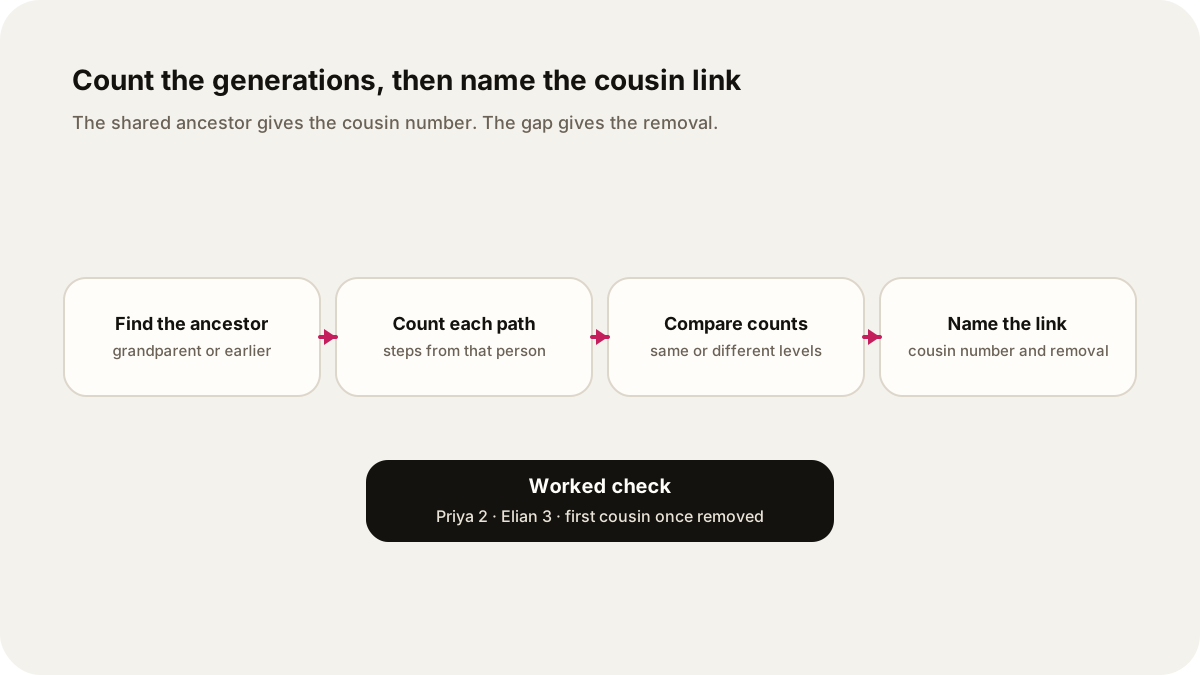
FamilySearch’s cousin chart uses a useful method: find the shared ancestor, count each person’s generations from that ancestor, then compare the two counts. The difference gives the “removed” number.
A fictional family tree, one step at a time
Imagine a fictional family with these names:
- Iris and Omar are the parents of Lena and Marcus.
- Lena’s child is Priya.
- Marcus’s child is Daniel.
- Daniel’s child is Elian.
Priya and Daniel are first cousins. Why? Their parents, Lena and Marcus, are siblings. Their shared ancestors are Iris and Omar. Priya is two generations from Iris and Omar: Priya’s parent Lena is one step, and Iris and Omar are the second step. Daniel is also two generations away.
Now compare Priya with Elian. Priya is still two generations from Iris and Omar. Elian is three generations away: Elian’s parent Daniel is one step, grandparent Marcus is two, and great-grandparents Iris and Omar are three. The smaller path still reaches the shared ancestor in two steps, which gives first cousin. The generation counts differ by one. Priya and Elian are first cousins once removed.
The direction matters when you explain the relationship. Priya is Elian’s first cousin once removed, and Elian is Priya’s first cousin once removed. You can also say that Elian is the child of Priya’s first cousin, which may be clearer in a conversation.
The quick calculation
Use this three-part check:
- Find the shared ancestor. Write down the nearest grandparent, great-grandparent, or earlier ancestor shared by both people.
- Count each person’s steps. A parent is one step from you. A grandparent is two. A great-grandparent is three.
- Compare the counts. For cousins, subtract one from the smaller count to get the cousin number. Both paths must be at least two steps. A one-step path names a parent, aunt or uncle relationship instead. The difference gives the removed number.
For the fictional example, Priya and Elian share ancestors Iris and Omar. Priya’s count is two. Elian’s count is three. Two means first cousin. Three minus two equals one, so the label is first cousin once removed.
If both people have the same count, there is no “removed.” If both are three steps from the same great-grandparents, they are second cousins. If one count is three and the other is five, the relationship is second cousin twice removed.
Check the tree against records
A family tree can contain a wrong parent, a repeated name, or a date that belongs to another person. Treat the label as a result to check, not as proof by itself.
The U.S. National Archives’ genealogy guide recommends starting with what you know and working toward what you do not know. Record names, dates, places, and relationships. Census, military, immigration, naturalization, and land records can supply clues, depending on the family and country.
For the fictional tree, you would look for records that support Lena and Marcus as siblings, then records that support Priya, Daniel, and Elian as their descendants. A single index entry may not settle a relationship. Compare dates, places, and the names of other family members. Keep the record link beside the claim it supports.
How to explain the label to a listener
Start with the shared ancestor. Then say the two generation counts. For example: “Priya and Elian share Iris and Omar as ancestors. Priya is two generations away. Elian is three. They are first cousins once removed.”
That order is easier to follow than a chart full of names. It also shows what remains unknown. If the record does not prove a parent-child link, say that the relationship is a working theory.
For a source-led audio guide, keep the family tree and the records together. The historical-letter guide shows why a family document needs its date and context. The oral-history guide covers another way to preserve a family account while keeping the speaker’s memory distinct from a confirmed record.
The label is a map of generations. The records show whether the road you drew is real.
Sources
- FamilySearch, Cousin Chart: shared ancestor, generation counts, and the meaning of “once removed.”
- Ancestry, Family Relationship Terms: first, second, and third cousin definitions and examples in both directions.
- U.S. National Archives, Start Your Genealogy Research: starting with known facts and record types such as census, military, immigration, naturalization, and land records.
If a family-history source or relationship needs correcting, contact Lissin with the passage and record link. See the editorial standards for correction handling.