
Golf par, birdie and bogey: how to read a stroke-play scorecard
Par is the hole's reference score. Compare it with actual strokes to name a birdie or bogey, then add the gross total for stroke play.
Par gives a hole its reference score. Your actual strokes tell you what happened. The difference gets a golf name: a birdie is one stroke under par, a bogey is one stroke over par, and a par is the same number of strokes as the hole's par. On a regular stroke-play scorecard, add the strokes for every hole, including any penalty strokes, to get the gross score for the round.
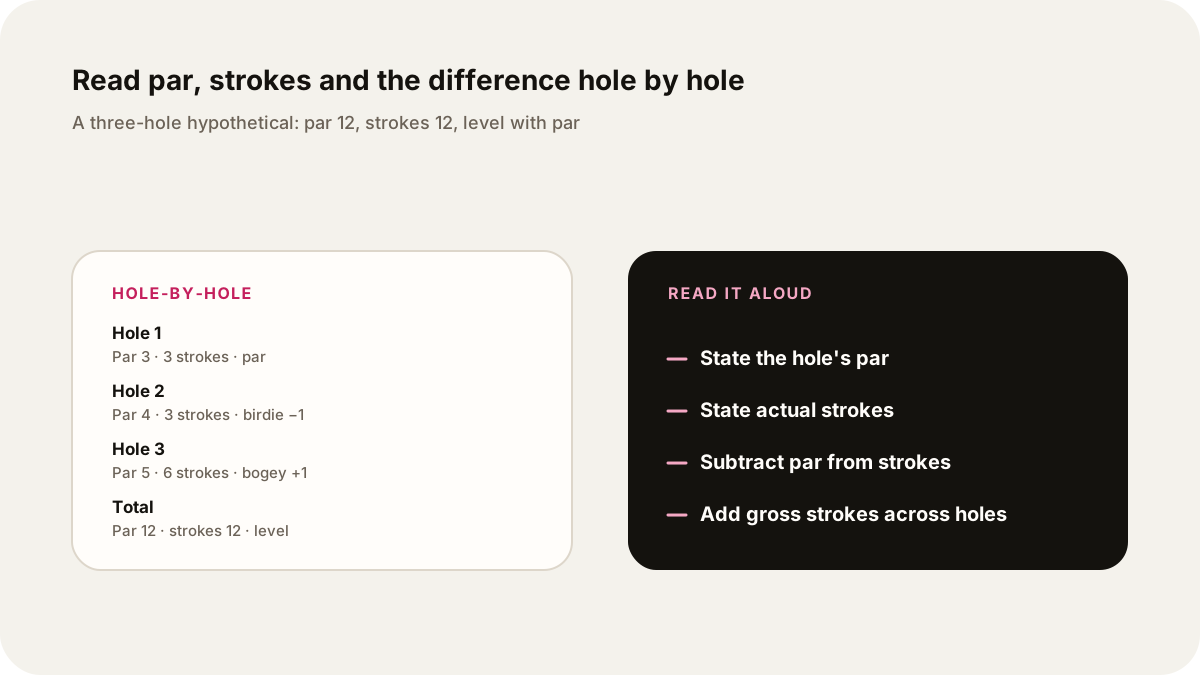
That sounds simple until a scorecard mixes a hole's par, a player's score, a running total, a handicap row and a competition result. Read those fields as separate jobs. This guide explains the terms, works through a three-hole example, and turns the arithmetic into a clear audio explanation.
What par means on a golf scorecard
Par is the score a scratch player would generally be expected to achieve on a hole under normal course and weather conditions, allowing two strokes on the putting green. The USGA definition of par describes how an authorised association or club establishes the value for each hole. The value printed on a scorecard is the course's reference for that tee and hole.
A par 3 therefore has three as its reference score. A par 4 has four, and a par 5 has five. These numbers describe the hole, not a prediction of what one particular player will shoot. Wind, lie, hazards, putting and the player's choices can all change the actual score.
Par also gives you the language for the difference. If the player's score equals par, the result is called even par on that hole. If it is one lower, it is a birdie. If it is one higher, it is a bogey. Two under par is an eagle; two over par is a double bogey. Those names describe the hole relative to par. They do not replace the actual stroke count.
Birdie and bogey are comparisons, not extra points
Suppose a par 4 is completed in 3 strokes. The player made a birdie because 3 minus 4 equals −1. On a par 5 completed in 6 strokes, the player made a bogey because 6 minus 5 equals +1. A par 3 completed in 3 strokes is simply par.
The comparison works in either direction:
| Hole par | Strokes | Difference from par | Name |
|---|---|---|---|
| 3 | 3 | 0 | Par |
| 4 | 3 | −1 | Birdie |
| 5 | 6 | +1 | Bogey |
The USGA golf terminology guide describes birdie and bogey as terms that came to mean scores one under and one over par. For this explanation, subtract the hole's par from the player's strokes, then name the result.
A worked three-hole scorecard example
Here is a hypothetical three-hole card. It is an arithmetic example, not a player's result from a named round.
| Hole | Par | Strokes | Relative score |
|---|---|---|---|
| 1 | 3 | 3 | Par, 0 |
| 2 | 4 | 3 | Birdie, −1 |
| 3 | 5 | 6 | Bogey, +1 |
| Total | 12 | 12 | 0 relative to par |
First add the hole pars: 3 + 4 + 5 = 12. That is the par for these three holes. Then add the actual strokes: 3 + 3 + 6 = 12. The gross stroke total is also 12. Finally compare the totals: 12 minus 12 equals 0, so the player is level with par across the three holes.
The hole labels still matter. The birdie on hole 2 is one stroke under its par, and the bogey on hole 3 is one stroke over its par. They cancel in the total. Saying only “12” hides that pattern; saying “12 strokes, level with the 12-par total, with one birdie and one bogey” preserves it.
How regular stroke play totals the round
In regular stroke play, players compete against the field by total strokes. R&A Rule 3 says that the winner is the player who completes all rounds in the fewest total strokes, including strokes made and penalty strokes. The USGA stroke-play explanation gives the same practical scorekeeping rule.
That means the total on a scorecard is not the number of birdies minus the number of bogeys. It is the sum of the strokes recorded on each hole. Relative-to-par language is a useful description beside that total, but it is not a different stroke total.
If a verified penalty applies, include the penalty strokes in the hole score before adding the round. For example, if a player makes 4 strokes on a par 4 and receives a one-stroke penalty, the hole score is 5. It is a bogey for that hole. Do not add a penalty merely because a story mentions a difficult lie or a ball near a hazard. The exact rule and the committee's ruling need to be known before the score changes.
The scorecard also has a practical responsibility. Under Rule 3.3, the player and marker must check and certify the hole scores before returning the card to the Committee. A spoken recap should distinguish a provisional running total from a certified competition result.
Gross score, net score and the handicap row
This article uses gross stroke totals. Gross means the strokes actually recorded, including verified penalty strokes, before handicap strokes are applied. In a handicap competition, a net score adjusts the gross score for the player's handicap strokes on the holes where those strokes are received. That is a separate competition calculation.
Do not infer a player's handicap from a single scorecard, and do not call a gross total a net result. R&A Rule 3.1c separates scratch competitions, where handicap is not applied, from handicap competitions, where net scores are used. If the card does not identify the competition terms and the player's handicap information, report the gross strokes and the hole-by-hole relation to par only.
This also keeps “level with par” from being confused with Stableford points. Stableford is another form of stroke play with a points method. R&A Rule 21 lists Stableford, Maximum Score and Par/Bogey as other forms with different scoring methods. A regular stroke-play recap should not convert a 12-stroke example into points unless the format is explicitly Stableford.
How to read the card aloud
For each hole, use the same order: name the hole, state par, state strokes, then state the difference. “Hole 2 is a par 4. The player took 3 strokes, one under par, a birdie.” This sentence lets a listener verify the label without seeing the card.
At the end, report the total and its scope. “Across these three holes, the player took 12 gross strokes on a par total of 12, level with par. The card contains one birdie and one bogey.” If the round is incomplete, say so. If penalties are unverified, leave them out and label the total as provisional.
Keep other sports terms separate. A tennis tiebreak, cricket follow-on, NBA shot clock and baseball pitching rate each use their own scorekeeping rules. Links to tennis tiebreak scoring, cricket follow-on scoring, NBA shot-clock rules, and baseball ERA versus WHIP provide useful comparisons, but none changes how a golf scorecard is totalled.
A short request for a source-led golf recap
If you want an audio explanation, provide the scorecard or official results and ask for a bounded read:
Read this golf scorecard as regular stroke play. For each hole, state the par, actual strokes, and difference from par. Label birdies and bogeys. Add gross strokes and par separately, include only verified penalty strokes, and say whether the round is complete. Do not calculate a handicap, Stableford points, a player’s current result, or a ranking unless those fields and the competition terms are supplied.
That request keeps the source record beside the narration. A listener can hear the arithmetic while still knowing which statements came from the card and which are simple calculations.
Sources
- The R&A, Rule 3: The Competition, accessed October 10, 2026. Defines regular stroke play, gross and net scoring, total strokes, penalties and scorecard responsibilities.
- The R&A, Rule 21: Other Forms of Individual Stroke Play and Match Play, accessed October 10, 2026. Distinguishes Stableford, Maximum Score and Par/Bogey from regular stroke play.
- The R&A, Rules of Golf Definitions, accessed October 10, 2026. Defines scorecard and other rules terms.
- USGA, Appendix F: Establishing Par, accessed October 10, 2026. Explains how par is established for holes and tees.
- USGA, Rules FAQ: Keeping Score in Stroke Play, accessed October 10, 2026. States that stroke-play scores include strokes made and penalty strokes.
- USGA, Word Play: How Golf Terminology Has Evolved, accessed October 10, 2026. Provides historical context for par, birdie and bogey terminology.