
Litres and millilitres: how to convert volume amounts
One litre is 1,000 millilitres. Choose one unit before you compare or add amounts, and keep L or mL beside every number.
If a bottle says 1 L and a recipe says 750 mL, they use the same metric volume scale. One litre is 1,000 millilitres, so 750 mL is 0.75 L. The useful rule is to choose one unit before you add or compare amounts: convert litres to millilitres by multiplying by 1,000, or millilitres to litres by dividing by 1,000.
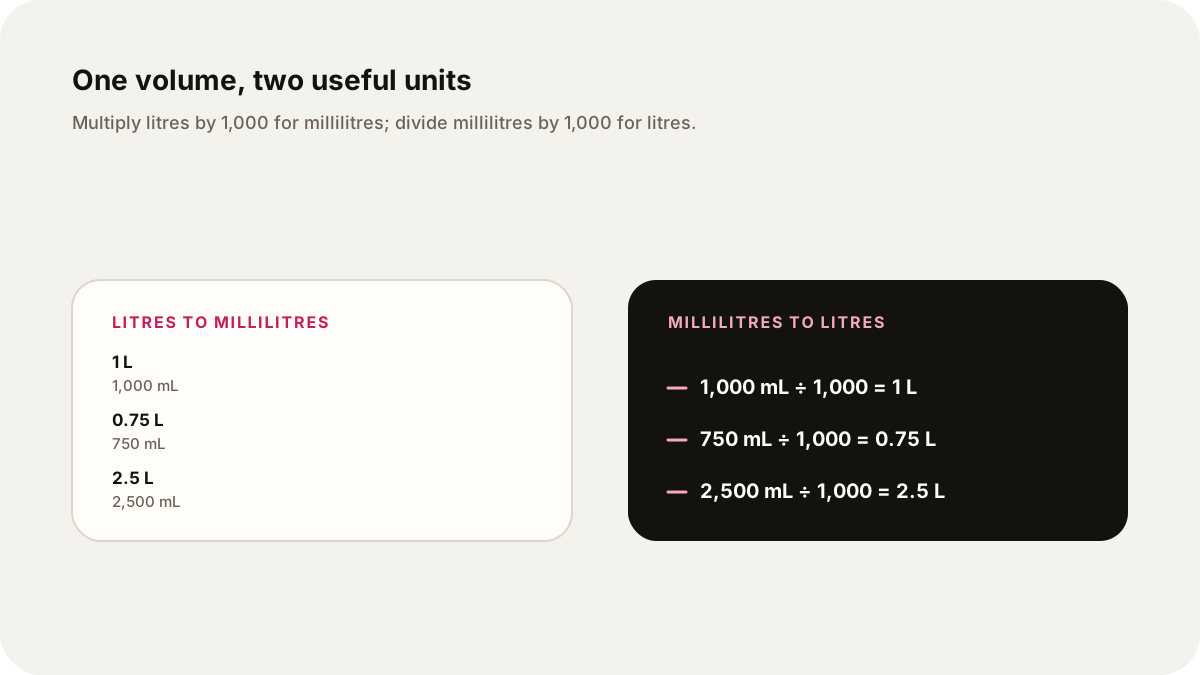
These are hypothetical bottle and recipe amounts, used to make the arithmetic easy to check. They are volume examples, not medicine instructions or measurements performed on a container.
What is the difference between a litre and a millilitre?
A litre is the larger unit. A millilitre is one thousandth of a litre. NIST lists the litre as a special name for a cubic decimetre and the millilitre as a special name for a cubic centimetre; its volume table gives 1,000 mL = 1 L (NIST, “SI Units - Volume”).
The symbols matter when you read a label aloud or write a calculation. Use uppercase L for litre and lowercase m followed by uppercase L for millilitre: mL. The m is the metric prefix milli-, which means one thousandth. NIST recommends the uppercase L to avoid confusing a lowercase l with the number 1, and its SI style guide shows prefixes attached to unit symbols without a space (NIST, “Guide to the SI, Chapter 6”).
That gives you two equivalent statements:
1 L = 1,000 mL
1 mL = 0.001 L
Keep the unit beside the number. “750” alone does not tell a listener whether the amount is 750 mL or 750 L.
How do you convert litres to millilitres?
Multiply the number of litres by 1,000. The decimal point moves three places to the right because one litre contains 1,000 millilitres.
1 L × 1,000 = 1,000 mL
0.75 L × 1,000 = 750 mL
2.5 L × 1,000 = 2,500 mL
The last example is useful because 2.5 L is more than one litre. It is 2,000 mL plus another 500 mL, which makes 2,500 mL. The comma is a readability mark; it does not change the value.
For an audio explanation, say the unit at both ends: “Two point five litres equals two thousand five hundred millilitres.” That avoids the common pause in which a listener hears “two point five times one thousand” but loses the unit.
How do you convert millilitres to litres?
Divide the number of millilitres by 1,000. The decimal point moves three places to the left.
1,000 mL ÷ 1,000 = 1 L
750 mL ÷ 1,000 = 0.75 L
2,500 mL ÷ 1,000 = 2.5 L
This is the reverse of the first rule. If you convert a value to litres and then back to millilitres, you should recover the starting value, provided you have not rounded it in between.
A quick table for bottles and recipes
The values below are hypothetical examples. They show the conversion pattern rather than reporting the capacity of a particular product or the amount used in a real kitchen.
| Label or recipe amount | In litres | In millilitres | Operation |
|---|---|---|---|
| 1 L | 1 L | 1,000 mL | 1 × 1,000 |
| 750 mL | 0.75 L | 750 mL | 750 ÷ 1,000 |
| 2.5 L | 2.5 L | 2,500 mL | 2.5 × 1,000 |
| 125 mL | 0.125 L | 125 mL | 125 ÷ 1,000 |
Suppose a hypothetical recipe lists 750 mL of water and a bottle label lists 1 L. Convert the bottle to millilitres before comparing: 1 L is 1,000 mL, so the bottle amount is 250 mL more than the recipe amount. Or convert the recipe to litres: 750 mL is 0.75 L, so the difference is 0.25 L. Both routes give the same comparison.
That is a volume comparison only. It does not tell you how much a person should drink, how much medicine to take, or whether a container has been filled accurately.
When should you keep litres instead of millilitres?
Use the unit that makes the numbers easiest to read, then use the same unit for the calculation. Litres are usually clearer for larger container amounts such as 2.5 L. Millilitres are usually clearer for smaller recipe quantities such as 125 mL. The choice changes the writing, not the amount.
Avoid mixing units in one addition. If a hypothetical recipe has 0.5 L plus 250 mL, convert first:
0.5 L = 500 mL
500 mL + 250 mL = 750 mL
You could also convert 250 mL to 0.25 L and write 0.5 L + 0.25 L = 0.75 L. The result is the same. The safest spoken order is: name the original units, convert one amount, then calculate.
The same habit matters when comparing a percentage-point change with a percentage change: keep the starting value and what the number measures clear. If you are explaining a measurement beside a diagram, area and perimeter is a useful related distinction: area describes a surface, while litres and millilitres describe volume.
What changes when a value is rounded?
Exact conversions between litres and millilitres do not need rounding when the starting value has three or fewer decimal places. For example, 0.75 L converts exactly to 750 mL, and 0.125 L converts exactly to 125 mL.
Rounding enters when the source value is approximate or when you choose fewer decimal places. If a hypothetical amount is 0.333 L, the exact three-decimal input converts to 333 mL. If the source was written as “about one third of a litre,” then 0.333 L is already a rounded representation of 0.333333… L, and 333 mL is correspondingly approximate. Say “about 333 mL” when the source is approximate.
Do not silently turn a rounded number into a precise measurement. Keep the original value, the converted value, and the precision label together. NIST describes the litre and millilitre relationship as a power-of-ten scale, while the BIPM’s current SI Brochure is the international reference for the SI (BIPM, “The International System of Units”).
An illustrative Lissin request could be: “Explain these bottle and recipe labels in litres and millilitres. Convert every amount to the requested unit, show one worked comparison, keep L and mL attached to the numbers, and say when a value is approximate.” That tells an audio guide what to calculate and what not to imply.
Sources
- NIST, “SI Units - Volume”: litre and millilitre definitions, 1,000 mL = 1 L, and volume examples.
- NIST, “Guide to the SI, Chapter 6: Rules and Style Conventions for Printing and Using Units”: uppercase L, attached prefixes, and mL notation.
- BIPM, “The International System of Units (SI) Brochure”: current international SI reference, 9th edition updated in 2026.