
12-hour vs 24-hour clock: noon, midnight and dates
Noon is the boundary between a.m. and p.m. Midnight is the boundary between dates. Use a named date with the clock notation so an appointment or deadline cannot be read two ways.
At noon, the 12-hour clock shows 12:00. At midnight, it returns to 12:00, but the date changes. That is why “12 a.m.” and “12 p.m.” cause trouble: the labels do not tell the reader whether the instant starts or ends a date. A 24-hour clock removes the am/pm step, but midnight still needs a date.
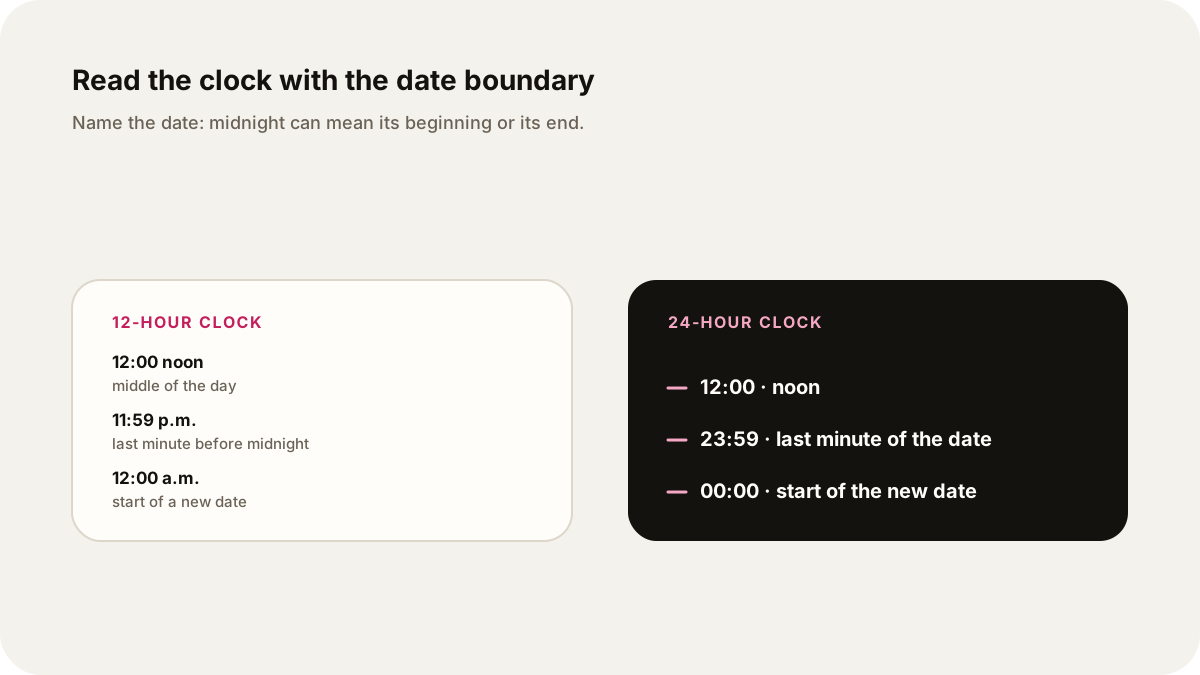
The short answer: noon is 12:00, midnight has two date meanings
The 12-hour clock labels the hours before noon as a.m. and the hours after noon as p.m. It counts 12, 1, 2, through 11, then starts the sequence again. Noon itself sits at the boundary, so NIST says not to call it 12 a.m. or 12 p.m.. Write noon, or write 12:00 with a named convention.
Midnight is the boundary between two calendar dates. “Midnight on Friday” can mean the instant that begins Friday or the instant that ends Friday. NIST recommends avoiding that ambiguity by naming the date, using 11:59 p.m. or 12:01 a.m. when appropriate, or using 0000 for the beginning of a date and 2400 for its end in a 24-hour representation.
The practical rule is simple: attach the clock reading to a date whenever the event could cross midnight.
How the 12-hour clock divides the day
The two labels are short for ante meridiem, before noon, and post meridiem, after noon. They work for ordinary hours, but not for the exact boundary itself.
| Moment | Clear 12-hour wording | Clear 24-hour wording |
|---|---|---|
| One minute after 14 June begins | 12:01 a.m. on 14 June | 00:01 on 14 June |
| Noon on 14 June | noon on 14 June | 12:00 on 14 June |
| One minute before 14 June ends | 11:59 p.m. on 14 June | 23:59 on 14 June |
| End boundary, where allowed | midnight at the end of 14 June | 24:00 on 14 June |
| Start of 15 June | 12:00 a.m. on 15 June | 00:00 on 15 June |
The table keeps two ideas separate. A clock notation names an instant within a day. A date tells you which side of midnight that instant belongs to. “12:00” alone does not answer both questions.
How the 24-hour clock counts
The 24-hour clock numbers hours from 00 through 23. NIST describes UTC this way: 00 is midnight, 12 is noon, and 23:59 is the final minute before the next midnight. To convert a 12-hour time, leave morning hours from 1 a.m. through 11 a.m. as 01 through 11, write noon as 12:00, and add 12 to afternoon and evening hours.
For example:
- 7:30 a.m. becomes 07:30.
- noon becomes 12:00.
- 3:45 p.m. becomes 15:45.
- 11:20 p.m. becomes 23:20.
- 12:10 a.m. becomes 00:10 on the date that has just begun.
The 24-hour clock is useful for schedules because 18:00 cannot be mistaken for 6:00 in the morning. It still does not make a date optional. A train at 00:15 on 15 June is four hours after 20:15 on 14 June, not part of the same calendar date.
A worked appointment example
Suppose a hypothetical appointment notice says: “The online session runs Friday, 18 October, from 11:30 p.m. to midnight.” A reader could reasonably ask whether the session ends at the start of 18 October or at the start of 19 October. Rewrite it with an interval whose endpoints carry dates:
18 October, 23:30 to 19 October, 00:00.
That means the session starts late on Friday and ends exactly as Saturday begins. If the notice instead means a session that starts at the beginning of Friday, write 18 October, 00:00 to 18 October, 01:00. The words “Friday at midnight” do not supply that precision by themselves.
This is a notation example, not a live booking or travel instruction. A real appointment also needs its time zone or place. The travel itinerary guide explains why a local time should stay attached to its source location when people may read the same schedule elsewhere.
A calendar example: midnight at the start or end
Consider a hypothetical library notice: “Returns are due at midnight on 30 June.” There are two possible interpretations:
- Start of 30 June: the deadline is 00:00 on 30 June. The book was due before 30 June began.
- End of 30 June: the deadline is 24:00 on 30 June, which is the same instant as 00:00 on 1 July.
The notice should choose one. “Due by 23:59 on 30 June” names the last minute of June. “Due at 00:00 on 1 July” names the first instant of July. ISO-style date and time fields generally use 00:00 for the start of a day; NIST’s time-of-day guidance also recognises 2400 as an end-of-day label when the surrounding date or time period makes that meaning clear.
If a form accepts only one convention, follow its instructions. Some public style guides tell writers to use “noon” and “midnight” in reader-facing copy, while technical systems use four-digit times. The UK Space Agency style guide, for example, says “noon” is preferable to “12:00 noon” and recommends “midnight” instead of “12 a.m.” That is a writing choice. It does not change what the clock measures.
What to say in an audio explanation
Read the date before the time. Say “midnight at the start of 15 June, written 00:00 on 15 June,” or “the end of 14 June, written 24:00 on 14 June where that notation is accepted.” Say “noon” rather than forcing a listener to decide between 12 a.m. and 12 p.m.
When you switch notation, announce it once: “The schedule uses the 24-hour clock.” Then read 06:30 as “six thirty in the morning” if your audience benefits from the translation, and read 18:30 as “six thirty in the evening.” Keep the written form beside the spoken form for dates, deadlines, and intervals.
The same discipline helps with historical records. A historical map audio guide keeps a source’s date and its later interpretation apart. A clock notice needs the same care: preserve the original wording, then state the precise date-boundary interpretation separately.
If the question is about a recurring date, check the calendar rule before doing the time conversion. Leap-year rules show why a date-based explanation should keep the civil calendar visible instead of treating every year as interchangeable.
Sources
- NIST, Times of Day FAQs: why 12 a.m. and 12 p.m. are ambiguous, and how to label midnight at the beginning or end of a date.
- NIST, WWV and WWVH digital time code: the 24-hour UTC sequence from 00 at midnight through 23:59 before the next midnight.
- UK Space Agency, Style Guide: reader-facing guidance to use “noon” and “midnight” clearly.
If a source or calculation needs correcting, contact Lissin with the original wording, date, and link. The editorial standards explain how source links and corrections accompany an audio guide.