
Why leap years skip centuries: the 1900, 2000, 2100 rule
A year divisible by 4 is usually a leap year, but a century must also divide evenly by 400. That is why 1900 skipped February 29 while 2000 kept it.
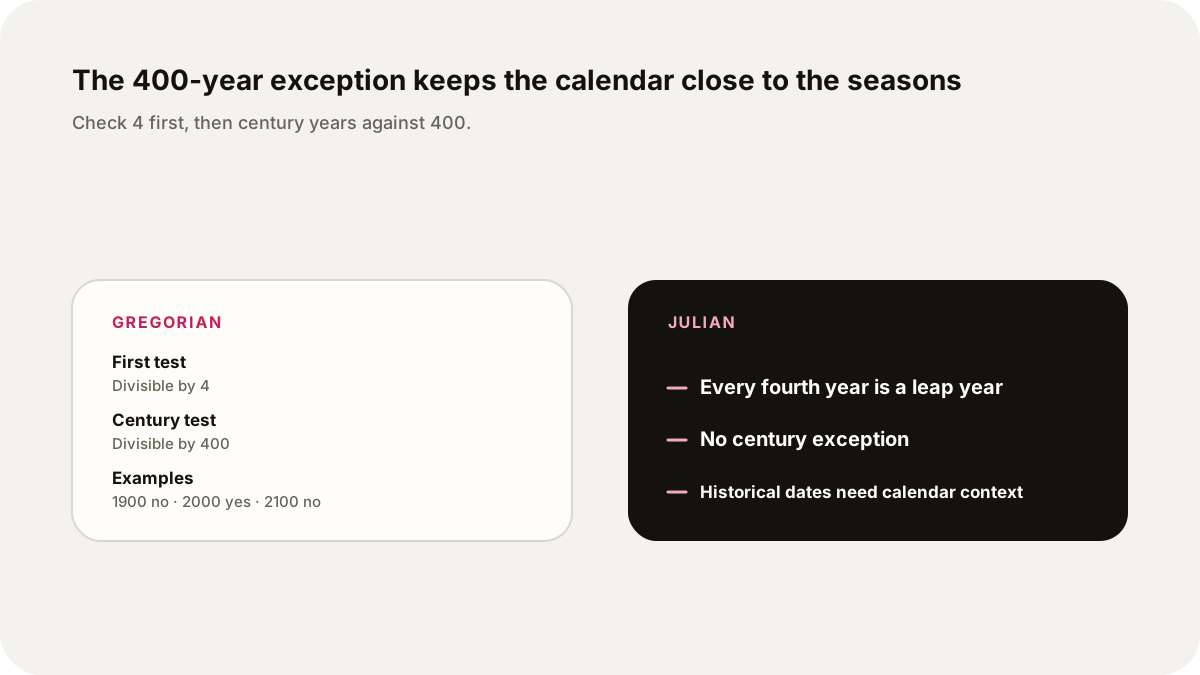
Leap years add one day to February so the calendar stays close to the seasons. In the Gregorian calendar, a year is a leap year when it is divisible by 4, except for century years that are not divisible by 400. That is why 2000 had a February 29, while 1900 did not and 2100 will not.
This guide is for an everyday learner who wants to hear the rule in the right order. It uses the Gregorian calendar for the examples. The Gregorian calendar is the civil calendar used in most countries, but it is not the only calendar in use and adoption was not simultaneous everywhere.
Key Takeaways
- A common Gregorian year has 365 days. A leap year has 366, with February 29.
- Divisible by 4 is the first test. A century year must also be divisible by 400.
- 1900 fails the 400 test, 2000 passes it, and 2100 will fail it.
Why does February sometimes have 29 days?
The seasons follow Earth’s orbit, not a neat whole number of days. The U.S. Naval Observatory explains that the tropical year is about 365.2422 days. A calendar made of 365-day years would lose about a quarter of a day each year. The dates of the seasons would slowly move through the calendar.
Adding a day now and then keeps the calendar and the seasonal cycle close. The added day is February 29. A common year has 365 days. A leap year has 366.
This does not mean the calendar perfectly measures Earth’s orbit. It is a rule that keeps the difference small enough for civil dates and seasonal dates to remain close over long periods.
The three-part Gregorian test
Use the tests in this order:
- Is the year divisible by 4? If no, it is a common year.
- Is it divisible by 100? If no, it is a leap year.
- If it is divisible by 100, is it also divisible by 400? If yes, it is a leap year. If no, it is a common year.
The second test is the century exception. The third test makes one in four century years a leap year. Over a 400-year cycle, the Gregorian rule gives 97 leap years and 303 common years. That average is closer to the tropical year than adding a leap day every four years without an exception.
For audio, do not shorten the rule to “every four years.” That works for many years, but it gives the wrong answer at a century. Say “every four years, except most century years, with years divisible by 400 kept as leap years.”
What does the rule average over 400 years?
The 400-year cycle gives a useful check on why the exception exists. For example, take the years 1601 through 2000 under the Gregorian rule. There are 100 years divisible by 4. Remove all four century years from that count: 1700, 1800, 1900 and 2000. Then add back 2000, which is divisible by 400. That leaves 97 leap years and 303 common years.
Here is the worked calculation:
97 × 366 = 35,502
303 × 365 = 110,595
35,502 + 110,595 = 146,097
146,097 ÷ 400 = 365.2425
The first two lines count days in leap years and common years. Their sum is the number of days in the 400-year cycle. The last line gives the average number of days per year.
The U.S. Naval Observatory gives the same Gregorian average. It also gives the tropical year as approximately 365.2422 days. The two numbers are close, but they are not identical. This rule keeps civil dates near the seasons over long periods; it does not make a calendar year equal to Earth’s exact orbital cycle.
Work through 1900, 2000, and 2100
These three years show why the exception matters:
| Year | Divisible by 4? | Divisible by 100? | Divisible by 400? | Gregorian result |
|---|---|---|---|---|
| 1900 | Yes | Yes | No | Common year, 365 days |
| 2000 | Yes | Yes | Yes | Leap year, 366 days |
| 2100 | Yes | Yes | No | Common year, 365 days |
The U.S. Naval Observatory’s leap-year explanation gives the same examples. The arithmetic is simple once the tests are separate. All three years pass the divisible-by-4 test. The difference appears at the divisible-by-400 test.
Suppose a calendar app is checking 2100. It should not stop after seeing that 2100 divides evenly by 4. It should notice that 2100 is a century year and then check 400. Because 2100 is not divisible by 400, the app should show February with 28 days. The same process gives the opposite result for 2000 because 2000 is divisible by 400.
How is the Julian rule different?
The Julian calendar uses a simpler leap-year rule: every fourth year is a leap year. The Gregorian calendar kept the same basic month structure but changed which century years receive an extra day.
The U.S. Naval Observatory’s calendar overview describes the Gregorian calendar as a reform introduced in 1582 and notes that the Julian calendar and variations of it remain in use by some groups for liturgical dates. That history matters when reading an old document. A date recorded in a Julian calendar may not line up with the same numbered date in a Gregorian calendar.
Do not say that one calendar replaced every other calendar on one universal day. Countries and communities adopted the Gregorian system at different times, and some still use other calendars for religious or cultural purposes. If an audio guide discusses a historical date, name the calendar system when the source makes it relevant.
A short checklist for a calendar explanation
When explaining whether a year is a Gregorian leap year, use this sequence:
- Name the calendar system.
- Check divisibility by 4.
- If the year ends in 00, check divisibility by 400.
- State whether February has 28 or 29 days.
- If the date is historical, check whether the source used the Julian or Gregorian calendar.
An illustrative request for a personal audio show could be: “Explain why 1900 was not a Gregorian leap year, why 2000 was, and why 2100 will not be. Start with the divisible-by-4 test, then apply the century and 400-year exceptions. Compare the Julian rule in one short section. If the historical source does not name its calendar, say that the calendar system is unknown.”
For another audio guide that turns a dated system into a sequence, see how to read a historical map. Why eclipses do not happen every month also explains a recurring astronomical pattern without treating a simple cycle as a guarantee. When an episode depends on a date or source, keep the source and corrections with the audio.
Sources
- U.S. Naval Observatory, Leap Years: Gregorian rule, tropical year context, and 1900, 2000, and 2100 examples.
- U.S. Naval Observatory, Introduction to Calendars: Gregorian and Julian calendar history and the limits of universal adoption claims.
- U.S. Naval Observatory, Explanatory Supplement to the Astronomical Almanac: Gregorian civil-use rule and the 1900, 2000, and 2100 comparison.
If you find a date or calculation that needs correcting, contact Lissin with the year, calendar system and source link. Our editorial standards explain how we handle sources and corrections.