
How to read print edition numbers and artist's proofs
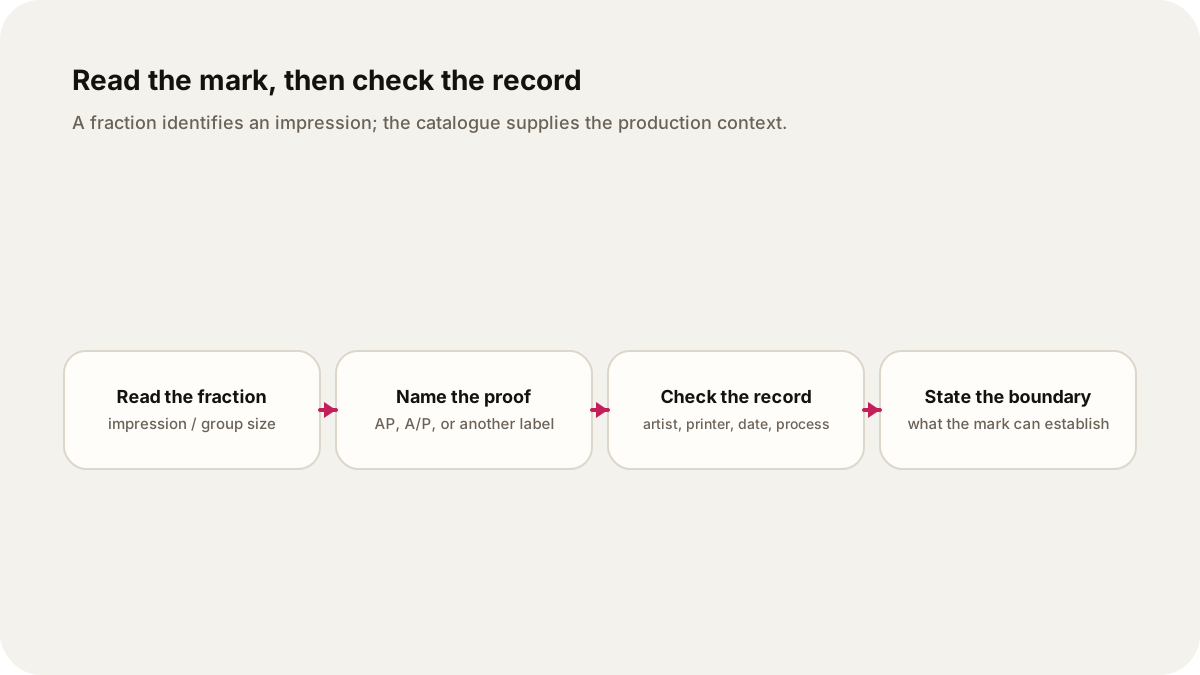
A fraction identifies an impression within a group. The catalogue record explains what that group means.
When you see 12/50 in the lower margin of a print, the first number identifies that impression and the second gives the size of the numbered edition. When you see A/P 3/8, you are looking at a separately numbered group of artist's proofs. The notation describes how the print was catalogued. It does not, by itself, tell you how the print was made, who printed it, or what it should cost.
Key Takeaways
- Read the fraction as “impression number / total in this numbered edition.”
- Treat A/P, AP, and E.A. as labels for a proof group, then check the catalogue record for the artist, printer, and edition details.
- Keep trial proofs, printer's proofs, and artist's proofs distinct. They can answer different questions about the printing process.
Start with the fraction
The common form 12/50 means impression 12 from a numbered edition of 50. It is not a date, a ranking, or a claim that only 50 impressions exist in every category. The edition line may also list proofs, a printer's copy, a publisher's copy, or other impressions separately.
The Metropolitan Museum of Art's record for Frank Stella's The Affidavit shows why the second number needs context. The Met describes one object as “artist's proof 8/12” and lists a main edition of 38, plus 12 artist's proofs and several other categories, including trial and printer's proofs. In other words, “8/12” does not mean the artwork has twelve impressions in total. It identifies the eighth proof in that proof group.
Read the inscription together with the catalogue entry. A pencil fraction on paper can identify a numbering scheme, but the institution's record may be the place that names the medium, printer, publisher, date, and full edition structure.
What A/P means
A/P or AP usually means artist's proof. The Fitzwilliam Museum's terminology record defines artists' proofs as proofs numbered separately from the edition, often made at the same time, for the artist's use. The Museum of Modern Art's definition of “proof” places artist's proofs alongside printer's proofs and other impressions outside the regular numbered edition.
You may see several forms: AP 3/8, A.P. 3/8, or E.A. 3/8. E.A. is short for the French épreuve d'artiste. The punctuation and language can vary, so do not infer a different process from the dots alone. Look for the catalogue's wording and the printer or publisher's documentation.
An artist's proof can be physically indistinguishable from a print in the main edition. Its label tells you about its place in the production and distribution record. It does not guarantee that the paper, ink, image, or signature differs.
Keep proof types separate
“Proof” is a broad word. A trial proof can be pulled while the plate, stone, block, or screen is still being adjusted. A working proof may include changes or hand additions. A printer's proof is associated with the printer. An artist's proof belongs to a separate group reserved for the artist or studio. MoMA's proof terminology gives these categories together and notes that some proofs can be indistinguishable from the edition.
That distinction matters when you describe a print aloud. “This is an artist's proof” is a statement about the catalogue category. “This is an early state with a missing colour” is a statement about the image and printing state, which needs its own evidence. Do not turn one label into the other.
A worked example: read the whole line
Imagine a label or catalogue entry that says:
Untitled, screen print, 2024. A/P 3/8. Edition of 40, signed by the artist. Printer: North Street Press.
Read it in four passes:
- Title and medium: identify the work and the process named by the record.
- Proof marking: say “artist's proof, number three of a group of eight.”
- Main edition: keep “edition of 40” separate from the proof group. The eight proofs are not silently added to the 40 unless the record says how the publisher counts them.
- People and dates: attribute the printer and date to the catalogue entry. A signature may support the record, but it does not replace it.
This is a hypothetical label for practice. It is not a description of a particular print or press. For a real object, copy the exact wording from the collection record and link it in your notes.
The Met's collection records show how much detail can sit behind a short mark. Its record for Richard Tuttle's When Pressure Exceeds Weight, VII identifies the printer and publisher, dates the work to 2012, and describes the medium as drypoint and à la poupée; artist's proof. Another Met record for Helen Frankenthaler's A Page From A Book I, II, III records each sheet as artist's proof 14/16. These entries are useful examples of catalogue description, not a universal rule for every publisher.
Turn the notation into a clear audio guide
If you want Lissin to make an audio guide, give it the object record and ask it to read the notation in context. A useful request could be:
“Using the linked museum record for this print, explain the title, medium, artist, printer, date, numbered edition, and proof group. Read 12/50 as impression 12 from an edition of 50, and A/P 3/8 as artist's proof 3 from a separately numbered group of eight. Keep trial, printer's, and artist's proofs separate. If the record does not say whether the image or paper differs, say that the record does not establish it. Link the source record and label any description of what the print looks like as an observation or interpretation.”
That request keeps the source boundary visible. It also leaves room for an unanswered question, which is better than inventing a production detail. The museum object audio guide shows the same discipline for physical description, documentation, and interpretation. For another example of separating an object's catalogue data from its production history, see the 78 rpm record audio guide. And source links and corrections explains how to keep the record attached to the published audio.
A quick reading checklist
Before you describe a print, write down the exact mark, its position on the sheet, and the wording in the collection record. Expand AP only when the record supports “artist's proof.” Record the main edition and every separate proof group as separate lines. Note the artist, printer, publisher, process, date, signature, and any stated differences between impressions.
Then say what the notation establishes: an identity within a group. Say what it does not establish: that the impression is earlier, better, more valuable, or unique. Those claims need other evidence and are outside the fraction itself.
Once you can read the mark without collapsing the categories, the margin becomes a compact production record. The number tells you where the impression sits. The source tells you what that group means.
Sources
- The Metropolitan Museum of Art, The Affidavit: an edition record listing a main edition, artist's proofs, trial proofs, printer's proofs, and an artist's proof numbered 8/12.
- The Metropolitan Museum of Art, When Pressure Exceeds Weight, VII: a collection record identifying the printer, publisher, medium, date, and artist's-proof designation.
- Fitzwilliam Museum, “Artists' proofs”: terminology record for proofs numbered separately from the edition.
- Museum of Modern Art, “Proof”: definitions of trial, working, artist's, and printer's proofs.
- Tate, Bob and Roberta Smith, There Is Still Art There Is Still Hope: a current institutional example of a signed artist's-proof edition.