
Turn one expert interview into a personal audio brief
Start with the question you want answered, then select the transcript passages that can answer it without putting new words in the expert's mouth.
You can turn one public expert interview into a personal audio show by choosing one question before you ask for a summary. The question gives the episode a job. The transcript supplies the answer, examples, and limits.
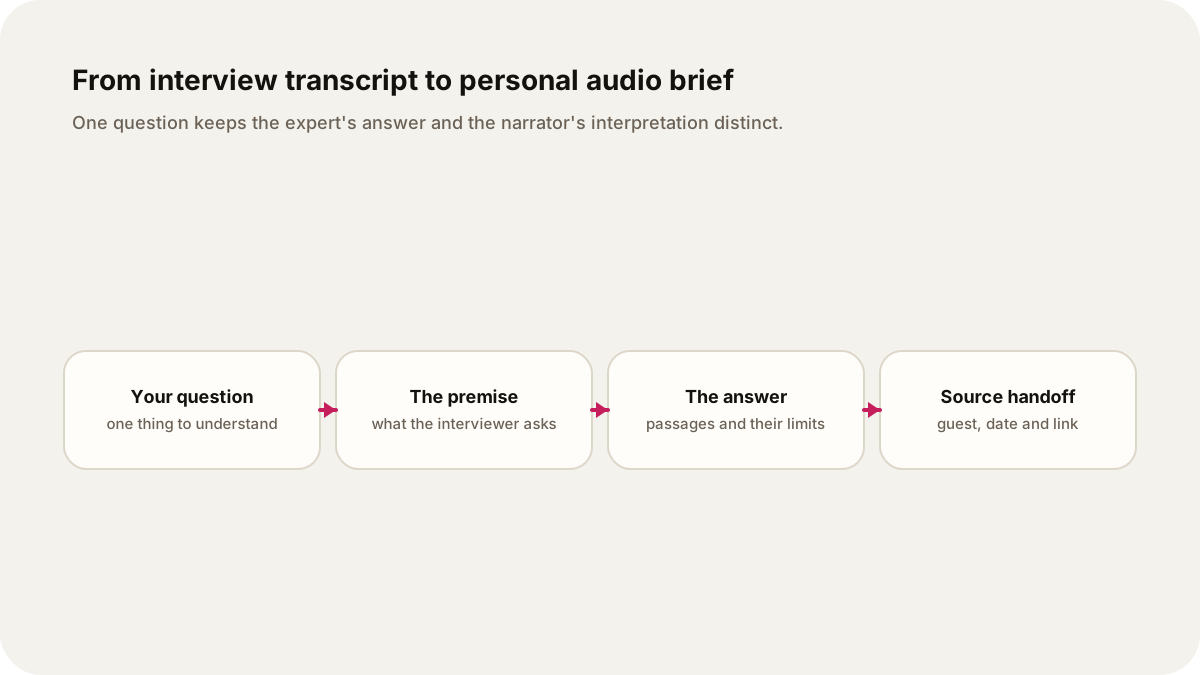
The brief at a glance
| Part of the transcript | NASA example | Job in your audio show |
|---|---|---|
| Interviewer premise | Van Wert asks what Conley likes best and least about her job. | State the framing as a question, not as a fact about every scientist. |
| Guest answer | Conley says she enjoys finding answers to interesting questions and dislikes politics. | Let the guest's distinction set the episode's focus. |
| Narrator's inference | You ask what measurement should come next in a similar investigation. | Mark the comparison as your prompt, then return to the transcript. |
Before you write, test each sentence: can you point to the interviewer, the guest, or your own explanation?
Start with the question you want answered
An interview can contain a career story, technical explanation, disagreement, and closing reflections. A personal episode does not need to carry all of them. Start with the question that matters to you, then select the answer passages that help with that question.
For example, NASA's 2024 interview with plant biologist and planetary protection officer Cassie Conley includes questions about her career, her research, planetary protection, and what she likes about science. A broad request such as “Tell me about Cassie Conley's career” would make the episode choose its own center. A better question is: “How does a scientist turn an interesting question into the next measurement?”
That question points to a few useful passages. Conley says she enjoys “figuring out interesting questions and then finding out the answers.” She also describes asking what measurement should come next to increase statistical confidence, using a Bayesian framework. Those passages support a short episode about the movement from question to measurement. The rest of her career story can remain linked for a listener who wants more.
Keep the interviewer's premise separate from the answer
An interviewer may place a premise inside a question. The guest can accept it, correct it, ignore it, or take the conversation somewhere else. A transcript makes that difference visible, so the audio brief should preserve it.
In the NASA interview, Fred Van Wert asks what Conley likes best and least about her job. The setup suggests that a NASA scientist must have one enjoyable part and one unpleasant part. Conley answers with a more specific distinction: she likes the research process and dislikes politics. The premise belongs to the interviewer. The reasons and examples belong to Conley.
Label the two layers in your notes:
- Interviewer premise: the assumption or framing inside the question.
- Interview answer: what the guest actually says, including qualifications, examples, and uncertainty.
This is a small editorial step with a large effect. If the narrator repeats the premise as fact, the planned episode may claim that every NASA scientist has the same work pattern. If the narrator names the premise and then follows Conley's answer, the listener can hear both the question and the person's response.
Choose a short passage that can carry the episode
Select one or two transcript windows rather than collecting every interesting line. For the question about moving from curiosity to measurement, use these windows from the NASA interview:
- Conley's description of enjoying interesting questions and finding answers.
- Her explanation of asking which measurement should come next to increase statistical confidence, and her reference to Bayesian statistics.
- Her account of an experiment on Columbia and what it demonstrated about survival during a meteorite-style planetary entry event.
The first passage gives the episode its human entry point. The second shows a method. The third offers a concrete research example. Keep the passages separate in the brief because they do different work. Do not suggest that the experiment proves every part of the broader theory. Conley describes what it demonstrated and what remained to be shown.
The NASA interview page identifies Van Wert's questions in bold and Conley's responses in regular text. That layout is useful evidence for your source ledger. It helps you tell a listener which words came from the interviewer and which came from the scientist.
Plan a personal show around one selected question
The episode can be five to eight minutes. Give each section one task:
- The question: say what you want to understand and identify the interview and date.
- The premise: paraphrase the interviewer's framing in one sentence. Mark it as the question's setup.
- The answer: explain Conley's distinction between enjoying research and disliking politics.
- The method: describe her next-measurement question and Bayesian framing in plain language.
- The example: use the Columbia experiment as a worked passage, then state what the interview says it demonstrated and what it does not establish.
- The source handoff: point to the full NASA interview and name the transcript sections used.
The episode can add one listener-facing comparison, as long as it is clearly yours. For instance: “If you were testing whether a plant could survive a harsh journey, what measurement would you make next?” That question is a prompt for the listener. It is not a quotation from Conley and it does not claim that the listener has run the experiment.
Lissin can make a personal audio show from the interview link and your question. Add the source and the desired focus in the request so the show has a bounded task. You can also specify the length, tone, and whether the episode should quote briefly or paraphrase. The result should identify the source and keep your interpretation beside the guest's words.
A worked request using the NASA transcript
Make a six-minute personal audio show from NASA's “Interview with Catharine ‘Cassie’ Conley,” conducted by Fred Van Wert on January 30, 2024. Answer this question: How does a scientist turn an interesting question into the next measurement? Use the passages about enjoying research questions, asking what measurement would increase statistical confidence, and the Columbia experiment. Separate Van Wert's interviewer premises from Conley's answers. Explain Bayesian statistics only at the level supported by the transcript. Mark any interpretation as the narrator's explanation. Do not invent dialogue, add a career conclusion that Conley did not state, or imply that the Columbia experiment proves the whole theory of transfer of life between planets. End with the NASA source link and the transcript sections used.
This request gives the episode a source, question, length, passage list, and boundary. It also tells the narrator what to do when the interview contains a tempting but unsupported conclusion. You can swap in another public transcript while keeping the same structure: choose a named expert, identify the interviewer, select one question, list the answer windows, and write the limits beside the claim.
Know which kind of audio guide you are making
This format is for a contemporary public interview where the listener wants an answer shaped around a selected question. It differs from an oral history audio guide, which preserves a narrator's recollection beside historical context, permission, and collection information. It also differs from a public lecture listening syllabus, which turns one lecture into several episodes with different teaching questions.
The guide to turning research into a personal audio show explains how to supply sources and creative direction. Here, the useful constraint is narrower: one interview, one selected question, and a clear boundary between the interviewer's premise and the expert's answer. For a source with several speakers or a long transcript, the source-checking guide for AI audio gives a claim-by-claim way to keep the handoff inspectable.
Sources
- NASA, Interview with Catharine “Cassie” Conley: public transcript, interviewer attribution, interview date, questions, answers, and the passages used in the worked example.
- NASA, Scientist Interviews: archive context and transcript presentation that distinguishes interviewer questions from responses.
- NASA, Interview with Alex Borlaff: another public NASA expert interview that shows how a single guest transcript can support a focused question.