
How to turn a documentary transcript into a personal audio brief
A transcript can show who spoke and when. This guide keeps narrator, interview, archive voice, caption cues and missing visual evidence separate as you plan a personal audio brief.
The most useful way to turn a documentary transcript into a personal audio brief is to give it one question and keep five categories of evidence separate: what the narrator says, what an interviewee says, what an archive recording contributes, what captions add about sound or text, and what a separate viewing or description records about the visuals. A transcript can tell you which words were spoken and when. It cannot, by itself, prove what the film showed.
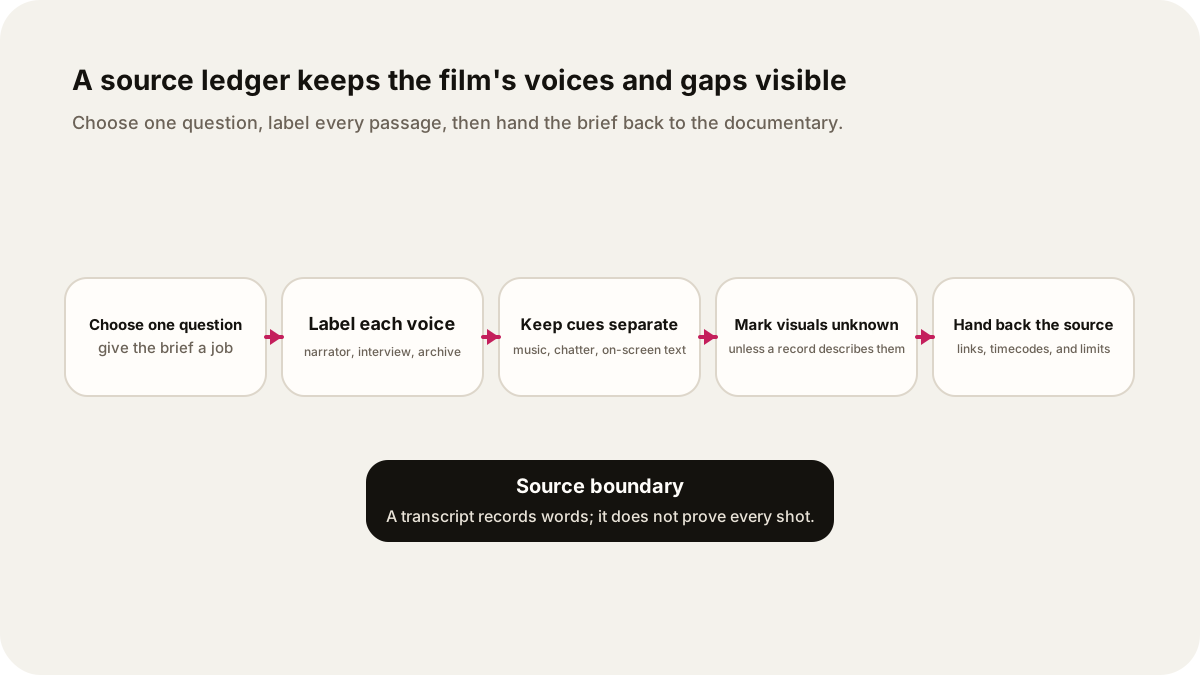
Key takeaway: Keep spoken words, speaker labels and caption cues with their timecodes. Mark visual evidence as unavailable when the text does not describe it. A brief can explain the transcript; it cannot turn an unseen shot into a verified fact.
The source is a record, not the whole film
NASA's page for Apollo 11: This Is Goddard provides a complete transcript, an SRT caption file, and the video itself. The SRT includes timecodes, labels such as NARRATOR, ARMSTRONG, HOUSTON, and GODDARD CONTROL, plus entries such as [music], [control room chatter], [words on screen], and [unintelligible]. That is enough to make a source-led listening plan. It is not enough to reconstruct every shot or claim that a visual detail appears in the film.
The National Archives makes the difference explicit in its catalog guidance. A moving-image summary should tell a researcher about the genre, people, locations, scenes, and activities depicted. That descriptive summary is a companion to the moving image. It is not the same thing as a line-by-line transcript. Treat the transcript, caption file, archival description, and film as four related records with different jobs.
PBS's caption specification gives a practical test for the caption layer. Captions should match spoken words without paraphrase, identify speakers, convey non-verbal audio cues where possible, begin and end with the corresponding speech or sound, and avoid covering important visual information. A caption such as [music] tells you that music is present. It does not tell you what the camera is showing while the music plays.
Start with one question
Documentaries usually contain more material than a short personal brief needs. Choose the question before selecting passages. “What happened in Apollo 11?” is too broad for a five-minute brief. “How does the film show the communication work around the landing?” gives the episode a job.
Write the question at the top of your notes, then sort passages by role:
| Evidence label | What it can support | What it cannot support by itself |
|---|---|---|
| Narrator | The film's stated explanation or sequence | Every image that appears under the narration |
| Interview voice | A named person's account, qualification, or disagreement | A claim that the whole documentary agrees |
| Archive voice | A historical recording or contemporaneous statement | The provenance of an unidentified voice |
| Caption non-speech | Music, applause, chatter, a sound effect, or on-screen words | The meaning of an unseen image |
| Visual evidence | A shot, diagram, place, action, or text visible in the film | Any detail missing from the viewing record |
Use “visual evidence unavailable” when you have only a transcript or caption file. That phrase is more useful than guessing. If a descriptive transcript or archival catalog supplies the scene, cite that record separately and keep its wording distinct from the spoken transcript.
A fictional transcript excerpt for the method
The five lines below are a fictional teaching example. They are not quotations from Apollo 11: This Is Goddard or any other real film. The timecodes and speaker labels show the shape of a source note; the visual field is deliberately marked unknown.
| Timecode | Label | Text or cue | Visual status |
|---|---|---|---|
| 00:02:10–00:02:14 | NARRATOR | “The signal passes through the ground network.” | Visual not described; unknown from this excerpt |
| 00:02:14–00:02:18 | INTERVIEW | “We watched the readings, then checked them again.” | Visual not described; unknown |
| 00:02:18–00:02:21 | ARCHIVE VOICE | “Stand by for the next call.” | Visual not described; unknown |
| 00:02:21–00:02:24 | CAPTION: NON-SPEECH | [room tone and switch clicks] | Sound cue only; no visual claim |
| 00:02:24–00:02:28 | ON-SCREEN TEXT | [title card] | Text is reported by the caption; the card's design is unknown |
The narrator's line can support an explanation of the network if the film or its accompanying source establishes that meaning. The interview line supports the speaker's account. The archive voice is evidence of a recorded statement, while the captioned room tone supplies atmosphere and timing. None of these lines proves what the camera showed. A listener brief should say that plainly.
Keep narrator, interview, archive, and caption voice apart
Speaker labels are useful because a documentary can move from a narrator's summary to an interviewee's qualification without warning. Preserve the label in your source ledger, even when the final audio paraphrases the passage. A simple note can look like this:
- Narrator: states the sequence or context.
- Interview: gives a person's account, including limits and uncertainty.
- Archive voice: preserves a historical recording or contemporaneous testimony.
- Caption cue: records sound, music, audience reaction, or visible text that is not ordinary dialogue.
- Your narration: explains why the selected passage answers your question.
Your narration is the only new layer. Mark it as interpretation. Do not let a sentence such as “the control room proves the system worked” hide a jump from a quoted voice to your conclusion. Instead write: “The documentary presents the control-room exchange as part of its account of the communications work. The selected transcript does not establish the performance of the whole system.”
That discipline also protects against a common accessibility error. Captions and descriptive transcripts solve different problems. PBS asks captions to carry speech and relevant sound cues, while the National Archives asks a catalog summary to describe scenes and activities. If the visual description is absent, preserve the gap. Do not turn [music] into an invented scene.
Turn the ledger into a personal brief
Once the question and evidence labels are in place, write a short handoff with five parts:
| Brief section | Instruction | Source boundary |
|---|---|---|
| Question | State the one thing you want answered | Your question, not a film claim |
| Sequence | Name the timecoded passages in order | Keep labels and timecodes beside them |
| Explanation | Ask for plain-language context | Mark interpretation as narration |
| Limits | List missing visuals, unclear words, or contested points | Keep “unknown” visible |
| Source handoff | Link the documentary, transcript, captions, and archive note | Let the listener inspect the record |
For the NASA example, a bounded request could be: “Make a six-minute personal audio brief about how the documentary presents communications support during Apollo 11. Use the narrator passages about the ground network, the labeled mission-control exchanges, and the captioned control-room sounds. Keep Armstrong, Houston, Goddard Control, and the narrator separate. Identify any archive recording. Treat visuals as unavailable unless the linked video or a cited descriptive record supports them. End with the NASA video and transcript links.”
Lissin can make a personal audio show from a topic, question, or set of sources. You can provide links, articles, PDFs, documents, or images, choose the editorial direction and voice, and make a one-time or recurring episode. If you have an SRT caption file, paste its text into the request or copy it into a PDF, keeping speaker labels and timecodes intact. For this workflow, provide the documentary link and the caption text or supported document when you have one. Ask for a source handoff and a list of unknowns. Treat documentary-grade transcription and visual description as unavailable unless your supplied sources establish them.
The related source-checking guide for AI audio explains how to keep a claim beside its source. For a broader source-to-audio workflow, see how AI turns research into a personalized audio show. If your material is a public speech rather than a film, the public lecture listening syllabus uses a different structure: several teaching questions from one lecture.
What to listen for before you press play
Check the finished brief against the source ledger. Are narrator statements still attributed to the narrator? Are interview and archive voices named? Did a caption cue become a claim about a shot? Did an unidentified sound receive a made-up source? Is “visual evidence unavailable” still present where no description was supplied?
Keep the original documentary, transcript, or caption file beside the audio. A personal brief should make the source easier to revisit, with a clear question and a shorter route through the evidence. It should not ask a transcript to prove what only the moving image, a descriptive transcript, or an archival record can show.
If a guide assigns words to the wrong speaker or invents an image, contact Lissin with the source and timecode. The editorial standards explain how source corrections stay with the guide.
Sources
- NASA, Apollo 11: This Is Goddard, released July 31, 2019 and updated May 3, 2023. The page identifies the documentary, provides the video, captions, and complete transcript, and says the film was preserved and digitized by the US National Archives.
- NASA, Apollo 11 SRT caption file, accessed October 10, 2026. The caption record supplies timecodes, speaker labels, on-screen text, non-speech cues, and unintelligible-audio markers used in the article's source distinctions.
- PBS Technical Operating Specification, Part 1, section 4.4, accessed October 10, 2026. The specification covers caption accuracy, speaker identification, non-verbal cues, synchronization, placement, and completeness.
- US National Archives, Scope and Content Note, reviewed September 26, 2024. The guidance distinguishes narrative summaries of moving images from transcription and asks catalogers to describe genre, people, places, scenes, and activities.
- Lissin for iPhone, accessed October 10, 2026. The current product page documents supported source inputs, editorial direction, voices, one-time and recurring shows, and the iPhone requirement.