
Turn a book review into a personal audio brief
Already have a review? Keep its judgement and evidence clear as you adapt it into a personal audio brief for one listener's question.
If you already have a book review, you have the starting point for a useful personal audio brief. The adaptation should preserve the reviewer's judgement while making its evidence easier to follow aloud. Keep the reviewer's view separate from the book's words, the publisher's description, and the question the listener wants answered.
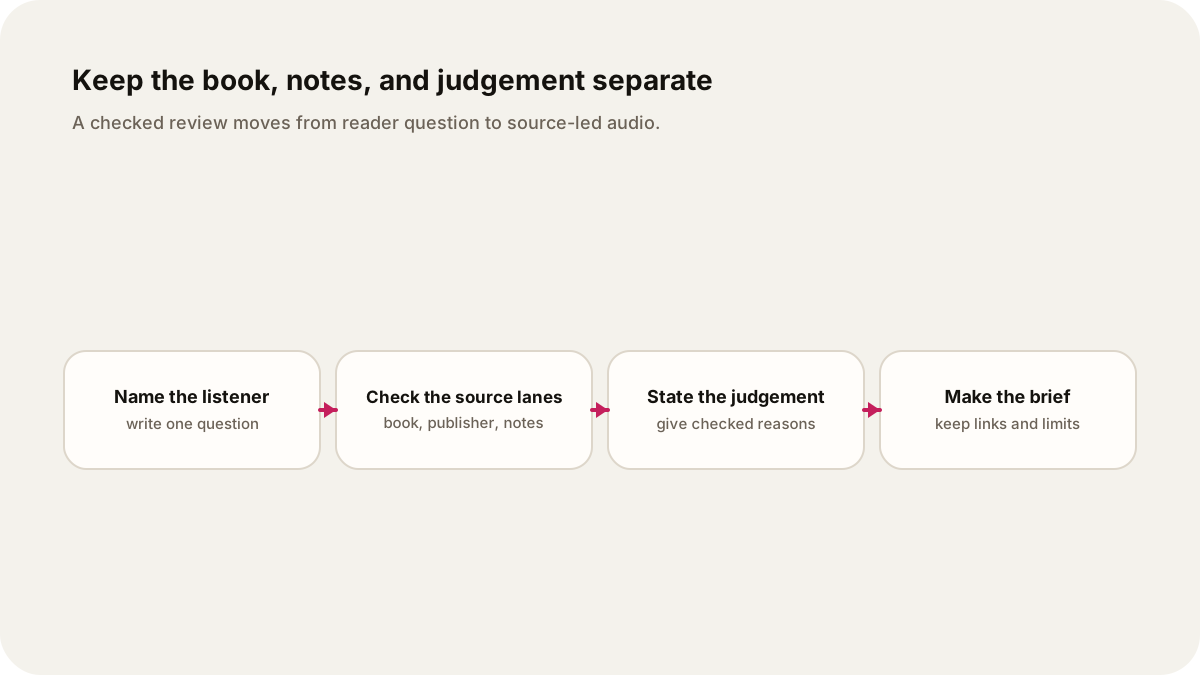
Start with the listener's question
Start with one question the listener wants the review to answer. It might be, “Would this history help a beginner understand the subject?” or “Does this novel's structure reward a patient reader?” The question gives the audio a job. It also keeps the adaptation from becoming a chapter-by-chapter retelling.
The USC Libraries guide to writing a book review describes a review as a description, critical analysis, and evaluation. It separates a descriptive review, which explains a book's purpose and structure, from a critical review, which tests how well the book meets its aims. The guide also recommends taking notes while reading, developing an argument about the book's value, and supporting that argument with evidence.
Use those three moves as the audio outline:
- What is this book trying to do?
- What evidence in the book supports or weakens that effort?
- Which reader, if any, should spend time with it?
Define critical judgement once: a reasoned assessment of how well a work meets its stated or visible purpose. After that, call it your judgement. A review is not a star rating with a plot summary attached.
Sort the review into source lanes
Before adapting the review, sort its material into four lanes. A source ledger is a small record that says where each statement came from and what kind of statement it is.
| Note type | What belongs there | How to say it aloud |
|---|---|---|
| Book record | title, author, edition, publisher and publication year | “The edition I read is…” |
| Book evidence | your page note or a short exact quotation | “On page 84, the text says…” |
| Publisher description | jacket copy or the publisher's catalogue entry | “The publisher presents it as…” |
| Reviewer judgement | your conclusion about clarity, evidence, pace or audience | “My judgement is…” |
The distinction matters because these sources have different authority. A publisher can describe a book's intended audience, but that description is promotional copy. It does not prove that the book succeeds with that audience. A reviewer's notes can explain what they noticed while reading, but a feeling is not evidence of what the author wrote. A quotation is exact only when it has been checked against the edition in front of you. If the reviewer has not read the full book, say that plainly and limit the audio to the supplied review and extracts. Do not imply a complete reading or invent the author's intent.
The USC arts and humanities guide recommends starting with bibliographic information and considering the author's perspective, evidence, audience, and physical features such as an index or bibliography. Those details give a reader a way to judge whether your review fits the book. They also make a spoken version easier to audit later.
Keep the reviewer's judgement visible
Keep the reviewer's verdict in one sentence before the summary. For example: “This hypothetical book would suit a curious beginner because its case studies are clear, but its final chapter assumes more background than the opening chapters provide.” This is a worked example, not a published review of a real book. The book title, author, and wording are intentionally omitted so the example cannot be mistaken for a source.
Now add two or three pieces of evidence. One could be a chapter that defines its terms well. Another could be a section where the argument jumps over a missing source. A third could be the index, illustrations, or notes if those features change how useful the book is.
Avoid claims about author intent unless the book states that intent or the publisher makes it explicit. “The author wanted to change how everyone thinks” is a guess. “The introduction says the book will compare three explanations” is a checkable statement. The difference protects the review from sounding certain where the evidence is thin.
If you use an extract, mark it as an extract in your notes. Do not smooth it into a paraphrase and then place quotation marks around the result. Keep the page number beside the words. When the audio is published, put the edition and page reference in the notes so a listener can check the passage.
Turn the finished review into a personal audio brief
Once the review and its source lanes are clear, use the review, its links, and any supplied extracts as the source for a personal audio brief. Lissin can work from a link, text, document, or PDF that you supply, then shape a personal show around the listener's question. Keep the source beside the finished audio. The show is an adaptation of the supplied review, not a substitute for the book or an automatic claim that the book has been independently reviewed.
Try this hypothetical request:
Use the book review, source links, and reading notes I pasted. Answer this question: who would benefit from reading this book, and what should they know before starting? Separate the reviewer's judgement, the book's stated purpose, the publisher's description, my checked page notes, and my own question. Use no quotation unless it appears in the supplied material with an edition and page number. If the review covers only selected chapters or extracts, say so. Do not infer author intent. End with three questions a listener can use to decide whether to read the book. Label any example as hypothetical.
That wording gives the episode a clear reader job. It also tells the narrator where certainty ends. If a page reference is missing, the brief should say so. If the publisher's page uses a broad claim, the brief should attribute it instead of repeating it as fact.
For a longer book, make one brief per question rather than one compressed summary. The guide to building a listening syllabus from a public lecture shows how separate questions can prevent one source from becoming a repetitive series. The same principle works here: one episode can explain the argument, another can test the evidence, and a third can help a particular reader decide.
Check the audio against the page
Check the audio against the supplied review and source record. Check names, titles, dates, chapter numbers, page references, and every quotation. Listen for sentences that quietly turn “the publisher says” into “the book proves.” Listen also for a judgement that has lost its reason. “The pacing is slow” becomes useful when you say which section slows the book and whether that matters for the reader you named.
The source-links and corrections guide explains why the record should stay with generated audio. If a correction is needed, update the source note and the spoken claim together. A clear correction is part of the review's credibility.
Do not promise a reading outcome. A book review can tell someone what the book attempts, how well it appears to work, and who may find it useful. It cannot promise that a listener will agree, learn a skill, or finish the book. For the same reason, describe a personal audio brief as a way to hear your checked question and judgement, not as proof that the source has been independently verified.
A compact review structure
For a five to eight minute audio brief based on a written review, use this order:
- Identify the book, reviewer, and listener's question.
- State the review's scope and the book's purpose as represented in the supplied material.
- Give a short, spoiler-aware summary of the review's account.
- Test the judgement with two or three checked examples.
- State who may value the book and why.
- Name the edition, source links, and any limits in the supplied review.
This order keeps the reviewer visible without letting the reviewer overwrite the book. It also gives the listener a practical decision: read it, borrow it, sample one chapter, or choose something else. If you are deciding whether to read a long source before reviewing it, listening versus reading a long article covers that separate choice. That is the point of a useful review. The audio simply gives the decision another route in.
Sources
- USC Libraries, “Writing a Book Review”: review purpose, descriptive and critical approaches, evidence, structure, and reader-focused evaluation.
- USC Libraries, “Writing Academic Book Reviews”: bibliographic information, author perspective, evidence, audience, and review features.
- George Mason University Writing Center, Turabian Style Quick-Guide: book and book-review citation examples, including page-specific notes.
- Build a three-part listening syllabus from a public lecture: separate questions and source windows for a personal audio series.
- Source links and corrections for AI-generated audio: keep source records and corrections attached to audio.