
Build a three-part listening syllabus from a public lecture
One lecture, three questions: the course's purpose, a worked example and a check of the source claims.
Give each episode a question and a long lecture can support a small listening series. The first episode explains the lecture's purpose. The second follows an example. The third checks which claims came from the lecturer. Here is a plan using one public MIT OpenCourseWare lecture.
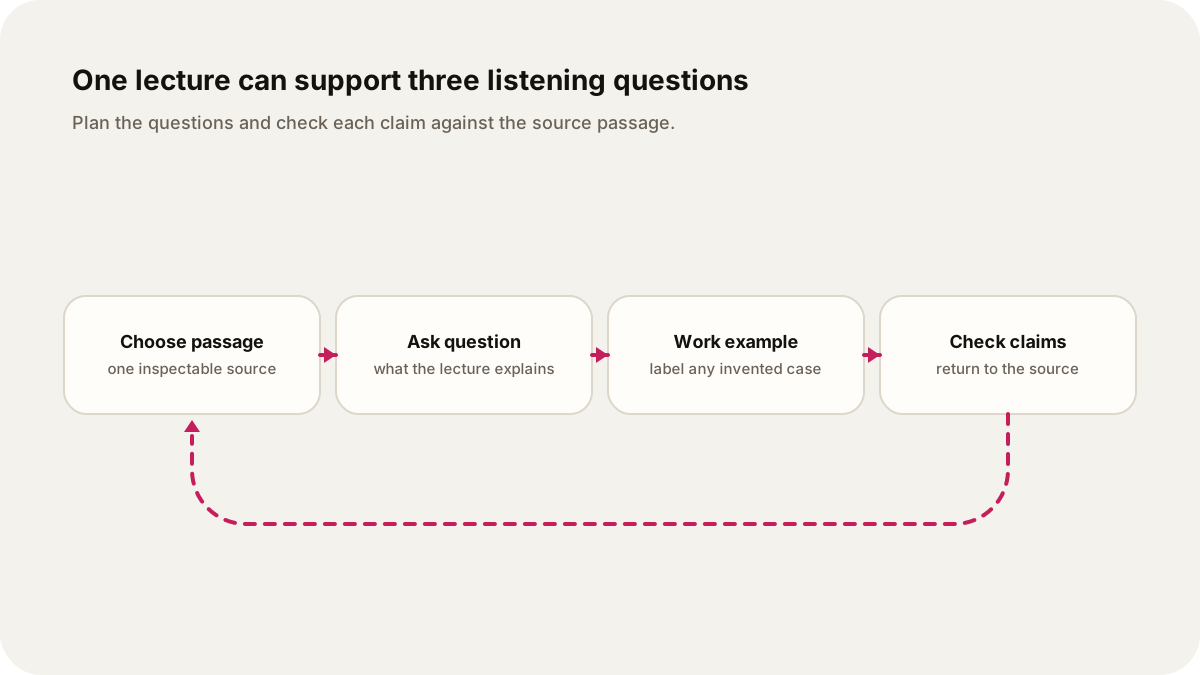
Choose a source you can inspect
Use a primary course page, syllabus, lecture notes, or recording. For this example, the source is MIT OpenCourseWare's 6.0001 Introduction to Computer Science and Programming in Python, taught in Fall 2016 by Dr. Ana Bell, Professor Eric Grimson, and Professor John Guttag. The current MIT page describes an undergraduate course for people with little or no programming experience and names its focus on computation, problem solving, and small Python programs.
The official Lecture 1: Welcome notes cover course information, what computation is, Python basics, mathematical operations, variables, and types. The downloadable Lecture 1 PDF gives the source windows used below.
MIT's OpenCourseWare guidance explains that OCW materials are available without enrollment or start dates. Its reuse guidance requires credit and limits reuse to non-commercial purposes under the stated license. Check the current source's terms before sharing a derivative recording.
Episode 1: Find the course question
Source window: the course description and Lecture 1 PDF pages 1 and 7 to 8.
Length: 4 minutes.
Question: What does the course say computation can do for problem solving, and what topics does its first lecture put on the table?
Identify the course, instructors, teaching term, and source pages before giving a plain summary. End by asking the listener to name one everyday problem that could be described as input, steps, and output. That question is a prompt for the planned episode, not a tested learning measure.
Episode 2: Follow one idea through an example
Source window: Lecture 1 PDF pages 10 to 12, which present the square-root example, define a recipe as ordered steps with a stopping rule, and introduce the term algorithm.
Length: 6 minutes.
Question: How does the lecture's square-root recipe turn a numerical goal into an algorithm with steps and a stopping rule?
Read the source's example first, then add one clearly labelled hypothetical example, such as sorting a list of temperatures from a week's weather log. The narrator should separate that example from the lecture and avoid putting words in the instructors' mouths. Finish with one question the listener can answer without looking at the screen: “What is the input, and what would count as the output?”
Episode 3: Make a source check
Source window: the course page, the Lecture 1 notes page, and PDF pages 1, 10 to 12, and 22 to 29.
Length: 5 minutes.
Question: Which sentence in the planned recap comes from the course page or Lecture 1 PDF, which sentence interprets the algorithm, and which sentence is the hypothetical example?
Use the third episode to check three short statements, label their provenance, and point the listener back to the exact course page or transcript section. If the source does not support a detail, remove it or mark it as an open question. That keeps a concise audio adaptation from becoming a fabricated lecture summary.
Write the request around the source
The following is an illustrative prompt for preparing the three episodes:
Use MIT OpenCourseWare's 6.0001 course page, Lecture 1 notes page, and downloadable Lecture 1 PDF as the factual sources. Prepare three audio outlines: four minutes on the course question, six minutes on the square-root algorithm plus a clearly labelled hypothetical weather-list example, and five minutes checking the claims. Include the source page or PDF page window and the question at the start of each outline. Attribute the lecture to MIT OpenCourseWare without implying MIT produced or endorsed these outlines.
Check the three outlines with the course page and PDF open. Repetition may be useful when it answers a new question; repeated background that answers none can be cut. If the lecture page, notes, PDF, or terms change, update the plan before sharing it.
For another way to plan a listening task, see audio study guides and retrieval prompts and how AI turns research into a personalized audio show. Keep the source pages beside the plan when you prepare the episodes.
Sources
- MIT OpenCourseWare: 6.0001 Introduction to Computer Science and Programming in Python: course description, instructors, level, teaching term, and topics.
- MIT OpenCourseWare: Lecture 1: Welcome: official lecture notes page and resource details.
- MIT OpenCourseWare: MIT6_0001F16 Lecture 1 PDF: source topics and page windows for computation, algorithms, Python, and types.
- MIT OpenCourseWare: Get Started: access, course material, and reuse guidance.