
Turn an event programme into a personal audio brief
A programme-based audio brief helps you choose what to follow before an event, while keeping planned abstracts separate from what speakers eventually say.
An event programme is useful before the event, when you still have choices to make. It tells you what is planned, where it is planned, and which sessions compete for the same block of time. A short personal audio brief can turn that grid into a listening plan: the questions you want answered, the two sessions you are weighing, the break you have to protect, and the details you need to check again before you leave.
This is a source-to-audio workflow. The programme remains the source. The audio brief helps you choose what to follow before attendance. It does not report what a speaker said, predict the outcome, reserve a seat, or replace the organiser's latest update.
What a real programme gives you
Official programmes commonly combine a timetable, room or venue, session title, speaker information, and sometimes an abstract or a link to a book of abstracts. The University of Zurich's ICOME-14 programme, for example, says the conference has three parallel sessions on its first two days and two on its last day. Its schedule places simultaneous panels in named rooms, then shows plenaries, coffee breaks, lunch, and a reception. The page also links to a programme PDF and a book of abstracts, and says the programme was updated on 24 May 2026.
That is enough material for a decision brief. It is not evidence of what those talks will conclude. The University of Helsinki's conference programme makes the same boundary visible: it lists panels in three rooms, gives a presentation format, and says changes will be updated where possible. Read the latest official page or PDF before acting on time, room, or speaker information.
Start with the question you want answered
An audio brief becomes useful when it has a job. “Tell me about this conference” is too broad. “Which session should I attend if I want one practical account of how archives are digitised?” gives the source a filter.
Write down three things before you ask for audio:
| Decision | What to record |
|---|---|
| Your question | The one thing you hope a session will help you understand |
| Your constraints | Time zone, room changes, access needs, and the break you cannot give up |
| Your choice | The sessions you might attend, including the one you would miss |
The constraint matters because programme choice is often a scheduling problem. If two sessions overlap, the brief should explain the trade-off, not quietly choose for you.
A short hypothetical programme
Consider this invented programme for a one-day event. It is deliberately small so the choice is visible:
| Time (Pacific Time) | Room A | Room B |
|---|---|---|
| 09:00–09:30 | Welcome | Welcome |
| 09:30–10:15 | “How local archives go digital” | “Who gets represented in a city archive?” |
| 10:15–10:45 | Break | Break |
| 10:45–11:30 | “What makes a public dataset usable?” | “Community memory and consent” |
There are two overlaps. At 09:30, an attendee interested in both digitisation and representation must choose. At 10:45, the same person must choose between dataset practice and consent. Assume the attendee is in London but the programme is published in Pacific Time. That time-zone label belongs in the brief because a mistaken conversion can change the choice.
The abstract for “How local archives go digital” might promise a process overview. The abstract for “Who gets represented in a city archive?” might foreground selection and omission. Those descriptions identify intended scope. They do not tell you which argument will persuade you or whether the speaker will cover your particular case.
Ask the audio brief to compare, then preserve uncertainty
Give Lissin the programme, your question and the decision you need to make. Lissin makes a personal audio show around the topic and sources you choose. Ask it to compare the planned sessions, keeping the organiser’s wording and any missing information clear.
Here is an exact illustrative request for the hypothetical programme above:
Use only this event programme and its abstracts. I am in London, and the timetable is in Pacific Time. My question is: which session should I attend if I want to understand both how archives are built and who may be left out? Compare the two 09:30 sessions and the two 10:45 sessions. Convert the times to London time, keep the 10:15–10:45 break visible, name the room for every option, and state which session I would miss in each overlap. Separate programme intent from anything unknown about the eventual talk. End with three questions I can listen for. Do not invent speaker claims, outcomes, attendance, booking, map directions, or schedule alerts. Link each point to the programme section it came from. If the event date is missing, flag it as unknown and keep the original programme times. Do not give a definite London-time conversion until the date is supplied.
That request asks for a decision aid, not a generated episode pretending to be a report. The brief can say that one abstract appears closer to the attendee's question, or that the other offers a useful counterpoint. It should say “the abstract frames this as…” rather than “the talk will prove…”.
Keep the time conversion checkable
Time conversion belongs in the source notes. NIST’s time-zone explanation distinguishes the ideal longitude model from the civil zones used by clocks. Use the organiser’s stated date and zone when you translate a session time. In this example, a 09:30 Pacific Time session may be 17:30 in London during part of the year, but daylight-saving rules and the event date determine the exact result. If the programme does not state a date, the brief should flag the conversion as conditional and ask the reader to verify it on the official page. The same applies to rooms, speaker substitutions, and revised abstracts.
The audio can read the original time and the converted time together, with the date and time-zone assumption. A table in the written brief can make the same check visible:
| Programme entry | Decision note |
|---|---|
| 09:30, Room A | Attend if the archive-building process is the primary question |
| 09:30, Room B | Attend if representation and omission are the primary question |
| 10:15–10:45 break | Keep as a real transition; do not fill it with a fictitious session |
| 10:45, Room A or B | Choose the follow-up question that the first session left open |
The point is not to make a perfect itinerary. It is to arrive with a reason for the choice and a small set of questions that can survive a changed schedule.
What the programme cannot tell you
A programme is an intention and logistics document. It can tell you what the organiser currently lists. It cannot establish what was said, whether a claim was supported, whether a session ran long, or whether a room changed after publication. A personal audio brief should keep those limits audible.
Before attendance, use the brief to choose and prepare. After attendance, use the official recording, transcript, slides, or your own notes if you want a recap. Those are different source tasks. Calling a programme-based preview a “lecture summary” would make the source promise larger than the evidence.
Lissin can make a personal audio brief from the programme and your question. Keep the organiser’s link with the brief, then check it again for session times, room changes and revised abstracts before you attend.
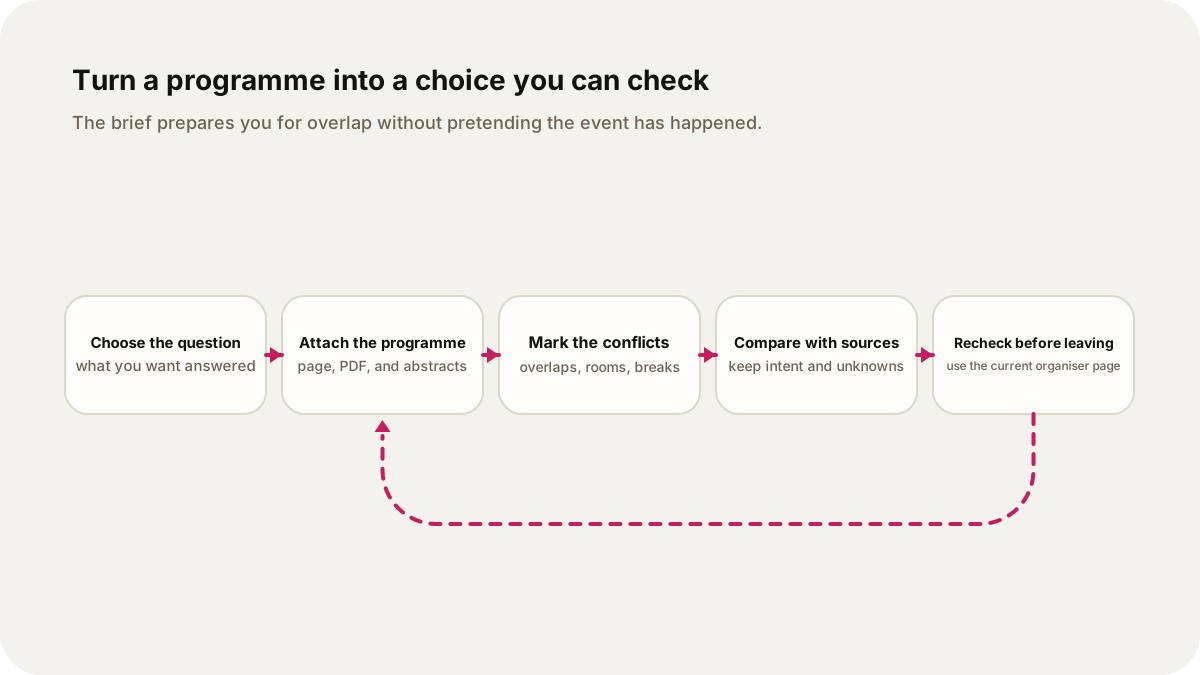
A five-step pre-event routine
- Choose the question. Write the answer you want, not a general topic.
- Attach the source. Use the official programme page or PDF, plus its abstract or book of abstracts when relevant.
- Mark the conflicts. List overlapping sessions, breaks, rooms, date, and source time zone.
- Ask for a comparison. Require source links, explicit uncertainty, and the session you would miss.
- Recheck before leaving. Compare the brief with the organiser's current programme and record any changes yourself.
For another source-led pattern, see turning a PDF into a personal audio brief, turning an interview into a personal audio brief, and source links and corrections in AI-generated audio. The programme workflow adds a specific decision: what to follow when two planned sessions occupy the same time.
Keep your question, session choice, overlap and organiser’s link with the brief. Recheck the programme before the event. If the explanation misreads a time or abstract, contact Lissin with the source entry; the editorial standards explain how corrections stay attached to a guide.
Sources
- University of Zurich's ICOME-14 programme, checked October 9, 2026.
- University of Helsinki's conference programme, checked October 9, 2026.
- NIST’s time-zone explanation, checked October 9, 2026.