
What to listen to while cooking, commuting, or doing chores
Pick for the next stretch: available minutes, likely interruptions, and enough attention to follow the audio.
Before choosing what to play while cooking, commuting, or doing chores, check three things: how much time you have, how often you may be interrupted, and how much attention the activity needs. A short story can fit a few minutes of folding laundry. A detailed explanation may deserve a seated train journey or a separate listening break.
You do not need one queue to fit every occasion. Keep a few short options alongside longer episodes, and choose before your hands are occupied.
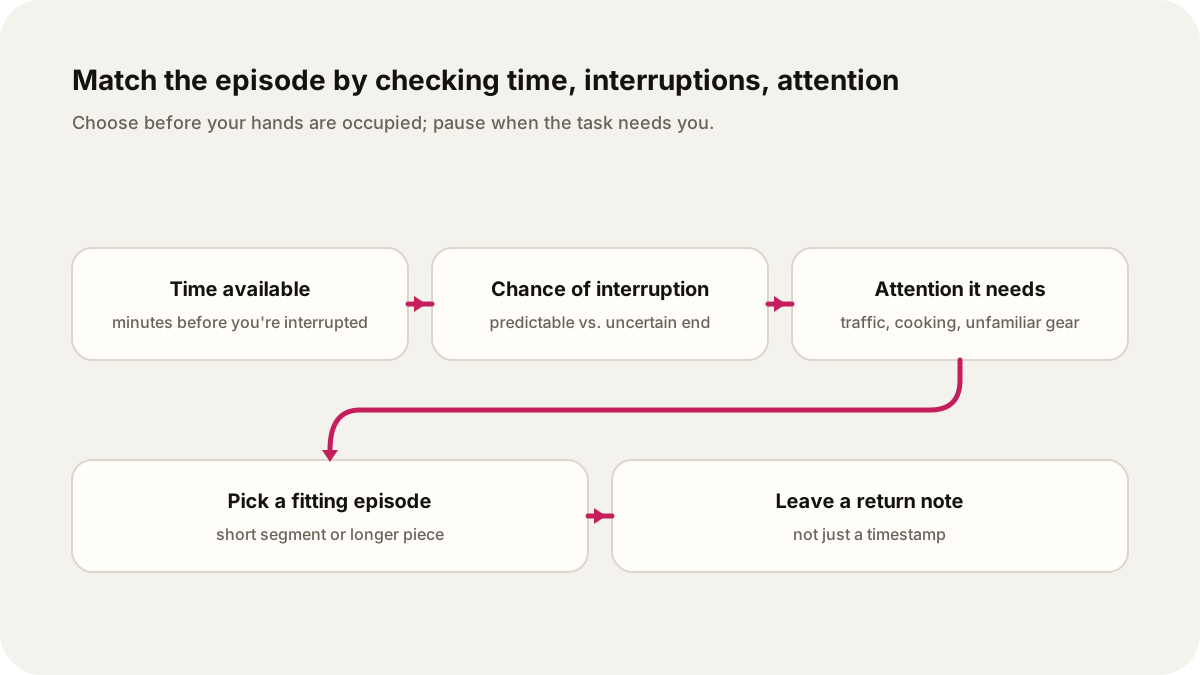
Original illustration: Lissin Editorial.
Match the episode to the available stretch
Use your own timings. These examples describe possible listening windows, not measured averages for how long a chore should take.
| Your situation | A useful starting choice | When to change it |
|---|---|---|
| Ten minutes of a familiar chore | One short segment or self-contained story | Pause if a task needs more attention than expected |
| Cooking with timers or unfamiliar instructions | Something easy to pause, or silence during demanding steps | Stop the audio while checking a recipe, handling a difficult step, or listening for a cue |
| A seated transit journey with a known arrival time | A longer explanation within the time available | Leave space for stops, transfers, and announcements |
| A familiar walk | An episode that fits the route and surroundings | Pause when navigation, traffic, or other people need attention |
| A task with an uncertain endpoint | A chaptered episode or a short piece | Save longer material for a more predictable window |
Driving should not be treated as an undistracted block. Set up listening before moving and pause when conditions require attention. The same principle applies to tools and equipment: having your hands occupied tells you little about how much attention you can spare.
In the kitchen: wet hands, timers, and noise
Cooking adds three problems that folding laundry does not: hands you may not want on your phone, timers that matter, and noise that comes and goes.
Set up before you start. Choose the episode, volume, and length before your hands are wet or covered in flour. The CDC's handwashing guidance lists washing your hands before, during, and after preparing food, so a mid-recipe tap on the phone can mean another trip to the sink. With a self-contained subject, such as the history of an ingredient, missing a minute while you wash up matters less.
Keep the cooking timer separate from the audio. On iPhone, you can ask Siri something like “Set the timer for 3 minutes” and run several timers at once, according to Apple's Clock guide. The same guide describes a Stop Playing option that ends audio or video when a timer finishes. That suits bedtime listening, not the oven: a timer set to Stop Playing ends your show instead of playing one of its alert sounds. Give cooking timers a sound.
Pause through the loud parts. A blender or extractor fan can cover the sentence you cared about. Pausing until the room is quieter is simpler than turning the volume up to compete. Keeping a device at no more than 60% of its maximum volume is part of the WHO's safe listening advice. Keep enough attention free to hear the timer and whatever is on the stove.
Choose something you can return to
A missed sentence in a light conversation may not matter. A missed qualification in a scientific explanation can change what you think you heard. If interruptions are likely, choose a show whose structure you can recover through chapters or notes, or keep the subject narrow enough to finish in one sitting.
When you pause, leave a short reminder of the section or question you had reached. “Still waiting for the explanation of why the bridge closed” is more helpful than a timestamp alone. Recovering the thread of a podcast describes how to use chapters, bookmarks, and notes when you return.
You can also split the work between formats. Listen for an introduction to a subject, then read its sources later when you need a figure, quotation, or table. Listening versus reading a long article explains that division without assuming the two formats produce identical results.
At-home listening does not mean attention-free listening
In Edison Research's January 2026 note, 63% of US weekly podcast consumers reported that home was where they most often consumed podcasts, up from 48% in 2019. The note also points to consumption on televisions as a possible contributor.
That is evidence about location, not proof that most of those people were cooking or doing chores. A person watching a podcast on a sofa and a person listening while washing dishes are both at home. Neither the location nor the popularity of an occasion determines which show will suit your next ten minutes.
The practical choice remains yours: can you follow this material during the activity, and can you stop at a useful point?
Describe an episode for a particular occasion
If an existing show fits, queue it. If you want something more specific, name the subject and the limits of the occasion in a brief. For example:
Give me a short, beginner-friendly explanation of why bread browns in the oven. Keep it to one question, explain unfamiliar terms, and finish with a clear answer. I want to listen later while doing a familiar chore.
The request names the occasion as well as the subject. Choose an episode length available in your plan; the finished duration may vary.
For a longer seated journey, you could ask for a deeper account with separate sections. For a few interrupted minutes, you could choose a self-contained story instead. Avoid packing several unrelated topics into a short brief simply because they all interest you.
In Lissin, choose the subject, format, direction, and length. After listening, ask for a specific change such as “Keep the explanation but shorten the historical background.” This source-to-show guide explains how to start with a question and sources.
Before the next chore or journey, save one short option and one longer one. Choose between them when you know the time and attention you actually have.
Sources
- Edison Research at SSRS, At-Home Podcast Listening Continues to Climb: US weekly podcast consumers' most frequent listening location; distinct from a measure of multitasking.
- Lissin for iPhone.
- CDC, "About Handwashing": lists washing hands before, during, and after preparing food.
- Apple Support, "Set timers in Clock on iPhone": Siri timers, multiple timers, and the Stop Playing option.
- World Health Organization, "Deafness and hearing loss: safe listening": advice to keep device volume no higher than 60% of maximum.
- Wickens, C. D. (2008), "Multiple resources and mental workload": human factors framework establishing attentional independence between auditory language processing and visual-manual tasks.
- Strayer, D. L., & Johnston, W. A. (2001), "Driven to distraction: Dual-task studies of simulated driving and conversing on a cellular telephone": clinical differentiation between passive acoustic reception and active conversational diversion.